
Update2026.10.24 (토)

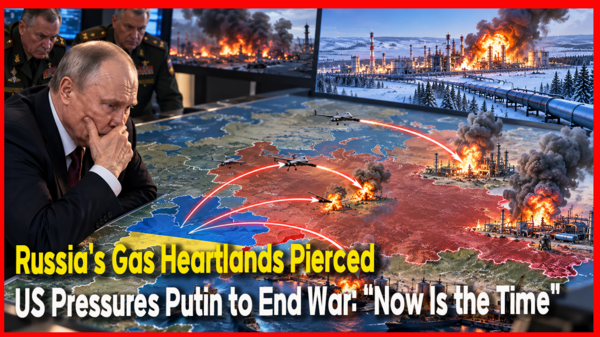
[Ukrainian Drones Fly 3,000km to Strike Russia’s Largest Gas-Producing Region for the First Time]
The nature of the war is shifting rapidly as Ukraine launched a surprise airstrike against Russia’s energy heartlands thousands of kilometers beyond the front lines. This escalation stems from the growing perspective that continuing the war no longer makes sense for Russia—and could even escalate into a phase that threatens the nation's very survival. Consequently, the United States has stepped up pressure on Putin, asserting that further prolongation of the war is futile and urging an end to the conflict. What is clear is that as the war drags on, the costs and risks Russia must bear are only compounding. At this exact moment, Trump is re-opening the door to negotiations with Putin.
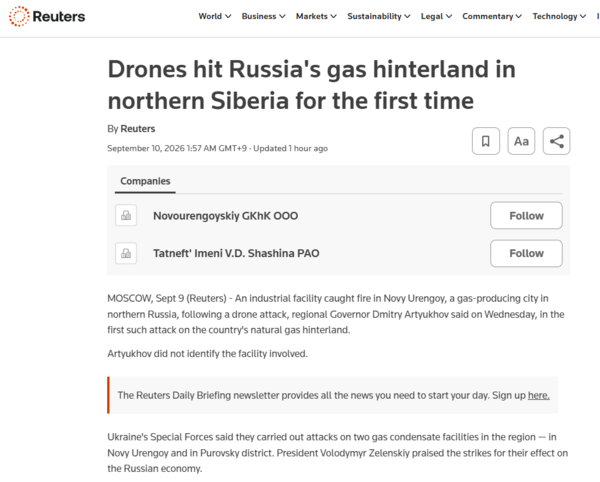
Reuters reported, "Scenes demonstrating the changing character of the Ukraine-Russia war have emerged," adding that "A drone attack caused a fire at an industrial facility in Novy Urengoy, located in the Yamalo-Nenets Autonomous Okrug in northern Western Siberia". Reuters further reported that "Governor Dmitry Artyukhov confirmed the attack and the resulting fire, though Russian authorities did not publicly specify which exact facility was struck".
Novy Urengoy, which bore the brunt of Ukraine's recent strike, is no ordinary provincial town. Reuters noted, "Novy Urengoy is Russia’s unofficial 'gas capital,' making the Yamalo-Nenets region the absolute core of Russia's natural gas industry". "Gazprom estimated the region's gas resources at 26.5 trillion cubic meters as of 2020. Most importantly, Novy Urengoy lies roughly 3,000 km from the Ukrainian border, making it deeply significant that Russia's deep rear—unthinkable as a target early in the war—is now within striking distance".
[What Matters Is Not a Single Plant, But '3,000km']
Reuters added, "The truly significant number is 3,000km, as it signifies that the reality of strikes has now reached the energy epicenter of northern Western Siberia, a region Russia had long believed to be a safe rear zone".
Ukrainska Pravda also highlighted: "Ukraine's latest attack goes beyond merely destroying a fraction of Russian gas production; it means that the core rear regions supporting the Russian economy and energy industry can no longer be viewed as safe havens completely isolated from the war". It pointed out that "as the war drags on, the likelihood grows that Ukraine will target even deeper military, energy, and industrial facilities inside Russia".
[Novorossiysk Shaken in the South]
The long-range pressure on Russia was not confined to the north. Reuters reported that "Drone debris also fell near several business premises and residential buildings in the Russian Black Sea port of Novorossiysk, causing fires". It added, "Novorossiysk is a crucial export hub for Russian crude oil, petroleum products, and grain, and has consistently served as a primary target for Ukrainian drone attacks".
Looking at a map makes the changing dynamics of this war vividly clear. In the south, key Black Sea military and export hubs are under threat, while in the northeast, Russia's gas core thousands of kilometers away is coming under attack. The conflict is transitioning from a war where Russia exclusively struck Ukraine’s rear to one where Russia’s own deep interior experiences the direct impact of the war.
[Precisely at This Moment, the US Accelerates Its Pace]
What merits close attention is that US peace diplomacy is regaining momentum precisely at this juncture. CIA Director John Ratcliffe made an undisclosed visit to Moscow to meet with top Russian intelligence leaders, including SVR Director Sergei Naryshkin and FSB Director Aleksandr Bortnikov. The Kremlin officially confirmed Ratcliffe's visit. However, it was confirmed that Ratcliffe did not meet Putin directly, with Putin receiving a debriefing after the fact.
More crucial details emerged shortly thereafter. US news outlet Axios reported that "Ratcliffe floated the possibility of a trilateral summit between Trump, Putin, and Zelenskyy during his time in Moscow, probing whether Russian intelligence chiefs could help nudge Putin back toward US-mediated negotiations". This reveals that the CIA chief's visit extended far beyond routine inter-agency intelligence contact and was directly tied to peace diplomacy regarding Ukraine.
[Following the CIA, Witkoff and Kushner Move]
Following the CIA Director’s visit, American peace diplomacy transitioned to a public phase. In this context, the Associated Press noted that "Special Envoy Steve Witkoff and Jared Kushner held several hours of talks with Putin in Moscow before traveling to Kyiv to negotiate with Zelenskyy". In essence, the US delegation reactivated shuttle diplomacy, traveling directly between Moscow and Kyiv to align terms between both sides.
Of course, this does not mean an immediate breakthrough has been forged. Nevertheless, Zelenskyy stated regarding the peace framework presented by US envoys that "there were quite good and valuable ideas." Discussions are also emerging around the possibility that the US, Ukraine, and Europe will conduct follow-up consultations to prepare for the resumption of trilateral negotiations that include Russia. The most intractable sticking point remains the disposition of the Donbas region, which Russia has yet to fully occupy.
[Trump Speaks Directly: “Putin Also Wants Negotiations”]
The decisive statement came from Trump. President Trump stated that he "recently had a phone call with Putin," characterizing it as a "good conversation". He proceeded to remark to the effect that "Putin wants to negotiate to end the war". This direct phone call between Trump and Putin occurred right on the heels of Witkoff and Kushner shuttling between Moscow and Kyiv.
Trump pointed to the intense personal animosity between Putin and Zelenskyy as one of the factors delaying negotiations. Reuters reported that "some intelligence officials across the US, Ukraine, and Europe continue to harbor strong doubts about Putin's actual willingness to end the war".
This is precisely where recent US actions need to be interpreted. There is no concrete evidence that the US delivered a formal "ultimatums" to Putin. However, the rapid succession of events over just a few weeks—from the CIA Director's Moscow trip to floating a Trump-Putin-Zelenskyy trilateral summit, Witkoff and Kushner's shuttle diplomacy, and the direct Trump-Putin phone call—is unmistakable. It signifies that the US is deploying substantial diplomatic capital to reopen the doorway to peace.
Interpreted strategically, what Trump is extending to Putin is less a demand to sign an immediate document of surrender and "admit defeat," and more pressure to choose a negotiable exit strategy before incurring even greater costs.
[The Question Is Whether Putin Can Make the Decision to 'Stop']
Ultimately, the most difficult hurdle is political rather than military. For Putin, the war in Ukraine is already bound up with his own political authority. Continuing the war carries enormous costs, yet ending it without achievements he can sell to the Russian public poses a severe political burden for Putin.
Therefore, what Putin requires is likely not a simple ceasefire, but a method of ending the war that can be presented domestically not as a "defeat," but as a "war concluded with concrete gains." This exact point is where negotiations over territorial issues, security guarantees, and future Russia-Ukraine relations will inevitably prove most difficult. Indeed, the single greatest sticking point in current talks remains the Donbas territory that Russia has yet to fully capture.
[Why Times Insight]
To view the Yamal strike merely as news that "a single gas facility caught fire" is to miss the fundamental core. What truly matters is the distance. Ukrainian drone strikes reached Russia's "gas capital," located roughly 3,000 km from the Ukrainian border. To the south, Novorossiysk, Russia's critical Black Sea export port, remains continuously within target range. As the conflict persists, the shockwaves of war are no longer confined to Ukrainian territory—they are flowing back deep into the Russian heartland.
And at this precise moment, the US is activating consecutive diplomatic channels: the CIA Director, presidential envoys, and direct presidential phone calls. While there are no grounds to call this an "ultimatum," the strategic message delivered to Putin is becoming heavier by the day.
If one were to condense Trump's calculation in Why Times style, it reads like this: "Putin, ending it now is the cheapest way out you have left."
Of course, this does not mean Trump literally uttered those words. It is our channel's analysis grounded in current military realities and consecutive US diplomatic steps. Putin may still calculate that Russia can sustain the war effort. Indeed, Russia continues its strikes on Kyiv and key regions of Ukraine even as US-mediated negotiations are underway. Thus, assuming Putin has already resolved to end the war would be premature.
Yet there is one question Putin cannot easily evade: If Russia fights for another year, will its position become decisively more advantageous than it is today? Or will the list of strategic Russian facilities within range of Ukrainian drones simply grow longer? If the latter holds true, what the US is currently attempting to open for Putin is not a "door to defeat," but an exit route before it is too late. This is why the true key watchpoint in this peace diplomacy is no longer limited to the single question of "whether Ukraine can hold out."
Ukraine has already defended its statehood for four and a half years and is now demonstrating the capability to strike Russia's energy heartlands thousands of kilometers away. Now, another question emerges: How long can Putin bear the mounting cost of this war? The drone that reached Yamalo-Nenets and the American peace diplomacy stretching from Washington to Moscow are currently posing that very question to the Kremlin simultaneously.

-중국 푸단대학교 한국연구원 객좌교수
-전 EDUIN News 대표
-전 OUR NEWS 대표
-제17대 대통령직인수위원회 정책기획팀장
-전 대통령실 홍보기획비서관
-사단법인 한국가정상담연구소 이사장
-저서: 북한급변사태와 한반도통일, 2012 다시우파다, 선거마케팅, 한국의 정치광고, 국회의원 선거매뉴얼 등 50여권