Update2026.10.24 (토)

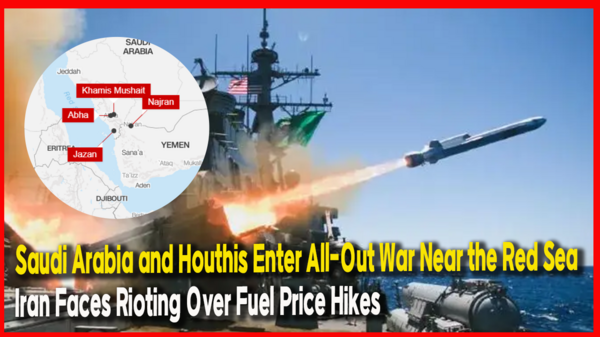
[Houthis Launch Simultaneous Strikes on 4 Southern Saudi Cities, Targeting Aramco Refineries]
The clashes surrounding the strategic Bab-el-Mandeb Strait—a vital gateway to the Red Sea—between Saudi Arabia and the Yemen-based Houthi rebels have escalated into an all-out war. Estimates suggest the conflict has left over 500 dead and displaced roughly 20,000 people. Concurrently, U.S. forces have resumed strikes on Iranian oil tankers, expanding the Middle Eastern theater across multiple fronts. Compounding the regional volatility, Iran—despite being a major oil producer—facing severe gasoline shortages, abruptly doubled domestic fuel prices. Fearing widespread public riots, Iranian authorities deployed security forces nationwide, worsening an already explosive domestic situation.
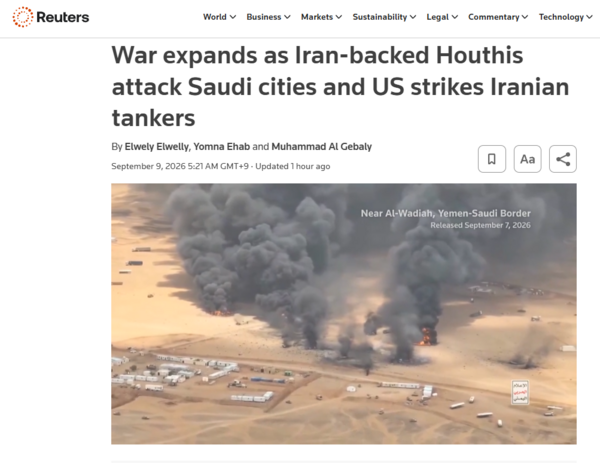
On September 9 (local time), Reuters reported that "the Iran-backed Houthi rebels launched a coordinated drone and missile attack targeting four southern Saudi cities: Khamis Mushait, Abha, Najran, and Jizan." The report added that targets included Saudi airbases alongside state-owned oil giant Saudi Aramco's refining and power facilities, with Saudi officials confirming at least 73 injuries, including women and children.
Reuters noted that "this represents the largest strike against the Saudi mainland since the war involving the U.S., Israel, and Iran broke out in February." Satellite imagery from NASA captured thick black smoke rising from the Jizan refinery and white smoke billowing from the oil distribution center in Abha.
In response, Major General Turki al-Malki, spokesperson for the Saudi-led coalition, condemned the attacks as a "dangerous and reckless act," vowing a firm response to deter the terror militia. Saudi fighter jets immediately launched retaliatory airstrikes against Houthi-controlled strongholds in eastern Sanaa and southwestern Taiz governorate.
[Yemen Civil War Escalates into Battle for Control of the Bab-el-Mandeb Strait]
The recent wave of airstrikes did not occur in a vacuum. According to Reuters, Saudi Arabia carried out approximately 121 airstrikes across various rebel strongholds in Yemen in recent days to counter Houthi attempts to seize the Bab-el-Mandeb Strait. Houthi leadership denounced the offensive as "merciless." Although the Yemeni civil war had remained relatively dormant following a 2022 truce, conditions deteriorated rapidly after the Houthis formally declared the ceasefire over last month. Saudi-backed Yemeni government forces have since launched multi-front ground offensives aiming to reclaim all Houthi-held territories.
Citing sources from both the Houthi rebels and Yemeni government forces, AFP reported that over the past week alone, more than 500 people have died—including 216 government soldiers, 278 Houthi fighters, and at least 29 civilians. The International Organization for Migration (IOM) stated that over 18,500 people were displaced along Yemen’s western coast in just three days.
During a joint press conference with his Russian counterpart in Moscow, Saudi Foreign Minister Prince Faisal bin Farhan declared, "Saudi Arabia will always advocate for peace and diplomatic solutions," but emphasized that "the Kingdom will not hesitate to take all necessary measures to defend itself, protect its national interests, and ensure the security and stability of our brotherly nation, Yemen."
Analysts emphasize that the situation poses risks extending far beyond Saudi border security. Danny Citrinowicz, a senior researcher at Tel Aviv’s Institute for National Security Studies (INSS), posted on X (formerly Twitter) that Saudi Arabia is now conducting operations with regional ramifications far surpassing its own territorial defense. He noted that the outcome will directly impact freedom of navigation through one of the world's most critical maritime chokepoints, as well as the ability of Iran and the Houthis to threaten international shipping.
www.inss.org.il
[U.S. Military Re-strikes Iranian Tankers; Threat Expands Across Gulf Oil Producers]
On the same day, armed skirmishes reignited between the U.S. and Iran in the Persian Gulf. Reuters cited a U.S. official stating that American forces struck an Iranian oil tanker after the Islamic Revolutionary Guard Corps (IRGC) attempted an attack on U.S. Navy vessels, marking a resumption of U.S. strikes following a two-day lull.
Iran's semi-official Tasnim News Agency reported that a U.S. missile struck an Iranian tanker in waters roughly 4 nautical miles (~7.4 km) off Kharg Island, a key crude oil export hub. Iranian state television subsequently reported that a second tanker was hit near Jask in the Gulf of Oman.
Iranian military leadership reacted forcefully. Major General Ali Abdollahi, Chief of Staff of Iran's Armed Forces, stated that "the aggressor U.S. military issued evacuation warnings before striking Iranian tankers," warning that "any future attack on Iranian vessels will provoke direct Iranian strikes against U.S. bases across the region." The IRGC Navy issued a statement declaring immediate countermeasures against "the malicious acts of the U.S. terrorist military targeting Iranian tankers." It added a direct threat: "All crew members on tankers docked near or operating close to ports in Kuwait and Bahrain—which harbor American terrorists and abet their crimes—must evacuate immediately. These vessels will be treated as valid targets regardless of whether they are anchored or docked." This comes after similar U.S. retaliatory strikes against Iranian tankers over the weekend following alleged Iranian ballistic missile targeting of American warships.
[Oil Prices Threaten $100; Iran Pressured Domestically and Abroad]
Simultaneous hostilities in the Persian Gulf and the Red Sea pushed global crude prices upward. Brent crude, the global benchmark, fluctuated near $99 per barrel, reaching its highest level since July 23. Houthi strikes on Saudi energy infrastructure have exacerbated market anxieties already strained by the blockade of the Strait of Hormuz. Meanwhile, retail diesel prices in the United States touched record highs, increasing political pressure on Republicans ahead of the November midterm elections.
Internally, Iran faces mounting unrest. On September 9, Iran International reported that after the government doubled gasoline prices from 50,000 rials to 100,000 rials per liter for drivers exceeding monthly subsidized quotas, security forces, special riot units, and Basij militia personnel were heavily deployed around gas stations in major cities like Tehran, Mashhad, Shiraz, and Tabriz. A Tehran resident noted that "gas stations were heavily guarded, with constant patrols by special forces and Basij members while streets remained packed with citizens."
Iran International highlighted that with average monthly wages in Iran hovering around $113, public anxiety over inflation is surging. Given that security forces killed an estimated 1,500 protesters during the 2019 fuel price demonstrations, observers warn that the risk of widespread public uprisings remains exceptionally high.
[Why Times Insight]
The defining dynamic of this crisis is its multi-front nature. Unrest is escalating simultaneously across at least four distinct arenas: the Persian Gulf (U.S.–Iran), the Red Sea and Bab-el-Mandeb Strait (Saudi Arabia–Houthis), mainland Yemen (Yemeni Government–Houthis), and domestic Iran (Security Forces–Protesters). Escalation in any single arena risks triggering a cascading failure across the others. The IRGC’s explicit warning against tankers anchored near Kuwait and Bahrain signals that the threat of conflict is expanding across all Gulf oil producers. As Danny Citrinowicz of INSS observed, Saudi Arabia’s military posture carries broad implications for global freedom of navigation and the long-term ability of the "Axis of Resistance" to disrupt commercial maritime routes.
Reports indicate that following an intercepted attack on U.S. naval vessels by the IRGC on September 5, Iran's air defense capabilities have been significantly neutralized, evidenced by U.S. refueling tankers flying unchallenged over Iran's Qeshm Island. This vulnerability suggests that future U.S. offensive operations near the Strait of Hormuz will face minimal resistance, leaving Iran exposed. However, the Houthis' ability to execute simultaneous strikes on four Saudi cities demonstrates that the offensive capabilities of Iran’s regional proxies remain active, leaving the Houthis' next strategic move as a critical focal point.
While military actions are spreading rapidly from Hormuz to the Bab-el-Mandeb Strait, the long-term sustainability of these proxy operations remains questionable. Despite expanding geographic friction, the United States maintains overarching strategic initiative, suggesting that retaliatory attacks by Iranian and Houthi forces are unlikely to be sustained over an extended period.

-중국 푸단대학교 한국연구원 객좌교수
-전 EDUIN News 대표
-전 OUR NEWS 대표
-제17대 대통령직인수위원회 정책기획팀장
-전 대통령실 홍보기획비서관
-사단법인 한국가정상담연구소 이사장
-저서: 북한급변사태와 한반도통일, 2012 다시우파다, 선거마케팅, 한국의 정치광고, 국회의원 선거매뉴얼 등 50여권