
Update2026.10.24 (토)

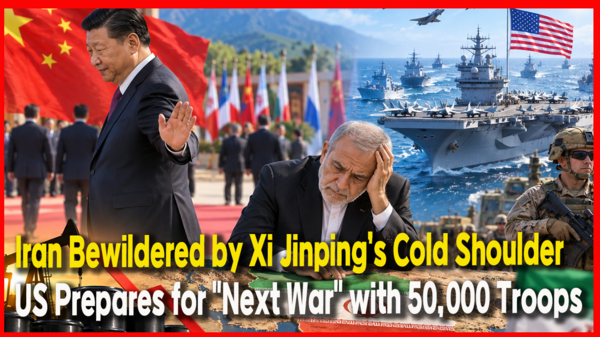
[Xi Turns His Back on Iran Three Weeks Ahead of US-China Summit]
At Iran's most isolated moment, a alarming scene unfolded as China—a partner Tehran heavily relied on—took a step back. Iranian President Masoud Pezeshkian, attending the Shanghai Cooperation Organization (SCO) summit in Bishkek, met Chinese President Xi Jinping, but no formal bilateral summit took place. The encounter immediately triggered debates in Iran over whether Beijing had betrayed Tehran.
The timing amplifies the severity. The US is choking off Iran's top revenue source—crude oil exports—via maritime blockades, while moving to maintain approximately 50,000 troops and 19 warships in the Middle East through 2027. Should China distance itself further, Tehran will face simultaneous American pressure across both economic and military fronts, beyond mere diplomatic isolation.
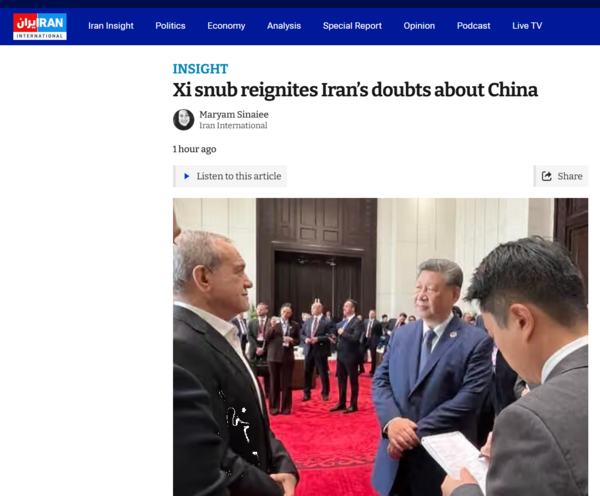
Iran International reported on the 4th that Iranian President Pezeshkian and President Xi met at the SCO summit venue in Bishkek on the 1st, but no official bilateral summit took place. The two leaders merely engaged in brief conversation. For Iran, which has promoted its "Eastern Diplomacy"—anchored by China and Russia—as a primary strategy to bypass US pressure, the scene was deeply embarrassing.
Iran International noted that Xi's snub reignited doubts within Iran regarding China. Iranian political circles openly discussed whether this was more than a procedural oversight, viewing it as a signal from Beijing to maintain distance from Tehran.
["Thought We Were Strategic Partners": "China Betrayal Theory" Explodes in Tehran]
The political backlash in Tehran was immediate. Heshmatollah Falahatpisheh, a former member of the Iranian Parliament's National Security and Foreign Policy Committee, argued that Xi’s behavior was a deliberate message to the US, asserting that the relationship Tehran called a "strategic partnership" held far less weight for Beijing.
Centrist and conservative figures echoed these concerns. Daoud Heshmati asserted that the absence of a bilateral meeting was a choice by the Chinese side, while conservative commentator Mostafa Najafi evaluated it as a "severe warning and negative signal" for Iran-China relations.
The controversy extended further. Centrist politician Hossein Marashi claimed that China demanded Iran keep the Strait of Hormuz open, resolve transit fee disputes, and improve relations with the US and Saudi Arabia.
This claim requires careful interpretation. No independent evidence confirms that China officially presented these conditions, and representatives for Iranian Parliament Speaker Ghalibaf denied the assertion. Rather than taking this as Beijing's official stance, it reflects how deeply distrust and perceptions of betrayal have spread within Iranian political discourse.
[The Real Issue Is Oil: China Turning Away Would Be Fatal for Iran]
Framing this strictly as a matter of diplomatic pride overlooks the core issue. China serves as the final major crude oil market enabling Iran's economy to endure international sanctions. The US Treasury Department noted that China has purchased approximately 90% of Iran's total crude oil exports, with independent "teapot" refiners in Shandong Province acting as primary buyers.
Reuters reported that as of March, China’s imports of Iranian crude reached record highs of roughly 1.8 million barrels per day. For Tehran, China is not merely an ally, but a vital economic artery generating foreign currency to sustain the regime and its wartime economy.
It remains premature to conclude that Beijing has fully turned its back on Iran, as there is no evidence that China has halted crude purchases or severed economic ties. However, if diplomatic distancing translates into reduced oil purchases and financial transactions, the dynamic changes fundamentally. Diplomatic coldness hurts Iran's pride, but a reduction in Chinese oil purchases threatens regime survival.
[Iran's Oil "Lifeline" Is Already Constricted]
Compounding the crisis, Iranian oil exports are plunging due to US naval blockades even before any shift in Chinese policy. Reuters reported on the 1st that US naval blockades have effectively paralyzed Iranian crude exports, driving daily shipments down from nearly 2 million barrels per day in March to between 220,000 and 255,000 barrels per day in August.
This represents a devastating blow to Iran's economy. Reuters noted that sharp drops in oil revenues severely weaken government finances, increasing reliance on money printing amid severe inflation, Rial devaluation, and shrinking trade. Tehran now faces potential shifts in Chinese behavior at its most vulnerable moment.
[Is Xi Mindful of Trump?]
Why now? While exerting economic pressure on Iran, the US has remained cautious regarding direct, comprehensive financial sanctions against China itself. AP analyzed that while the Trump administration presses Iran economically, directly targeting major economic partners like China involves complex strategic calculations. Thus, Xi's actions in Bishkek cannot be attributed solely to capitulation under American pressure.
However, ahead of a sensitive US-China summit, Xi had little incentive to showcase close alignment with Pezeshkian in a formal summit. Beijing likely sought to avoid introducing new friction into US-China negotiations via the Iran issue.
Notably, the SCO's broader position differs. In the Bishkek Joint Declaration, the SCO criticized US and Israeli attacks and sanctions against Iran. China shielded Iran in multilateral settings while maintaining deliberate distance in Xi's bilateral diplomacy.
This distinction is crucial. Rather than abandoning Iran, Beijing appears to be calibrating its relationship into a "conditional partnership," offering support only to the extent that it does not jeopardize relations with Washington.
[A More Threatening Scene: Washington Prepares for the "Next War"]
From Tehran's perspective, moves in Washington present a far more immediate threat than Beijing's diplomatic posture. The Wall Street Journal (WSJ) reported that the US Department of Defense has initiated measures to extend the deployment of US forces in the Middle East through 2027.
WSJ noted that the current footprint—roughly 50,000 US troops, 19 warships, fighter squadrons, air defense units, and airborne forces—represents a significant force posture for a short-term retaliatory capability. This indicates Washington is preparing for potential long-term military operations rather than a brief conflict.
Possibilities for expanded US military action against Iran continue to circulate, though Washington has not made a final decision to initiate a new full-scale war. Nevertheless, maintaining a large-scale military presence signals that the Trump administration views conflict with Iran not as a past event, but as an ongoing confrontation that could escalate.
[China Steps Back, the US Retains Forces]
The brief encounter in Bishkek carries strategic weight. For years, Tehran maintained it could withstand US pressure through its "Eastern allies," China and Russia. Yet when confronted with threats to regime survival, Beijing shows little inclination to risk direct conflict with the US to rescue Iran.
It is premature to declare that China has abandoned Iran, as Beijing remains the largest buyer of Iranian crude and bilateral ties persist. However, the Bishkek summit revealed a gap between Tehran's view of China as a "strategic partner" and Beijing's actual assessment of Iran's strategic value—a gap likely to widen as US pressure mounts.
[Why Times Insight]
Tehran's primary concern should not be the absence of a formal summit between Xi and Pezeshkian. The core danger is that Beijing begins to view Iran not as a strategic ally to defend, but as a liability to manage in its dealings with Washington.
China remains the last lifeline for Iran's economy. While Beijing buys the vast majority of Iranian crude, the US is tightening maritime blockades. If China curtails oil purchases and financial transactions out of concern for its relationship with Washington, Iran faces economic suffocation prior to any military outcome.
Concurrently, the US is maintaining a force of 50,000 troops and 19 warships in the region long-term.
The picture facing Iran is straightforward: China is taking a step back, while the US reinforces its military presence. If Xi's posture in Bishkek signals a shift in Beijing's strategic calculations, the backlash in Tehran may reflect more than temporary political frustration—it may mark a fundamental realignment.
-중국 푸단대학교 한국연구원 객좌교수
-전 EDUIN News 대표
-전 OUR NEWS 대표
-제17대 대통령직인수위원회 정책기획팀장
-전 대통령실 홍보기획비서관
-사단법인 한국가정상담연구소 이사장
-저서: 북한급변사태와 한반도통일, 2012 다시우파다, 선거마케팅, 한국의 정치광고, 국회의원 선거매뉴얼 등 50여권