Update2026.10.24 (토)

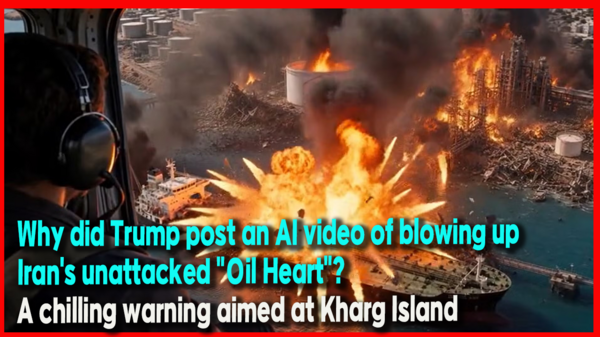
[Vance Answered: "Trump Was Sending a Message to Iran"]
US President Donald Trump posted AI-generated videos on his social media account showing oil facilities on Iran's Kharg Island—which have not actually been attacked—engulfed in flames. The site recently targeted by real US military strikes was not Kharg Island, but Larak Island, located more than 600 kilometers away. Why, then, did President Trump go out of his way to create and display footage showing the destruction of Kharg Island, the very heart of Iran's crude oil exports? US Vice President JD Vance addressed the issue directly, stating that the post was "a message sent to Iran". The central question is no longer whether the video is real or fake, but what specific warning Trump intended to deliver to Tehran.
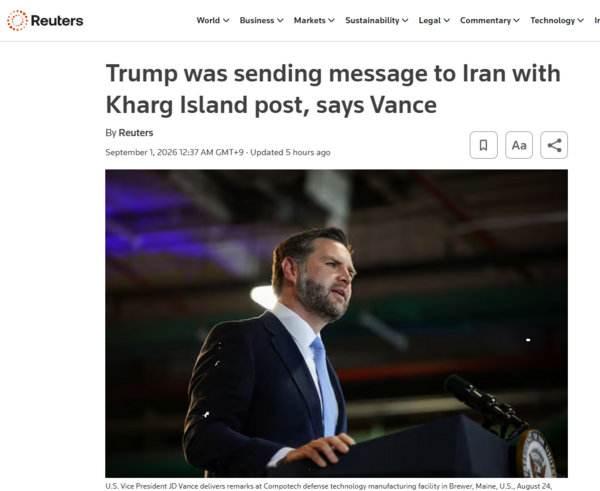
Reuters reported that "President Trump posted two AI-generated video clips on his Truth Social account depicting massive bombardment of oil facilities on Kharg Island, featuring sequential explosions of oil storage tanks, supertankers, and large coastal installations," adding that "Trump captioned the post with 'Kharg Island being blown to smithereens!!!', though no such attack actually took place on the island."
Did President Trump simply confuse Larak Island with Kharg Island? Reuters noted that Vice President Vance offered a starkly different explanation the following day: "Vance explained that President Trump was not using social media to announce an actual military operation, but rather to 'send a message to the Iranians,'" while a US official also confirmed that Kharg Island was not an active target of the recent strikes. Ultimately, this makes it increasingly likely that Trump's video was intended to show Iran a scenario that could unfold in the future rather than a war that had already taken place.
[Why Kharg Island?]
This brings up the most critical question: Iran houses dozens of military bases, missile sites, and strategic ports, so why did Trump specifically single out Kharg Island? Kharg Island is no ordinary landmass; prior to the conflict, it served as the core hub handling roughly 90% of Iran's total crude oil exports. Reuters analyzed that "an actual strike on Kharg Island would inflict massive damage on Iran's energy trade, pushing its already strained economy deeper into a corner." Striking Kharg goes far beyond taking out an isolated military base—it directly targets the last economic lifeline of the Iranian regime.
Equally significant is that this is not the first time Trump has referenced Kharg Island. In July, President Trump posted a series of AI-generated images portraying Kharg Island under bombardment and Iranian tankers being seized by US forces. This repetition suggests that the latest video was not a random choice, but part of a calculated pattern using Kharg Island as a recurring symbol of strategic leverage against Iran.
[The US Actually Struck in March… But Spared the Oil Facilities]
The decisive key to interpreting this AI video dates back five months. On March 13, the US military launched a major strike on Kharg Island. According to US Central Command (CENTCOM), American forces conducted precision strikes on more than 90 military targets, including naval mine storage facilities and underground missile bunkers. However, CENTCOM included a crucial detail when announcing the operation's outcome: "preserving the oil infrastructure."
This distinction carries immense strategic weight. While the US possessed the military capability to strike Kharg Island and executed a large-scale bombardment against military targets, it deliberately left the oil facilities—the economic engine of Iran—intact. Washington clearly drew a boundary between neutralizing military capabilities and destroying Iran's capacity to export crude oil.
[Erasing the 'Red Line' in the AI Video]
This context explains why the new video is so significant. The oil storage tanks and export terminals that survived the actual March bombardment are shown engulfed in fire in Trump’s AI clip. Missiles rain down on coastal installations as tankers explode. Target sets intentionally spared in real-world combat were completely wiped out in the virtual domain.
When paired with Vice President Vance’s explanation of a "message to Iran," a broader strategy emerges. Trump used AI to visually project a scenario across a line the US had previously refrained from crossing. The underlying warning reads: "We spared your oil facilities last time while hitting your military sites, but that restraint will not last forever." Rather than an official announcement of an incoming strike, the video is best understood as a form of extreme visual psychological pressure characteristic of Trump's diplomatic style.
[The Immediate Context: Real Strikes on Larak Island]
The timing of the post adds another layer of tactical relevance. Immediately prior to the video post, the US military carried out strikes on Larak Island near the Strait of Hormuz. CENTCOM announced that American forces destroyed two rocket launchers belonging to the Islamic Revolutionary Guard Corps (IRGC) that were being prepared to deploy sea mines. The action marked a fresh direct military engagement between the US and Iran after a month-long lull. Iran responded by launching missile attacks toward US bases in Jordan, prompting Trump to warn of severe retaliation.
Larak Island and Kharg Island represent fundamentally different strategic assets. Larak Island's proximity to the Strait of Hormuz makes it critical for mine warfare and controlling maritime choke points, whereas Kharg Island underpins Iran's entire crude export economy. In short, Larak represents Iran's 'Hormuz closure card,' while Kharg represents its 'oil revenues.' Immediately after physically striking the former, Trump published imagery showing the destruction of the latter.
["Block Hormuz Again, and Your Oil Heart Isn't Safe"?]
Connecting these two developments clarifies the core message: the US will not tolerate Iranian attempts to rebuild mine-laying capabilities around the Strait of Hormuz. As maritime tensions escalated, global energy markets reacted swiftly, with Brent crude rising over 2.5% to cross $90 per barrel. The Strait of Hormuz and Iranian oil infrastructure remain sensitive targets capable of disrupting global economic stability.
The video effectively conveys a threat: "If you continue provocations in Hormuz, our next targets will not be limited to a few rocket launchers." This follows prior maritime pressure actions, such as the US military using a Hellfire missile in June to disable an Iranian-bound tanker heading toward Kharg Island.
Crucially, however, a clear line must be drawn: no official evidence indicates that the US has authorized an actual physical attack on Kharg Island’s crude export facilities. Vance’s remarks framed the video as a "message," not a notification of imminent military action.
[Why Times Insight]
Is Trump’s AI video a hollow bluff, or a preview of an upcoming military campaign? At present, it is most accurately characterized as a 'visual ultimatum' occupying the space between the two.
Trump did not showcase the current reality of Kharg Island; he presented a vision of its future that he asserts the US can create at will. Because the US military demonstrated its capability in March by striking over 90 military targets on the island while precisely avoiding oil terminals, Tehran has no reason to question whether Washington possesses the physical capability to destroy Kharg. That point has already been proven. Thus, the real message embedded in the video may be: "Consider why your oil infrastructure was left standing last time."
In March, Washington maintained a clear boundary between military targets and economic infrastructure. Through this AI video, Trump visually erased that line. While not an active military operation, the post serves as a graphic warning that if Iran continues maritime blockades, mine-laying, and direct engagements, the crude export facilities previously treated as off-limits may be integrated into the target set.
Viewing Trump’s Kharg Island AI video simply as a "fake news event" misses its strategic intent, just as reading it as an "imminent strike alert" overstates its immediate scope. Instead, it represents a psychological warfare tactic: displaying the aftermath of a strike before dropping a single bomb to force the adversary’s leadership into a costly strategic calculation.
The central question Trump posed to Iran boils down to one sentence: "We spared your oil facilities last time—are you sure you want to keep threatening Hormuz?"
Whether Iranian leadership treats this warning as a bluff or as a signal that the US is prepared to cross its final remaining red line will determine the trajectory of the next phase in the US-Iran conflict.

-중국 푸단대학교 한국연구원 객좌교수
-전 EDUIN News 대표
-전 OUR NEWS 대표
-제17대 대통령직인수위원회 정책기획팀장
-전 대통령실 홍보기획비서관
-사단법인 한국가정상담연구소 이사장
-저서: 북한급변사태와 한반도통일, 2012 다시우파다, 선거마케팅, 한국의 정치광고, 국회의원 선거매뉴얼 등 50여권