Update2026.10.24 (토)

[Canada unable to smile despite GM’s $1.1B investment… The "50% auto tariff" is the next ticking bomb]
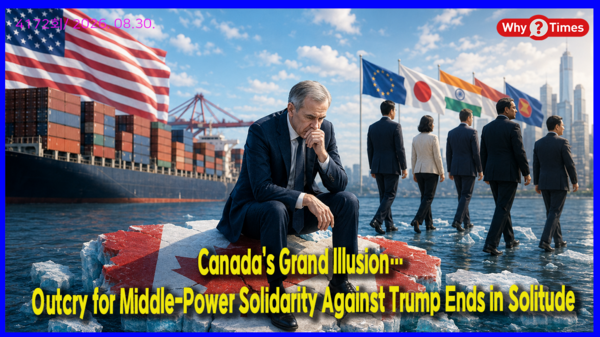
Canadian Prime Minister Mark Carney’s high-stakes gamble against U.S. President Donald Trump is unfolding in an unexpected direction. Carney’s strategy was premised on reducing dependence on the United States by leading a joint middle-power response to American economic pressure while expanding economic ties with China. However, when an outright tariff war with the U.S. erupted, other nations failed to step into the ring alongside Ottawa, leaving Canada to absorb the full force of the blow on the front lines.
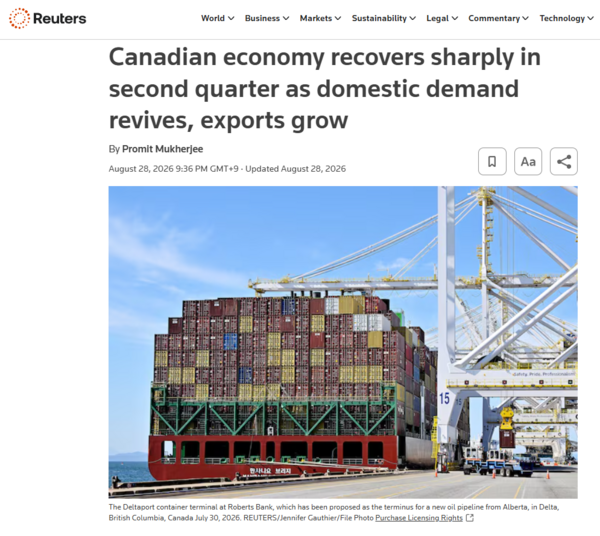
Reuters reported that "the Canadian economy delivered unexpectedly strong growth, with Statistics Canada releasing second-quarter GDP data showing an annualized expansion of 3.3%—its fastest pace since 2023." The report noted that "with exports rising 3.6% alongside a rebound in consumer spending and business investment, the figures superficially appear to be a major win for Prime Minister Mark Carney as he directly confronts U.S. President Donald Trump. Yet, a critical trap lies hidden within these numbers."
Reuters emphasized that "the real test for Canada's economy has not even begun," pointing out that "the new 50% U.S. tariffs on $20 billion worth of Canadian goods took effect, meaning the second-quarter growth figures covering April through June contain virtually no impact from this current tariff shock, and the newly imposed levies could easily undermine the economic recovery seen so far."
Furthermore, Reuters noted that "a more telling sign comes from Canada’s central bank." A Reuters survey of 35 economists showed unanimous expectations for the Bank of Canada to hold its benchmark interest rate steady at 2.25%, with market participants speculating that rates could remain frozen well into next year. With U.S.-Canada trade talks suspended, a cautious shadow has fallen over the economic outlook despite strong Q2 growth, as observers wait to see where the Canadian economy is headed.
According to Reuters, another symbolic piece of news broke: General Motors reached a tentative agreement with the union to invest approximately CAD 1.1 billion in its Canadian automotive plants. The deal includes producing next-generation GMC Sierra full-size pickup trucks at the Oshawa plant and establishing a transmission production line at the St. Catharines facility. At first glance, this appears to be a major boon for Canada's auto sector.
However, a closer look reveals that this news underscores the crisis facing Prime Minister Carney. Trump is threatening to raise tariffs on Canadian-built cars, trucks, and auto parts to 50% starting next January. Meanwhile, the Canadian government maintains that it cannot accept any trade deal with Washington that fails to guarantee the survival of its domestic auto assembly and parts industries. As a result, the auto sector is fast becoming the next major battleground in the U.S.-Canada tariff conflict.
[How did Canada and the United States reach this point?]
To understand the situation, one must look at the true core of this conflict. Viewing the clash between Washington and Ottawa simply through the lens of "Trump unilaterally pressuring Canada" misses a crucial piece of background. It is essential to recognize that the Carney administration’s push to curb U.S. reliance and pursue closer ties with Beijing collided head-on with Washington's broader strategy to decouple from Chinese supply chains.
To be sure, Canada’s China policy cannot be blamed as the sole cause of this tariff war. In fact, during the recent collapse of negotiations, U.S. officials introduced last-minute conditions that Ottawa denounced as unfair and economically unacceptable. Consequently, Carney halted negotiations, leading Washington to trigger 50% tariffs on Canadian goods.
Yet, taking a step back to examine the strategic friction reveals that the China factor was always present. According to Reuters, the Carney administration moved to significantly lower existing trade barriers on Chinese electric vehicles, agreeing to allow up to 49,000 units into the country under reduced tariffs. Washington's reaction was immediate and fierce. U.S. Trade Representative Jamieson Greer firmly criticized Canada's decision, emphasizing that Chinese vehicles would not be permitted entry into the American market. While the U.S. was working to block Chinese automobiles from entering the North American supply chain, Canada moved in the exact opposite direction.
[China was "insurance" for Carney, but a "side door" for the United States]
Prime Minister Carney had his reasons for seeking improved relations with Beijing. Given the Canadian economy's heavy reliance on the United States, his calculus suggested that diversifying markets toward China, Europe, and Asia would grant Ottawa the economic autonomy needed to withstand American pressure.
Washington, however, viewed the move through a completely different lens. Reuters noted: "While the United States is locking the front door against Chinese vehicles and strategic industries, Canada—which shares the North American economic space—opening its doors to Chinese EVs sparked deep concern in Washington that Canada could serve as a 'side door' for China to enter North America. This explains why the U.S. government publicly raised red flags immediately following Canada's decision."
Reuters further argued: "While it would be an overstatement to call Carney’s outreach to China the sole cause of this tariff war, it undoubtedly served as a key catalyst connecting pre-existing U.S.-Canada trade friction to the Trump administration’s overarching strategy of blocking China from North American supply chains. Excluding this dimension makes it difficult to explain why the current conflict over Trump's 50% tariffs escalated to this magnitude."
["Middle powers, unite!"… Canada’s strategic miscalculation]
Compounding the situation was another ambitious strategy Carney unveiled at Davos: "Middle-Power Solidarity". Carney argued that as the international order reshapes itself around superpowers like the U.S. and China, middle powers across Canada, Europe, and Asia must unite. His logic was that one-on-one negotiations between a superpower and a middle power inevitably disadvantage the smaller party due to the asymmetry of power, making collective bargaining essential to build leverage.
The fundamental flaw in this approach was failing to realize that politically sympathizing with Carney's thesis is vastly different from jumping into an active tariff war against the United States. Indeed, after U.S.-Canada negotiations broke down and 50% tariffs took effect, no other middle power stepped forward to join Canada’s retaliatory tariff front against Washington.
Ultimately, the biggest vulnerability of Carney’s "Middle-Power Coalition" theory was exposed by reality. Generating political sympathy over U.S. pressure is one thing; creating an economic block capable of replacing the world's largest consumer market on short notice is a completely different challenge.
[Canada stands alone with CAD $27.6B in retaliatory tariffs]
Left with no alternative, Canada chose to respond unilaterally. The Canadian government announced that it will impose retaliatory tariffs of 15%, 25%, and 50% on CAD 27.6 billion worth of U.S. imports. Targeted goods include steel, dairy products, home appliances, agricultural equipment, pulp and paper, and electronics—a dollar-for-dollar response to Washington’s levies.
Even more telling is the financial toll. The Canadian government rolled out an additional CAD 7.5 billion emergency relief package for businesses and workers impacted by the duties. This comes on top of the approximately CAD 25 billion already spent since the initial U.S. tariffs were implemented. The cost of this trade war has moved well beyond abstract diplomatic disputes, turning into a heavy fiscal burden for Ottawa and a real-world strain on Canadian businesses and workers.
[76% of Canadians support Carney… But the economy is a "ticking time bomb"]
From a domestic politics perspective, Prime Minister Carney is holding his ground. A Reuters survey showed that a solid majority of Canadians back Carney’s firm stance and his decision to walk away from talks with Trump. The fusion of anti-Trump sentiment with national sovereignty concerns has bolstered Carney’s political support base.
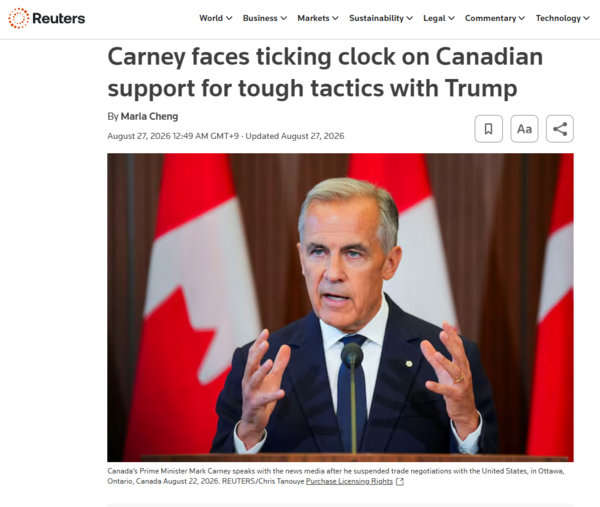
Yet, Reuters titled its analysis "Carney faces ticking clock" for a reason. As the real economic damage from the tariff war accumulates, his current high approval ratings could begin to erode within months. Analysts warn that if Washington maintains a strong protectionist stance beyond the U.S. midterm elections, Carney’s bargaining power will deteriorate further.
A symbolic moment underscored just how fractured the bilateral relationship has become. Trump signed an executive order directing federal government documents to refer to Lake Ontario as "Lake America." While Washington lacks the authority to change official designations used by Canada or international bodies, the fact that trade friction between the world's closest neighbors has degenerated into a petty dispute over the name of a shared lake reflects the severity of the crisis.
[Why Times Insight]
Prime Minister Carney’s fundamental miscalculation was not his courage to stand up to Washington, but his overestimation of the alternative buffers available to sustain Canada during a major breach. His strategic blueprint was straightforward: rally middle powers to resist superpower pressure, improve ties with Beijing to reduce dependence on America, and expand trade across Europe and Asia to secure strategic autonomy.
When the trade war erupted, cold realities set in. Political rhetoric from middle-power allies failed to translate into a joint tariff coalition; China could not substitute for the U.S. market; and opening the market to Chinese EVs served primarily to trigger Washington’s strategic alarm bells. The immediate U.S. rebuke of Canada's EV decision clearly illustrated this dynamic.
Now, as Canada prepares its CAD 27.6 billion retaliatory package alone, it is simultaneously funneling an extra CAD 7.5 billion in public funds to shield affected businesses and workers. The vast chasm between the political rhetoric of "middle-power solidarity" and the actual economic bill Canada must foot on its own is fully exposed.
In this light, media coverage that frames the crisis purely as "Trump's excessive pressure on Canada" tells an incomplete story. Regardless of whether Trump's 50% tariffs are deemed extreme, an accurate analysis must address why the Carney administration lowered EV barriers previously aligned with U.S. policy, why Washington reacted so sharply, and why middle-power solidarity failed to function as an economic shield.
Above all, one must not be misled by the reported 3.3% GDP growth. That figure reflects an economy prior to the new 50% tariff regime. Upcoming employment, export, manufacturing, and automotive metrics will be the true indicators of whether Carney’s strategy succeeds or fails. The Bank of Canada’s cautious stance amid the ongoing trade war underscores the sheer scale of the uncertainty ahead.
The fundamental question facing Carney is no longer whether he can stand up to Donald Trump. It is how long Canada can afford the mounting costs of confronting the United States when neither China nor a middle-power coalition can replace access to the American market. The answer will determine not only Carney’s political fate, but also the viability of the "Third Way for Middle Powers" he championed at Davos.

-중국 푸단대학교 한국연구원 객좌교수
-전 EDUIN News 대표
-전 OUR NEWS 대표
-제17대 대통령직인수위원회 정책기획팀장
-전 대통령실 홍보기획비서관
-사단법인 한국가정상담연구소 이사장
-저서: 북한급변사태와 한반도통일, 2012 다시우파다, 선거마케팅, 한국의 정치광고, 국회의원 선거매뉴얼 등 50여권