Update2026.10.24 (토)

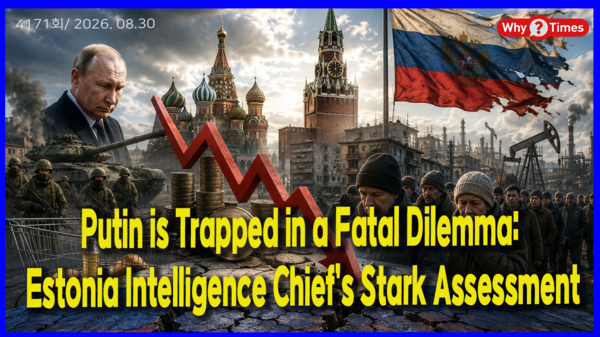
[Estonia Intel Chief’s Bombshell Assessment: "Putin Has Only Bad Options Left"]
Russian President Vladimir Putin is falling into a fatal trap where ending or continuing the war in Ukraine presents severe risks. Despite pouring immense military personnel, financial resources, and even drawing in North Korean support, he has failed to secure a decisive victory. Prolonging the war continues to erode the Russian economy and fuel internal discontent. Conversely, halting the conflict now risks bringing the accountability for four and a half years of staggering sacrifices directly onto Putin himself.
Amid these conditions, Kaupo Rosin, Director General of the Estonian Foreign Intelligence Service (EFIS), issued a stark warning: Putin has only bad choices remaining, and if internal changes begin in Russia, they could occur "overnight".
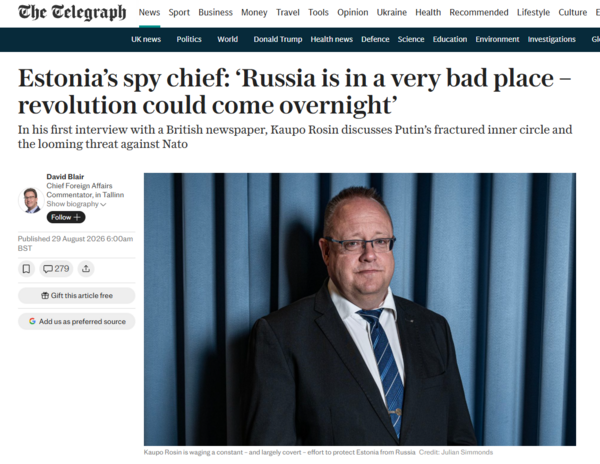
The Telegraph reported that Rosin delivered an unusually strong warning regarding Russia's internal stability. He noted that Russia has objectively fallen into a "very bad situation," with voices within Putin’s inner circle increasingly calling for a reconsideration of the war's continuation.
According to the Telegraph, Rosin warned that key figures in the Kremlin no longer speak of "total victory". Should a shift occur within the regime, it could happen far faster than expected. The core issue remains that Putin finds it nearly impossible to stop: continuing the war further degrades Russia, but stopping it immediately forces him to take political responsibility for years of failure and losses.
Estonia shares a nearly 290 km border with Russia, and EFIS is widely recognized as a frontline NATO intelligence agency with high-precision insights into Russian domestic affairs, with former MI6 chief Richard Moore having publicly praised EFIS's capabilities. Rosin emphasized that while Putin publicly insists that persistence will yield a Russian victory, those around him no longer fully buy into this narrative, increasingly pushing him to reassess the situation. Rosin summarized Putin's current dilemma in a single sentence: "There are only bad options."
[Continuing the War Ruins Russia; Stopping It Shakes Putin]
Putin’s primary dilemma lies in these competing pressures:
If the war continues: Heavy troop casualties, mounting fiscal burdens, and economic distress will exacerbate internal tension. Rosin pointed out that elite figures may eventually conclude that the regime is better off without Putin.
If the war stops: Having justified the 2022 full-scale invasion under the banners of "demilitarization," "denazification," and existential survival against the West, concluding the conflict without a clear victory leaves Putin unable to justify the immense loss of lives and resources to the Russian public. Rosin noted that stopping the war risks exposing Putin as a weak leader, destabilizing his political authority.
[Russian Military Forces Face Recruitment Shortfalls]
The crisis extends directly to battlefield capabilities. Rosin noted that battlefield losses have surpassed the rate of new military recruitment. Citing British intelligence agency GCHQ estimates, the Telegraph reported that total Russian killed in action has reached approximately 500,000.
This reality fuels widespread speculation regarding a potential large-scale mobilization. According to Rosin, Russian society widely anticipates another draft, with systems prepared even if a final political order has not yet been confirmed. The paradox remains stark: if victory were near, Russia would not require hundreds of thousands of additional soldiers alongside North Korean manpower and ammunition support.
[Economic Pressure Mounts: Deficit Forecast at 10 Trillion Rubles]
Economic constraints further limit Putin's timeline. Rosin estimated that Russia’s fiscal deficit could reach approximately 10 trillion rubles—nearly half of its defense budget. Deprived of access to international financial markets due to Western sanctions, the Russian government may be forced to raise taxes or impose additional financial burdens on oligarchs and enterprises.
Furthermore, Ukrainian long-range strike capabilities have increasingly targeted the economic infrastructure sustaining the war effort. Rosin directly cited attacks on oil infrastructure as a major factor severely damaging Russia's economy and raising the overall cost of continuing the war.
[Key Warning Signs: Elites Abandon "Total Victory" Narratives]
Rosin emphasized that the most critical signal is not immediate mass civil unrest, but rather the mindset of the elites holding access to funds, arms, and intelligence.
Crucially, Kremlin insiders are no longer framing the conflict around "complete victory". Instead, Rosin revealed they are actively discussing various exit strategies and ending scenarios. For an authoritarian system reliant on the loyalty of military, security, and economic elites, a shift in perception among key decision-makers poses a direct threat to Putin's hold on power.
[Regime Shifts Can Occur "Overnight"]
Drawing parallels to the 2023 Wagner Group rebellion led by Yevgeny Prigozhin, Rosin argued that internal regime shifts in Russia do not happen gradually. When structural failure occurs, it will unfold rapidly and unexpectedly, "overnight". Prigozhin’s march toward Moscow demonstrated that while the regime appears solid externally, its internal structure remains remarkably fragile.
[Context Behind CIA Director's Moscow Visit]
Recent high-level diplomatic moves reflect these shifting internal dynamics. CIA Director John Ratcliffe’s visit to Moscow served to deliver direct messages to Russian officials.
The Telegraph reported that Ratcliffe warned Moscow against testing NATO or underestimating Article 5 collective defense commitments. Rosin noted that Putin understands the ongoing validity of Article 5, making conventional military aggression against NATO countries unlikely over the coming year, provided the West maintains support for Ukraine and reinforces its defense posture.
[Why Times Insight]
Putin remains unable to end the war not simply because he believes victory is imminent, but because the political consequences of the day after are far more dangerous for his regime.
Once fighting stops, the domestic focus shifts from territorial gains to calculating the human and economic toll. Without a compelling narrative of victory, Putin's image as a strong leader dissolves. Consequently, prolonging the conflict becomes a mechanism for personal political survival.
However, intelligence assessments suggest that Russian domestic endurance may fracture before Ukraine's defenses give way. As Rosin highlighted, when key elites stop discussing complete victory and begin debating end-state scenarios, every additional day the war continues drains vital resources and shortens the political runway remaining for Putin's regime.


-중국 푸단대학교 한국연구원 객좌교수
-전 EDUIN News 대표
-전 OUR NEWS 대표
-제17대 대통령직인수위원회 정책기획팀장
-전 대통령실 홍보기획비서관
-사단법인 한국가정상담연구소 이사장
-저서: 북한급변사태와 한반도통일, 2012 다시우파다, 선거마케팅, 한국의 정치광고, 국회의원 선거매뉴얼 등 50여권