Update2026.10.24 (토)

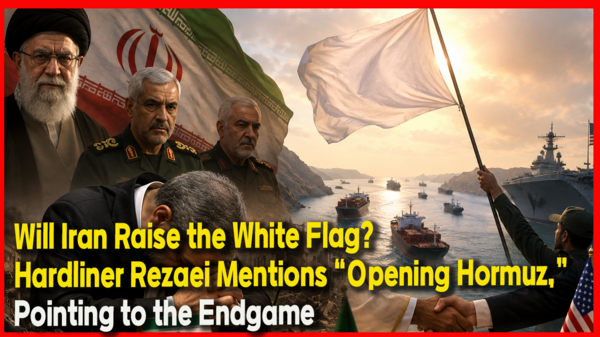
[IRGC Figurehead Rezaei Moves: “Hormuz Opens Under the Right Conditions”]
The conflict with Iran is entering a critical inflection point. Following President Masoud Pezeshkian’s public remarks advocating for an end to hostilities—noting that the war should conclude while Iran maintains "strength and dignity"—Mohsen Rezaei, Secretary of the Supreme National Security Council (SNSC) and former Commander-in-Chief of the Islamic Revolutionary Guard Corps (IRGC), revealed that Iran is drafting specific terms for reopening the Strait of Hormuz. While Tehran officially insists it will never surrender, the fact that its top security chief is now detailing steps for a conditional ceasefire strongly suggests a trajectory toward de-escalation.
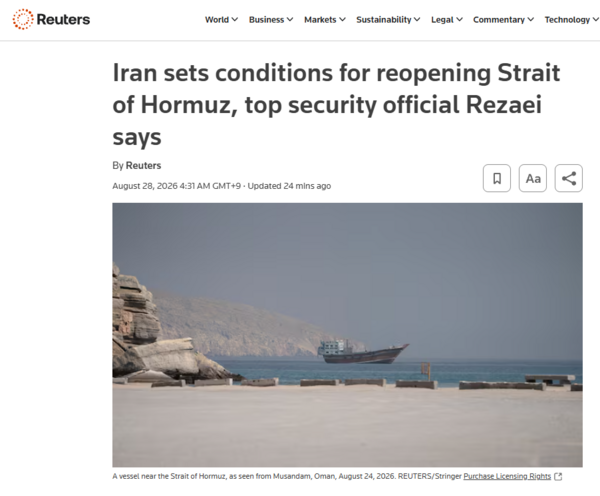
Reuters reported that key figures in Iran’s security architecture—representing hardline factions—have shifted focus from how to fight to under what conditions to end the war and reopen Hormuz. Media outlets highlighted this as a powerful signal that senior leadership in Tehran is actively seeking an exit strategy.
According to Reuters, the decisive shift occurred when SNSC Secretary Mohsen Rezaei stated in an interview with Lebanon’s Al-Manar TV that mediating nations had inquired about terms for reopening the strait, and the Iranian government is currently preparing a formal list of demands. Rezaei explained that these conditions include a full termination of the war surrounding Iran.
Crucially, Reuters noted that Rezaei specified if the United States accepts these terms, vessels could resume passage through designated central maritime lanes in the Strait of Hormuz. Whether Washington will find these conditions acceptable remains a separate issue; however, Iran’s transition from an unconditional blockade to structured negotiations marks a major strategic shift.
Rezaei is no ordinary official. Reuters explained that as IRGC Commander-in-Chief from 1981 to 1997 and a leading hardline figure, his appointment to lead the SNSC underscores his political authority. Reuters evaluated him as a prominent hardliner, meaning the fact that such a figure is now discussing the reopening of Hormuz within a diplomatic framework carries immense political weight.
[From “No Opening” to “Open Under Terms”]
This evolution is significant given Iran’s aggressive rhetoric just weeks ago. The SNSC declared that the Strait of Hormuz would remain closed indefinitely unless the U.S. altered its posture and met Tehran’s demands. Rezaei himself had issued stern warnings promising retaliation against any nation aiding U.S. economic sanctions.
The official narrative has now transitioned from "we will not open" to "we will open under specific terms". While this does not represent an explicit capitulation, hardline willingness to discuss concrete terms for ending the war indicates that Tehran’s core calculus has shifted.
Furthermore, Iran and Oman are actively coordinating on the parameters of a new transit corridor. Reuters reported that both countries continue to fine-tune details regarding the corridor, with Rezaei acknowledging an agreement on a joint navigation corridor spanning Omani and Iranian territorial waters. The dialogue has fundamentally re-centered from enforcing a blockade to restoring maritime traffic.
[From Pezeshkian to Rezaei: Ending the War Takes Center Stage]
This shift is not isolated to Rezaei. President Pezeshkian recently raised the imperative of stopping the conflict while Iran retains bargaining power. At the same time, he framed the outcome not as a defeat, but as concluding the war from a position of strength.
Public declarations must be distinguished from tactical realities. Formally declaring surrender to the U.S. is politically impossible for the regime, as it would dismantle its anti-American foundational legitimacy. The crucial metric is not whether the word "surrender" is uttered, but what actions are being taken on the ground.
Pezeshkian is talking about ending the conflict; Rezaei is formulating terms for reopening Hormuz; and negotiators are hammering out maritime corridors with Oman. Taken together, these moves confirm that crafting an exit strategy has become a top national security priority in Tehran.
[Intermediaries Surge Into Tehran: Qatar, Oman, and Pakistan]
Diplomatic activity among third-party mediators has intensified. Al Jazeera reported that Qatari Prime Minister Sheikh Mohammed bin Abdulrahman Al Thani visited Tehran to discuss de-escalation and resuming dialogue with Iranian officials—noting Qatar's status as a key nation that previously brokered temporary agreements between Washington and Tehran.
Al Jazeera further reported that Pakistan has also stepped up, with General Asim Munir, head of Pakistan’s military, meeting with Pezeshkian and Rezaei in Tehran. Regarding this, Reuters reported that his visit was an extension of efforts to restore peace and stability. Analysts note that simultaneous interventions by Qatar, Oman, and Pakistan reflect a genuine readiness on both sides to explore military de-escalation.
[Yet Trump Shows No Rush]
The primary variable remains Washington’s stance. Reuters notes that while Tehran and regional mediators search for an off-ramp, the Trump administration has balked at returning to previous baseline agreements, and news that Washington rejected earlier ceasefire baselines caused global oil prices to rise by over 2%.
Instead, the U.S. is maintaining military pressure while expanding economic sanctions. Reuters reported that Washington is expanding its strategy to target Iran’s crude exports, international financial access, and third-party entities providing economic lifelines, calculating that it can wait until Tehran lowers its bargaining demands further. This creates a clear asymmetry: Iran is seeking an immediate exit, while the U.S. sees no urgency to compromise.
[Economic strain: The Domestic Pressure Cooker]
Driving Tehran's shifting posture is severe internal economic distress. The Governor of the Central Bank of Iran recently conceded that crude exports—the country's main source of foreign currency—have virtually halted. The Iranian Rial plunged to a record low of 2,050,000 Rial per USD, prompting official warnings to citizens not to expect economic improvement over the coming year.
Domestic shortfalls are severe. Al Jazeera highlighted data from statistics authorities indicating food prices jumped over 128% year-over-year. Coupled with medicine shortages and rolling blackouts, fuel exhaustion at gas stations in cities like Tehran, Mashhad, and Karaj has forced citizens in an oil-rich nation to wait in long lines for gasoline.
Al Jazeera explained that raising fuel prices risks triggering severe public unrest, yet maintaining heavily subsidized fuel is fiscally unsustainable. As the conflict drags on, the socio-economic burden on the regime threatens to outweigh the military costs.
[Why Times Insight]
An explicit declaration of surrender by Iranian leadership remains highly improbable, as it would undermine the anti-Western identity the Islamic Republic has cultivated since 1979. Thus, assessing Tehran requires analyzing concrete actions over official rhetoric.
Pezeshkian advocates for peace while denying surrender. Rezaei threatens Washington while simultaneously establishing terms to reopen Hormuz. Iran asserts its control over the strait while actively negotiating passage corridors with Oman. Meanwhile, envoys from Qatar and Pakistan continue high-level shuttle diplomacy.
Tehran's underlying message is consistent: "We will not declare defeat, but we need an exit." The fact that both the president and the top security official are addressing the end of hostilities and the reopening of Hormuz indicates a pivot toward preserving regime survival and economic stability.
With the U.S. maintaining maximum pressure rather than accepting previous terms, the key question is how far Tehran will compromise to secure a ceasefire. The conflict is not over, but the shift from missile strikes to negotiating the terms of peace suggests the six-month war is finally nearing its endgame.

-중국 푸단대학교 한국연구원 객좌교수
-전 EDUIN News 대표
-전 OUR NEWS 대표
-제17대 대통령직인수위원회 정책기획팀장
-전 대통령실 홍보기획비서관
-사단법인 한국가정상담연구소 이사장
-저서: 북한급변사태와 한반도통일, 2012 다시우파다, 선거마케팅, 한국의 정치광고, 국회의원 선거매뉴얼 등 50여권