
Update2026.10.24 (토)

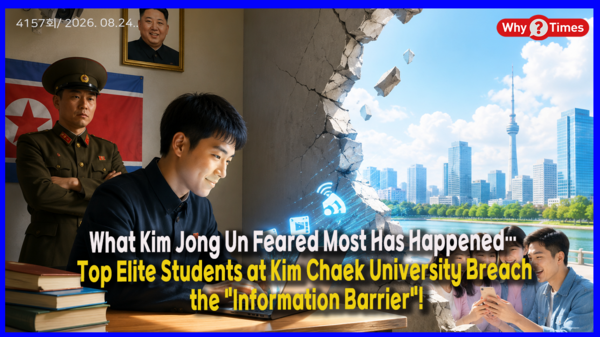
[North Korea’s Top Elites Personally Bypass the Regime’s "Information Firewall"]
The very rift the Kim Jong Un regime fears most has erupted at North Korea’s premier science and technology institution. Seven top-tier students at Kim Chaek University of Technology developed their own technology to bypass the regime's information blackout walls, accessed the global internet, and downloaded, watched, and distributed South Korean video content before being arrested by the Ministry of State Security. Following the incident, central North Korean authorities launched a massive ideological audit across universities nationwide. The fundamental question remains: can threatening students with guns and knives and searching their computers and mobile phones completely suppress the curiosity and desires of young elites who have already glimpsed the outside world?
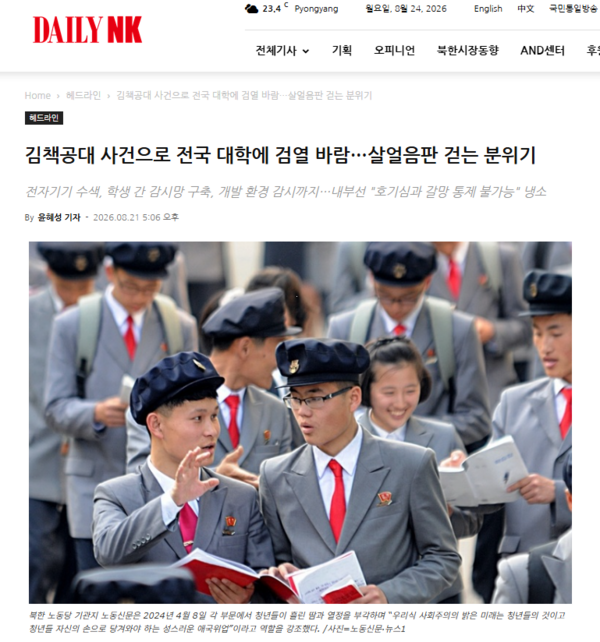
High-intensity inspection orders were issued to universities in Pyongyang and across North Korea following the arrest of the seven Kim Chaek University students. Central authorities mandated rigorous audits across all universities, treating the rapid spread of South Korean culture among science and technology elites as a grave threat to the regime after these students were caught developing a novel bypass technology to access and distribute foreign media.
The primary reason this incident is unprecedented is that the individuals involved were not ordinary North Korean citizens, but top-tier scientific and technological talent painstakingly cultivated by the regime. The issue surfaced when seven Kim Chaek University students were caught developing and utilizing a new bypass method to breach external information walls. These students were talented enough to be affiliated with university research institutes.
Their actions went far beyond covertly watching South Korean dramas off smuggled USB drives. Using their self-developed bypass tech, the students intercepted wireless signals around Pyongyang’s diplomatic enclave and embassy districts to access the global internet. They downloaded South Korean media files, transferred them to USB drives and SD cards, and distributed them to those around them. Paradoxically, the exact scientific and technological expertise North Korea needs most was weaponized to breach its own information blockade.
[Ministry of State Security Conducts Months-Long Tracking… Raids Site to Arrest All 7 Students]
The response from North Korea’s Ministry of State Security was equally extraordinary. Using advanced equipment to monitor abnormal signals in Pyongyang, agents detected recurring anomalous traffic around the university district. Following months of precision location tracking and stakeouts, agents raided a location where the students had gathered to watch South Korean videos, arresting all seven on the spot and seizing their equipment and media files.
The shock wave across Pyongyang’s university campuses has been substantial. News that Kim Chaek University’s top minds—traditionally treated as the nation's "intellectual elite"—were branded reactionaries and dragged away overnight sent ripples of fear, not only among students but also among high-ranking Pyongyang parents with children at the university, who fear potential fallout. Local observers speculate that key perpetrators could face severe punishments, such as imprisonment in political prison camps (gulags), though actual sentencing has not yet been finalized.
[Why Kim Jong Un Turned Universities Nationwide Upside Down Over 7 Students]
The most notable aspect of this incident is not the arrests themselves, but the regime’s subsequent reaction. Rather than treating the event as an isolated act of misconduct by individual students, authorities expanded inspections to universities across Pyongyang and the provinces. This indicates that North Korea’s top leadership views the penetration of external information into the elite youth class not merely as a cultural matter, but as a direct challenge to regime security.
To be sure, it is premature to conclude that anti-Kim Jong Un ideology has spread throughout university campuses. What is clear is that students actively sought out and distributed South Korean content, triggering an aggressive state response. However, the fact that top-tier technology elites bypassed state blockades knowing full well the risks of punishment serves as a crucial indicator that the young elite's curiosity about the outside world cannot be easily eradicated through coercive control alone.
[What Kim Jong Un Truly Fears Is Not 'South Korean Dramas']
The Kim Jong Un regime’s strict control over youth exposure to foreign culture is nothing new. North Korea has long managed external cultural inflows and youth cultural shifts in direct connection with regime ideology, maintaining a firm emphasis on party control, discipline, and ideological indoctrination. Following the 9th Party Congress, the regime has continued to prioritize party-centered discipline and mass mobilization over substantive reform.
What, then, does Kim Jong Un truly fear? It is not a single South Korean drama. The core threat is that South Korean media enables North Korean citizens to realize the stark gap between the outside world as depicted by regime propaganda and reality. For computer- and tech-savvy university students in particular, the ability to operate communications technology means they do not have to passively accept state-rationed information; they can actively seek out alternative sources. The Kim Chaek University incident made that latent threat a tangible reality, making it an exceptionally sensitive matter for the regime.
[Kim Jong Un’s Dilemma: The More Elites You Train, the Stronger Their Ability to Breach Firewalls]
This highlights the fundamental dilemma facing the Kim Jong Un regime. To modernize its economy and military, North Korea must continuously nurture top talent in computer science, AI, electronics, telecommunications, and cyber capabilities. Yet, as young people are taught advanced computing and networking skills, they gain a deeper understanding of how North Korea’s information control systems operate. As seen in the Kim Chaek University case, some will inevitably turn those technical skills toward bypassing the control grid.
Kim Jong Un cannot afford to halt the training of tech talent, nor can he grant them free access to information. As technical capabilities rise, new vulnerabilities inevitably emerge within the information blockade. If North Korean authorities must now guard against the technical ability to access information rather than merely cracking down on USB drives and videos, they face a challenge far more daunting than traditional methods of information control.
[Tightening Control on Chinese Cell Phones: Shrinking Direct External Links]
Concurrently, authorities have intensified crackdowns on Chinese mobile phone users in the Sino-North Korean border regions, fueling mutual surveillance and distrust among residents. Because Chinese mobile phones bypass North Korea’s internal telecommunications network to connect directly across the border, they have long been a primary target for state enforcement.
North Korea has also been adjusting its trade framework with China, shifting from raw material exports toward value-added processing combined with Chinese investment, alongside expanding official customs trade. Crackdowns on traders using Chinese phones serve not only an information-control purpose, but also an economic one: absorbing private trade networks into state-managed systems.
Extinguishing unauthorized internet access among university students and clamping down on Chinese cell phones in border regions share a single common objective: reducing the unmonitored spaces where individual citizens connect directly with the outside world. Whether restricting internet access at universities, Chinese telecom networks along the border, or private trade networks in the economy, the regime is attempting to force all channels back under state control.
[Why Times Insight]
There is no firm basis yet to extrapolate this incident into an "anti-Kim Jong Un uprising among North Korean university students." However, the key takeaway from the Kim Chaek University incident is not the specific number of students involved—seven. It is the fact that the nation's top state-funded science and technology elites used their state-provided skills to personally breach the information walls erected by the regime.
Even more significant is the regime's ongoing tightening of ideology, discipline, and party-centric governance. Reaffirming the "Three Revolutions" (Ideological, Technological, and Cultural) and self-reliance at the 9th Party Congress, North Korea continues to prioritize discipline, ideological campaigns, and mass mobilization over marketization. Ultimately, the Kim Chaek University incident exposes an internal collision course between a state that demands technological advancement and a regime that demands absolute information control.
The battle Kim Jong Un faces cannot be won simply by confiscating a few cell phones and seizing USB drives. Weapons and coercion can temporarily suppress behavior, and device inspections can temporarily block incoming data channels. However, erasing the curiosity of a new generation that knows the outside world exists—and possesses the technical skill to access it independently—is an entirely different challenge.
This is precisely why the arrest of seven Kim Chaek University students cannot be dismissed as a routine crackdown on South Korean media. The more brilliant young minds Kim Jong Un cultivates to build a "science and technology powerhouse," the greater their capacity grows to look past the walls the state has built. What Kim Jong Un truly fears may not be a single South Korean drama, but a young generation that has begun figuring out how to look over that wall for themselves.
-중국 푸단대학교 한국연구원 객좌교수
-전 EDUIN News 대표
-전 OUR NEWS 대표
-제17대 대통령직인수위원회 정책기획팀장
-전 대통령실 홍보기획비서관
-사단법인 한국가정상담연구소 이사장
-저서: 북한급변사태와 한반도통일, 2012 다시우파다, 선거마케팅, 한국의 정치광고, 국회의원 선거매뉴얼 등 50여권