Update2026.10.24 (토)

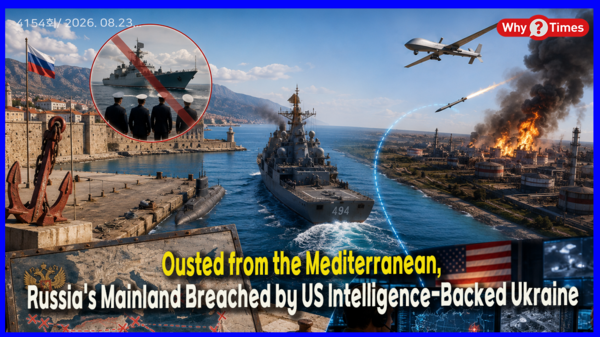
[Russian Warships Disappear from the Mediterranean: "Is This Truly a Global Navy?"]
Russia, which once claimed to be a global military power rivaling the United States, is being pushed into an unexpectedly humiliating position amid the protracted war in Ukraine. For the first time since establishing its permanent Mediterranean Task Force in 2013, the Russian Navy has effectively lost its continuous military presence in these waters. Concurrently, targets on the Russian mainland—ranging from oil refineries and military bases to core facilities of its space industry—are increasingly exposed to Ukrainian long-range strikes.
Particularly notable is the deep integration of US intelligence assets into Ukraine’s deep-strike operations inside Russian territory. Vladimir Putin’s war, launched with the intent to quickly subjugate Ukraine, has produced a striking paradox: it has drastically constrained Russia’s global operational reach while turning the Russian heartland itself into an active battleground.
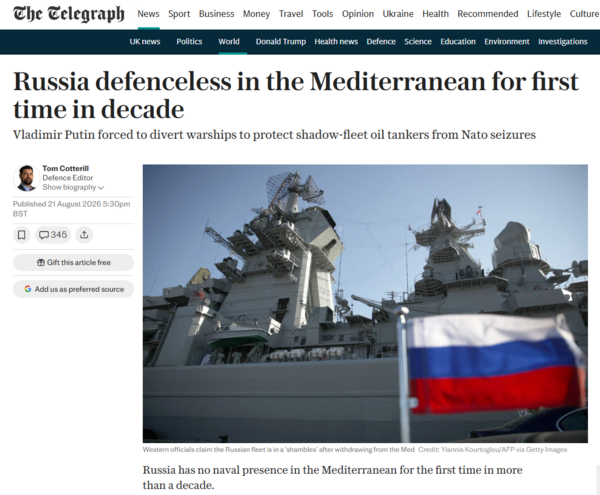
On August 22, the UK's The Telegraph reported that "Russian naval forces have virtually vanished from the Mediterranean, failing to deploy warships on a permanent basis in the region since June." The report emphasized that this marks the first such disruption in over a decade since the recreation of the Mediterranean Task Force in 2013. A NATO official remarked that "there has been nothing there since June," noting that "it is difficult to call yourself a global navy if you cannot deploy vessels worldwide." This reality sharply contrasts with Moscow’s long-standing propaganda portraying Russia as a maritime power capable of standing toe-to-toe with the US.
The Telegraph pointed out that "this is not merely a routine shift of a few ships to other waters." Following the restoration of its permanent Mediterranean force in 2013 and subsequent military intervention in the Syrian Civil War, Russia used the Eastern Mediterranean as a stage to project its revived global power. Naval installations in Tartus and the Hmeimim Air Base in Syria served as strategic footholds to project force from the Black Sea across the Mediterranean into the Middle East and Africa. Yet, several years into a war meant to bend Ukraine to its will, Russia finds itself unable to maintain a continuous naval presence in the region.
[Draining Combatants to Guard the 'Shadow Fleet']
Another factor exacerbating the strain on the Russian Navy is maritime friction with Western nations surrounding the "shadow fleet" used to evade sanctions. According to The Telegraph, as Western nations tighten enforcement and interdict vessels transporting Russian oil, Moscow has had to assign warships to protect them. While Russia needs to maintain sufficient naval power simultaneously in the Mediterranean, Atlantic, and English Channel, the depletion of resources due to the war in Ukraine has forced difficult trade-offs and forced strategic concentration.
The severity of the situation is also evident in naval logistics. The Telegraph reported that "the Russian Navy is struggling to secure adequate support and refueling capabilities, and Western officials evaluate the condition of Russia's surface fleet very negatively." Observers emphasize that "the essence of a blue-water navy is not just the number of warships, but the ability to sustain a fleet over long periods using supply ships, repair vessels, and overseas bases—and it is precisely here that Russia's vulnerability is exposed."
The Telegraph concluded that "ultimately, Russia's strategic flexibility in its navy has shrunk significantly while waging a prolonged war against Ukraine alone." In the Black Sea, missile and naval drone attacks have severely constrained the Black Sea Fleet's freedom of movement, and now its permanent presence in the Mediterranean has effectively ceased—a development that severely damages Russia's self-proclaimed status as a "global navy."
[Pushed Off the Seas, the Russian Mainland Becomes Ukraine’s Strike Zone]
An even more humiliating scenario is unfolding on the Russian mainland. Associated Press noted that "early in the war, Russia launched long-range missiles across Ukraine while keeping its own rear as a relatively safe strategic sanctuary, but the situation has completely inverted." Ukraine’s long-range strike campaign has expanded significantly this year, tracking military, industrial, and logistical facilities over hundreds of kilometers behind the frontlines. Units like the 413th Separate Unmanned Systems Regiment "Raid," interviewed directly by AP, deploy FP-1 long-range attack drones to strike deep targets within Russia.
On August 15, strategic industrial facilities in Russia’s Samara region suffered a major attack. AP reported that "Russian authorities acknowledged a large-scale attack, which targeted the 'Progress Rocket Space Centre' under the state space agency Roscosmos," while Ukrainian sources confirmed the use of domestic long-range weaponry. Russia, which once launched strikes across Ukraine with impunity, now finds itself forced to defend core assets of its own space and missile industry.
[Hammering Russia's Achilles' Heel: Oil Refineries]
Ukraine’s strikes have placed a heavy focus on the Russian energy sector. Reuters reported that "Ukrainian forces confirmed striking the TANECO Oil Refinery in Tatarstan and the Tamanneftegaz oil terminal in the Krasnodar region on August 20." Fires broke out at both facilities, reflecting a calculated strategy rather than mere retaliation—aimed at inflicting long-term damage on Russia’s oil refining and transport capacity, the lifeblood of its war economy.
These strikes are already impacting the daily lives of Russian citizens. According to Reuters, the combination of Ukrainian attacks on refineries and seasonal demand spikes has led to fuel rationing at gas stations in Moscow. Major energy firms including Gazprom Neft, Rosneft, Lukoil, and Tatneft implemented sales limits, prompting the Russian government to restrict fuel exports and increase oil product imports. For Putin, seeing the capital of a top global oil producer face gasoline rationing due to Ukrainian strikes represents a significant political embarrassment.
[Backed by US Intelligence]
From Moscow's perspective, an even more alarming factor is the direct involvement of US intelligence in enabling Ukraine's deep-strike capabilities. According to Defense News, Sen. Mark Warner, the ranking Democrat on the Senate Intelligence Committee, recently confirmed that US-Ukraine intelligence cooperation has been restored to robust levels. Defense News highlighted that "US intelligence support plays a crucial role in enabling Ukrainian long-range drones and missiles to hit targets deep inside Russian territory."
The depth of this assistance is particularly striking. Citing reporting from The Atlantic, Defense News noted that US intelligence is utilized not only against Russian forces within Ukraine, but also for "strike packages targeting energy infrastructure inside Russian territory." Officials described this intelligence as a vital asset continuously provided to Ukraine free of charge, with CIA Director John Ratcliffe playing a key role in maintaining the arrangement.
Defense News observed that "this carries immense significance." While US forces are not launching missiles directly, the integration of world-leading US Intelligence, Surveillance, and Reconnaissance (ISR) capabilities with Ukraine's long-range strike systems creates a potent combination. Russia is now forced to defend strategic assets across its entire territory against combined US intelligence insights and Ukrainian strike units. Reports that US intelligence feeds directly into "strike packages" on Russian energy targets signal that Washington's role in the conflict extends far beyond mere arms supply.
[A Decade-Old CIA-Ukrainian Intelligence Network Revives]
This intelligence partnership was not built overnight. Defense News reported that "the CIA established close ties with Ukrainian intelligence following Russia's 2014 annexation of Crimea, investing millions of dollars to train Ukrainian operatives and helping establish roughly a dozen secret forward bases along the Russian border." Although intelligence sharing experienced a brief hiatus following a White House clash between President Trump and President Zelenskyy in 2025, US officials confirm it has fully rebounded.
Consequently, the territory Russia must defend has effectively expanded to encompass the entire nation. AP noted that "Ukrainian long-range attacks have increased sharply this year, putting Russian oil, defense, logistics, and aerospace facilities in the crosshairs." Data from the Armed Conflict Location & Event Data Project (ACLED) corroborates this trend, demonstrating a marked escalation in strikes inside the Russian rear. Moscow's initial assumption that it could contain the battlefield within Ukrainian territory has completely collapsed.
[Russia Started the War—Now Its Own Territory Is the Battlefield]
Reflecting on the conflict's origin, AP noted that "when Putin launched the war in 2022, his calculation was straightforward: use overwhelming military force to swiftly break Ukrainian resistance and drag the country back into Russia's strategic orbit." Prolonged conflict, however, has yielded the opposite result. Ukraine survived, developed its own long-range drone and missile industry, and leveraged US intelligence assets to strike deep inside Russia. Recent operations have expanded beyond oil refineries to encompass major industrial and supply chain hubs.
This does not imply an immediate total collapse of the Russian military on the frontlines. AP cautioned that "Russia still commands vast manpower, missile inventories, and drone fleets, continuing to inflict lethal strikes on Ukrainian cities." Therefore, an accurate assessment should not frame the current situation as an "imminent total defeat for Russia," but rather as a process where a war initiated to subjugate Ukraine is continuously consuming Russia's own strategic assets and global power.
[Why Times Insight — Russia Is Losing Great Power Prestige, Not Just Territory]
The disappearance of Russian warships from the Mediterranean and the strikes on refineries deep inside Russia are interconnected developments. Both illustrate how the war in Ukraine is steadily draining Russia's strategic strength. Despite committing massive human and material resources, Moscow has seen its Black Sea operational footprint shrink and its permanent Mediterranean presence disappear.
The Mediterranean retreat is a severe blow to Russia's image as a military superpower. A key benchmark of great-power status is the ability to project power far beyond one's immediate borders. Russia spent over a decade maintaining a continuous naval presence in the region for this exact reason. Failing to sustain that presence calls into question Putin's vision of a "global Russian navy."
Furthermore, this pressure comes from Ukraine—a neighbor Moscow expected to defeat within days. Today, Ukraine operates drone forces capable of striking targets over 1,000 kilometers inside Russia, backed by US intelligence optimized for targeting Russian energy infrastructure. Possessing the world's largest nuclear arsenal and a massive conventional army has not shielded Russia's core industrial assets from recurring damage.
Evaluating this war solely by daily territorial shifts in Ukraine misses the broader picture. One must weigh what Russia gains against what it surrenders. For every minor tactical gain, Russia loses its naval standing in the Mediterranean, the strategic safety of its homeland, the security of its energy infrastructure, and its international prestige.
This remains the central paradox of Putin's war: an invasion launched to force Ukraine into Russia's orbit has instead pushed the Russian Navy out of the Mediterranean and turned the Russian homeland into a target zone. Coupled with advanced US intelligence feeding Ukrainian deep strikes, Moscow is now forced to counter not just Ukrainian weaponry, but the vast surveillance architecture of the United States.
Ultimately, Russia is losing far more than personnel, armor, and oil output. It is burning through the carefully cultivated myth of a superpower capable of challenging global leadership—a loss of prestige that will be far harder to rebuild than any damaged infrastructure.


-중국 푸단대학교 한국연구원 객좌교수
-전 EDUIN News 대표
-전 OUR NEWS 대표
-제17대 대통령직인수위원회 정책기획팀장
-전 대통령실 홍보기획비서관
-사단법인 한국가정상담연구소 이사장
-저서: 북한급변사태와 한반도통일, 2012 다시우파다, 선거마케팅, 한국의 정치광고, 국회의원 선거매뉴얼 등 50여권