


Update2026.10.24 (토)


[Xi Jinping's Dilemma Ahead of September U.S. Visit: Abandon Iran, or Clash with Trump?]
U.S. President Donald Trump has declared an unprecedented "economic war" against Iran. However, the real battlefield for this measure appears to be Beijing, not Tehran. With China purchasing more than 80% of Iran's crude oil exports, it is difficult to isolate Iran completely unless China participates in the U.S. blockade. Ultimately, Trump’s new economic campaign against Iran acts as a tight stranglehold on Tehran while simultaneously serving as a high-pressure card that forces Chinese President Xi Jinping to choose between maintaining China's strategic alliance with Iran or avoiding a direct collision with the United States.
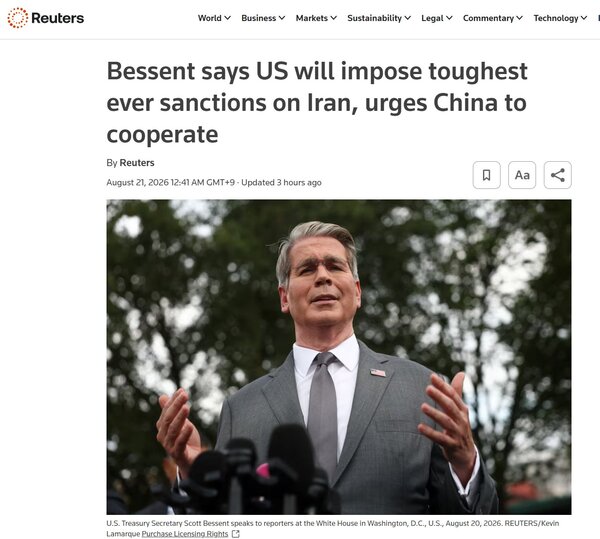
Reuters reported on the 21st that "U.S. Treasury Secretary Scott Bessent declared that 'the United States will impose the toughest sanctions in history on Iran'." In an interview with CNBC, Bessent described the combined U.S. naval blockade and new economic sanctions against Iran as a "one-two punch," expressing a firm stance that these measures will take effect on Iran and pressure the regime toward collapse. Specific details of the sanctions are set to be unveiled during a press conference on the 24th.
Reuters further noted that this measure is highly likely to go beyond simply adding a few targets to existing financial sanctions. President Trump warned that countries, companies, and financial institutions providing an economic lifeline to Iran will pay a massive economic price. This can be interpreted as an intent to sever Tehran’s international economic connectivity entirely—not just through primary sanctions targeting Iran itself, but through secondary sanctions aimed at third-country financial institutions and enterprises doing business with Iran.
Crucially, Bessent applied global pressure by emphasizing that "it is time for countries around the world to make a decision." Regarding this, Reuters observed that if the U.S. objective extends beyond inflicting additional economic pain on Iran to effectively forcing nations worldwide to choose between Iran and the U.S., this operation could evolve into a far more expansive economic isolation campaign than previous "maximum pressure" efforts.
[The Problem: Iran is Already an Economic Wreck]
More importantly, these sanctions are not striking a financially resilient Iran. The Associated Press analyzed that the Iranian economy is already under severe strain due to the compounding impacts of war, existing sanctions, currency devaluation, and trade and logistics disruptions. AP further noted that with the UAE halting economic and financial transactions with Iran, the detour routes in neighboring countries that Iran previously used during U.S. sanctions regimes are narrowing. How much further new U.S. sanctions can block Iran’s crude oil sales and foreign exchange settlement networks will serve as the core variable determining Tehran's economic endurance.
What makes the situation even more painful for Iran is that the U.S. economic blockade is beginning to align with measures taken by neighboring states. AP pointed out that the UAE suspended all trade, commercial, and financial transactions with Iran following the detection of two ballistic missiles assessed to have been fired from Iran. The UAE was one of Iran's major trading partners, and Dubai served as a vital commercial and financial hub connecting sanctioned Iranian entities to global markets. If the UAE's suspension persists long-term, Iran will face substantial pressure not only on crude exports but also across its import, foreign exchange, re-export, and settlement channels.
[Therefore, the Real Battlefield of Trump's Economic War is China]
However, one decisive variable remains in the U.S. economic blockade of Iran: China. Reuters noted that, according to commodities analytics firm Kpler, China imported an average of approximately 1.38 million barrels per day of Iranian crude oil in 2025, accounting for over 80% of Iran's crude exports. Consequently, as long as China continues purchasing Iranian crude, it will be difficult for Washington to completely cut off Tehran's primary source of foreign currency, regardless of how severe U.S. sanctions may be.
Furthermore, a complex transaction network designed to bypass U.S. sanctions already exists between China and Iran. Reuters stated that China's trade in Iranian crude utilizes independent refiners ("teapots") and intermediaries with relatively limited exposure to the U.S. financial market. Therefore, if the Trump administration intends to elevate these sanctions to a truly "historic" level, it must go beyond sanctioning additional Iranian firms and target the Chinese networks purchasing and settling payments for Iranian oil.
[Why Bessent Directly Brought Up China]
This is precisely why the most notable detail in Bessent's statements on the 20th concerned China. Reuters reported that when asked whether the U.S. would extend sanctions to China, Bessent avoided a direct answer, indicating that such conversations are best handled privately. However, he simultaneously applied pressure by highlighting China's heavy reliance on Gulf energy, arguing that joining the U.S. pressure campaign against Iran would ultimately benefit China as well.
This remark can be seen as a carefully calculated message. Reuters pointed out that rather than issuing a public ultimatum to China right now and driving U.S.-China relations toward a breakdown, the U.S. is likely using the Iran issue as a new piece of leverage in bilateral negotiations. In particular, because the Iranian oil issue is an arena where China's energy security directly collides with America's grand strategy on Iran, it could serve as a major test for future U.S.-China relations.
[China is Already Pivoting Toward Russian Oil]
Notable changes are also emerging in China's recent behavior. Reuters reported that as securing Iranian crude becomes increasingly difficult due to the U.S. naval blockade and the war in the Middle East, China is significantly expanding its imports of Russian crude. Volumes of crude oil heading from Russia's European ports to China in August are expected to reach approximately 1.25 million barrels per day.
This shift carries major significance. According to Reuters, if China can substitute a substantial portion of Iranian crude with supplies from Russia or other oil-producing nations, Iranian oil ceases to be an "irreplaceable resource without which China's economy collapses." Under those circumstances, Xi Jinping's core dilemma shifts from an energy shortage to a geopolitical cost-benefit calculation: "Is supporting Iran still worth incurring the risk of U.S. financial and trade sanctions?"
[Xi Jinping Ahead of September U.S. Visit: The Worst Possible Issue Has Erupted]
This makes the U.S. economic campaign against Iran erupt at a highly inconvenient moment for Xi Jinping. Reuters explained that as Washington and Beijing prepare for high-level diplomacy and economic negotiations, they are already bargaining over numerous issues, including trade, rare earths, agricultural products, and advanced technology. Adding the issue of Iranian crude purchases to the table will inevitably increase Beijing's negotiating burden.
According to Reuters, if the Trump administration demands that China curtail its purchases of Iranian oil, Xi Jinping's choices are far from simple. Acceding to U.S. demands would weaken the long-established China-Iran strategic partnership and impose a political burden of appearing to yield to American pressure. Conversely, refusing the demand and continuing large-scale purchases of Iranian crude leaves Chinese refiners, financial institutions, and shipping firms exposed to additional U.S. secondary sanctions. This represents a strategic analysis built on the direction of new U.S. sanctions and China's economic ties with Iran, rather than a confirmed outcome.
[The Ultimate Key: 'Will China Actually Reduce Iranian Oil Purchases?']
Moving forward, the most vital indicator will not be official statements from China's Ministry of Foreign Affairs, but actual crude purchase volumes and the actions of financial institutions. Reuters observed that if independent Chinese refiners scale back Iranian oil purchases and Chinese financial institutions begin restricting Iran-related transactions, the U.S. economic blockade will enter a completely different phase. On the other hand, if China maintains its existing bypass channels and continues buying Iranian crude, the Trump administration will face a tougher decision on whether to directly sanction Chinese enterprises.
[Why Times Insight]
Viewing Trump’s recent "Economic D-Day" merely as another round of sanctions on Iran misses the core of the strategy. While the primary target of this economic warfare is Iran, the nation that holds the key to its success or failure is China. With China absorbing over 80% of Iran's crude exports, total economic isolation remains unattainable unless the Beijing outlet is sealed.
Conversely, if China drastically cuts back on Iranian crude out of concern over U.S. pressure, the dynamic shifts entirely. With the UAE having already halted trade and financial dealings, losing its largest oil buyer in China would simultaneously squeeze Iran’s critical lifelines: oil sales, foreign currency acquisition, and international settlement channels. The exact operational strength of these new U.S. sanctions will become clearer following Secretary Bessent’s detailed announcement on the 24th.
Ultimately, Trump's objective is not merely to "sanction Iran," but to make the cost of doing business with Iran far outweigh the benefit. If successful, banks and corporations worldwide are likely to pull back from transactions with Iran on their own accord, even without the U.S. manually blocking every single deal. This analysis synthesizes the Trump administration's signaled economic penalties against third parties and Bessent's call for international cooperation.
The ultimate test of this strategy rests squarely on Xi Jinping. Propping up Iran risks a direct collision with Trump’s new economic blockade; backing away from Iran risks undermining China's Middle East strategy and its influence over Tehran. Furthermore, because China is already ramping up Russian crude purchases to offset potential supply dips from Iran, it possesses the economic flexibility to choose.
In the end, Trump’s "Iran Economic D-Day" functions as an operation to choke off Tehran’s economic breath while serving as a high-stakes pressure campaign compelling Beijing to make a choice. The central question is no longer just how long Iran can endure—it is whether China is willing to risk an economic clash with the United States to keep Iran afloat. That decision represents the true battlefield of this economic war.

-중국 푸단대학교 한국연구원 객좌교수
-전 EDUIN News 대표
-전 OUR NEWS 대표
-제17대 대통령직인수위원회 정책기획팀장
-전 대통령실 홍보기획비서관
-사단법인 한국가정상담연구소 이사장
-저서: 북한급변사태와 한반도통일, 2012 다시우파다, 선거마케팅, 한국의 정치광고, 국회의원 선거매뉴얼 등 50여권



