Update2026.10.24 (토)

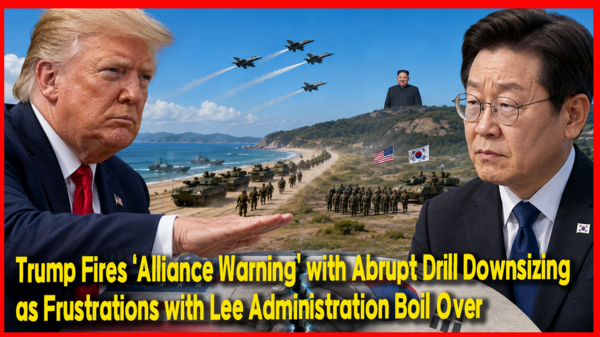
[Trump’s ‘Downsizing Order’ Arrives Right on Day 1 of Joint Military Drills]
U.S. President Donald Trump abruptly ordered a major reduction in the joint South Korea–U.S. military exercise, Ulchi Freedom Shield (UFS). Ostensibly citing his "good relationship" with North Korean State Affairs Commission Chairman Kim Jong Un and the financial costs of the maneuvers, Trump nevertheless brought up in the exact same post that President Lee Jae-myung’s administration declined to participate in Washington’s Iran denuclearization operations. Rather than a simple gesture of appeasement toward Pyongyang, this should be seen as an explosion of Trump’s accumulated grievances—spanning non-cooperation on Iran, delayed investments in the U.S., intelligence-sharing disputes, and differing approaches to North Korea—channelled into the reduction of joint military drills. The rift in the ROK–U.S. alliance has ceased to be a subterranean conflict among working-level officials and has escalated into public distrust between the two leaders.
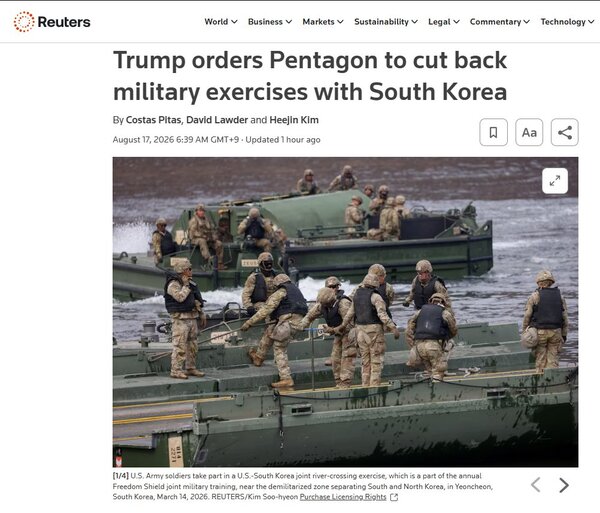
According to a report by Reuters on August 17, President Trump instructed Secretary of War Pete Hegseth to significantly downsize the scope of joint U.S.–ROK military exercises. On his social media platform, Truth Social, Trump posted: "Given my very good relationship with Chairman Kim Jong Un of North Korea, I do not like the fact that the U.S. agreed long ago to participate in joint military exercises with South Korea."
The timing of the announcement is also tellingly strategic. The post went public on August 17—the exact starting day of the UFS exercise—after South Korean and U.S. military authorities had already finalized their training plans. The exercise, involving around 18,000 South Korean troops, was structured to address emerging threats highlighted by the war in Ukraine, including drone, cyber, and electronic warfare; however, Trump’s public directive to scale down right before kick-off forced allied military authorities into the awkward position of having to adjust plans mid-stream.
[Grievances Against the Lee Administration Stung Worse Than Kim Jong Un]
The most noteworthy aspect is Trump’s direct mention of South Korean President Lee Jae-myung in the same statement. Trump revealed that he recently asked the South Korean president whether Seoul would join efforts toward Iran’s denuclearization, to which he received a brief "No thanks" response. Although Trump framed this as a "somewhat unrelated story," he would have had no reason to include it in a post announcing the reduction of joint exercises if it were truly irrelevant. Juxtaposing Seoul's non-cooperation on Iran alongside the military drill reduction served as an explicit political message conveying his dissatisfaction with the Lee administration.
Trump’s tone also betrayed a lack of trust in an allied leader. Bloomberg noted that airing private inter-leader communications and condensing Seoul’s response into a curt, cynical "No thanks" leaves the American public with the impression that Seoul brushed off a critical U.S. security request lightly. While Seoul’s refusal to participate in Iran operations was likely guided by complex considerations—including the safety of South Korean citizens and vessels in the Middle East, diplomatic ties with Tehran, and risks of military escalation—from Trump’s standpoint, South Korea appeared to be an ally enjoying U.S. protection while stepping back whenever Washington asked for help. Analysts at Bloomberg added that Trump’s resentment over receiving insufficient support in the Iran context sits heavily behind this decision.
[Alliance Distrust Compounded by Friction Over $350 Billion Investment]
Trump’s frustration extends well beyond security affairs. Reports from Reuters highlight a long-standing dispute between Seoul and Washington over a promised $350 billion strategic investment in the United States. While Trump demanded swift, full execution of the promised capital, Seoul argued for project-by-project commitments, citing concerns that lump-sum cash transfers would severely shock its foreign exchange market and domestic economy. As follow-up negotiations stalled, Trump went as far as threatening tariff hikes, accusing South Korea of delaying its trade commitments.
Hence, Trump’s reference to training costs is not a routine budget complaint. In his transactional calculus, defense cost-sharing, U.S.-bound investment, and Middle East support form a single ledger assessing "how much South Korea is contributing to America." Despite Seoul pointing out its world-class defense expenditure and financial contributions to hosting U.S. Forces Korea (USFK), Trump demonstrated that if performance on investments or Middle Eastern support falls short of his expectations, military perks under the alliance can be curtailed. This exercise reduction is alarming as it signals the application of Trump’s transactional diplomacy—linking security with trade to pressure Seoul—directly to actual military readiness.
[Intelligence Leak Controversy Exposes Eroded Trust]
Friction was further stoked by a controversy involving Unification Minister Chung Dong-young’s remarks regarding North Korean nuclear facilities. During a parliamentary committee session in March, Minister Chung publicly cited Kusong in North Pyongan Province as an active highly enriched uranium (HEU) production site alongside Yongbyon and Kangson. Reports surfaced thereafter that Washington restricted certain satellite intelligence-sharing on North Korean nuclear sites, while South Korea’s Defense Intelligence Command characterized the intelligence as "joint ROK–U.S. classified information". Conversely, Minister Chung and President Lee strongly rebutted leak allegations, claiming the information was already in the public domain.
The fundamental issue lies in how both nations handled the incident, regardless of whether a formal breach occurred. If reports of restricted intelligence-sharing hold true, Washington questioned the Lee administration’s security protocols. Meanwhile, the South Korean president publicly dismissing the concern as an "absurd claim" indicates that Seoul viewed Washington’s inquiry as political posturing. Clashing narratives over intelligence-sharing—the bedrock asset of the alliance—reveal that mutual trust had already sustained significant damage.
[North Korea Policy Shows Outward Alignment but Divergent Foundations]
In his Liberation Day address, President Lee proposed that North and South Korea lay down mutual threats and initiate talks to transition the armistice into a peace regime. As noted by Reuters, the Presidential Office in Seoul positively received Trump’s comments regarding his "good relationship with Kim Jong Un," aligning with the Lee administration’s goal of re-engaging Pyongyang and resuming U.S.–North Korea dialogue. Superficially, both leaders appear aligned in prioritizing dialogue and de-escalation.
However, their baselines and calculations differ sharply. While the Lee administration centers its efforts on restoring inter-Korean relations and establishing a peace regime, Trump prefers direct summit-level negotiations with Kim Jong Un built on personal rapport. Should Seoul’s role be marginalized in this process, the "ROK–U.S.–DPRK cooperation" envisioned by South Korea could devolve into a "Korea Passing" setup where Washington and Pyongyang negotiate over Seoul's head. Furthermore, with Kim Jong Un’s leverage bolstered by military cooperation with Russia, Pyongyang has ignored Seoul's overtures, meaning there is no guarantee that scaling down drills will automatically translate into resumed dialogue.
[South Korean Military’s ‘No Reduction’ Explanation Rendered Moot]
South Korea’s Joint Chiefs of Staff had previously explained that the reduction of battalion-level outdoor mobility training (FTX) events—from 17 last year to 14 this year—was an "adjustment due to dispersion throughout the year" rather than a downsizing. However, Trump’s public directive for a "major reduction" completely undercut the South Korean military’s stance. Although Seoul announced that exercises would proceed as scheduled, it remains uncertain to what degree the U.S. president's command will alter actual troop commitments, equipment deployment, and scenario execution.
This iteration of UFS was intended not only for Peninsula defense but also to advance alliance modernization and respond to broader Northeast Asian security dynamics. The Eighth U.S. Army had highlighted goals such as bolstering "Fight Tonight" readiness, modernizing alliance capabilities, and shaping the regional security environment. Scaling back military drills due to political bargaining sends a signal to both North Korea and China that America’s Indo-Pacific strategy can be altered by White House transactional calculations.
[Why Times Insight]
The core of this crisis goes beyond Trump trimming military drills to accommodate Kim Jong Un. The critical take is that Trump publicly raised Seoul’s non-cooperation on Iran, tied training costs to investment disputes, and issued a direct political warning to the Lee administration. Factoring in intelligence-sharing disputes and subtle divergences on North Korea, this action marks the surface eruption of deep-seated alliance distrust through the medium of military exercises.
Trump has demonstrated that if South Korea fails to satisfy U.S. demands, alliance commitments and joint exercises will be leveraged as bargaining chips. This signals a risky shift from traditional mutual defense principles toward a transaction-based relationship governed by profit and loss. If the Lee administration interprets this merely as an opportunity to restart Washington–Pyongyang dialogue, it risks misreading the true source of Trump's frustration.
Rather than celebrating Trump’s remarks on Kim Jong Un, Seoul must soberly evaluate why Washington has come to view South Korea as an unreliable ally. Middle East cooperation, investment timelines, intelligence security, wartime operational control (OPCON) transfer, and North Korea policy should not be handled in isolation, but packaged together into a comprehensive alliance trust restoration initiative. Otherwise, this UFS reduction will not be an isolated disruption, but the prelude to broader friction impacting USFK force posture, defense cost-sharing, intelligence-sharing, and extended deterrence.

-중국 푸단대학교 한국연구원 객좌교수
-전 EDUIN News 대표
-전 OUR NEWS 대표
-제17대 대통령직인수위원회 정책기획팀장
-전 대통령실 홍보기획비서관
-사단법인 한국가정상담연구소 이사장
-저서: 북한급변사태와 한반도통일, 2012 다시우파다, 선거마케팅, 한국의 정치광고, 국회의원 선거매뉴얼 등 50여권