


Update2026.10.24 (토)


[“China’s Economic Crisis Is Now a Matter of Arithmetic”… The World Can No Longer Absorb Chinese Goods]
A stark warning has emerged that China’s industrial overcapacity has escalated beyond simple trade disputes and could become the epicenter of the next global economic crisis. If China continues to push products it cannot absorb domestically into global markets, manufacturing sectors and jobs worldwide will collapse. Conversely, if blocked by trade barriers and forced to halt factory operations, a wave of corporate bankruptcies and local government debt crises in China could spill over into global financial and commodity markets. Ultimately, a "two-way shock originating from China"—where keeping production running triggers a crisis, and stopping production also triggers a crisis—is fast becoming a reality.
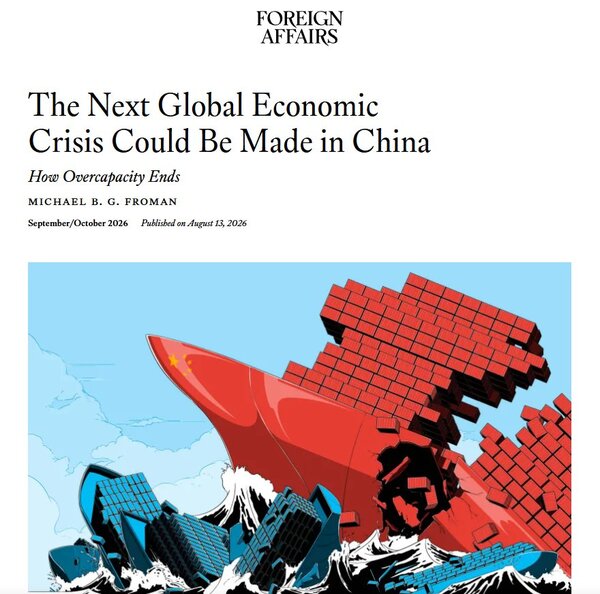
In an article titled “The Next Global Economic Crisis Could Be Made in China,” published in the September/October issue of Foreign Affairs, Michael Froman, President of the Council on Foreign Relations (CFR), assessed that “the world is nearing the limit of its capacity to absorb China’s overcapacity.” He noted that “the growth model forged by the Chinese Communist Party—reliant on investment, production, and state subsidies rather than consumption and market forces—has entered an arithmetically unsustainable stage.”
Froman previously served as United States Trade Representative (USTR) during the Barack Obama administration and earlier as Deputy Assistant to the President for International Economic Affairs at the National Security Council (NSC). He also personally led negotiations as the U.S. Sherpa at the 2009 London G20 Summit. In this light, his assessment carries distinct weight: it is not a simple hawkish call to pressure Beijing, but a structural warning grounded in the sheer scale of the Chinese economy and global demand.
[China’s Trade Surplus Expands Three Times Faster Than Global Demand]
The core of the issue raised by Froman is an "arithmetic boundary" that precedes political backlash. When China’s economy was smaller, an export expansion strategy growing two to three times faster than global GDP was feasible. However, now that China has grown into the world’s largest manufacturing power, the global economy cannot absorb an unlimited supply of Chinese goods indefinitely.
In this regard, Reuters pointed out that “China’s merchandise trade surplus in 2025 reached a record high of approximately $1.2 trillion,” noting that “it was the result of companies dumping goods into overseas markets rather than cutting production amid a real estate slump and sluggish domestic demand.” Reuters added, “In contrast, the IMF projected global economic growth at around 3.0% in July. While global demand grows around 3%, China’s exports and trade surplus are expanding much faster, widening the gap between supply and demand.”
According to Foreign Affairs, Yasheng Huang, a professor at the Massachusetts Institute of Technology (MIT) and expert on the Chinese economy, characterizes this structure as an “absolute advantage economy.” China competes head-to-head with the U.S. and Europe in high-tech sectors like AI, batteries, and electric vehicles (EVs), while simultaneously competing with developing nations in Africa and Southeast Asia in low-value-added industries like textiles, apparel, and toys. In effect, a distorted manufacturing structure has emerged that erodes jobs and market share across virtually all industries in every nation at the same time.
The United Nations Industrial Development Organization (UNIDO) projected that “China already accounts for about 30% of global industrial production, a figure that could reach 45% by 2030.” Aside from the United States immediately following World War II, there is virtually no precedent for such an immense concentration of industrial power in a single country. Furthermore, an OECD analysis revealed that approximately 60% of the market share gains achieved by surveyed Chinese firms between 2005 and 2023 can be attributed to the impact of government subsidies.
[Overcapacity Explodes in Solar and EVs]
Foreign Affairs noted that “China’s overcapacity is particularly acute in sectors designated by Beijing as strategic industries.” It added, “China’s annual production capacity for solar equipment stands at roughly 1,200 gigawatts (GW)—nearly double the total volume installed globally in a year. In effect, factories capable of producing far more solar equipment than the world actually needs are already up and running inside China.”
The automotive sector is even more extreme. China possesses facilities capable of producing approximately 25 million electric vehicles and plug-in hybrids annually, yet internal domestic demand for new energy vehicles falls far short of this capacity. Including internal combustion engine vehicles, China’s total automotive production capacity stands at approximately 55 million units per year—accounting for 60% of the total global market of roughly 90 million units. For Chinese factories to operate at normal capacity, Chinese-made vehicles would effectively need to capture more than half of the entire global auto market.
The China Association of Automobile Manufacturers (CAAM) projected that “China’s auto exports could surpass 10 million units for the first time this year.” This represents an increase of over 40% compared to roughly 7.1 million units in 2025. Reuters highlighted that “In July, China’s domestic vehicle sales dropped 21.1% year-on-year, while exports surged by 88.2%,” adding that “by offloading unsold domestic inventory abroad, China’s economic downturn is being converted into structural adjustment pressure on the global automotive industry.”
The impact is already materializing in Europe. Reuters reported that “Volkswagen considered plans involving job cuts of up to 100,000 employees and halting production at four factories in Germany.” It further noted, “Although the supervisory board temporarily withheld approval for immediate plant closures, additional headcount reductions, capacity cutbacks, and the long-term survival of those plants remain unresolved.” European automakers, including Volkswagen, are now facing double pressure: after losing market share inside China, they must now fight off low-cost Chinese vehicles in their home markets.
[If Chinese Factories Idle, Commodity Exporters Will Collapse]
However, a sharp reduction in Chinese production could be equally disastrous for the world economy. If Chinese factories grinding to a halt leads to widespread bankruptcies of loss-making enterprises, rising unemployment, shrinking local government revenue, and the worsening of real estate and financial distress, the fallouts will trigger simultaneously. A steep drop in production and investment—the main pillars of China's economy—would cause global demand for raw materials such as iron ore, copper, and crude oil to plummet.
Froman cited the 2012–2015 slowdown in China’s fixed-asset investment, during which copper prices tumbled by over 40%, crude oil by more than 60%, and iron ore by over 70%. Australia, Brazil, and Chile rely on China for 25% to 40% of their total exports, while countries like Angola, the Democratic Republic of the Congo, and Mongolia exhibit a dependence ranging from 45% to 90%. This serves as a warning that if China begins adjusting its production downward, it will not only bring down Chinese firms, but also set off a chain reaction destabilizing the public finances, currencies, and employment of commodity-exporting nations.
[U.S. Auto Industry Unreassured Even with 127.5% Tariffs]
Amid this sense of urgency, the American International Automobile Dealers Association (AIADA) launched the “No China Autos” campaign on August 5, advocating for a permanent ban on Chinese automakers entering the U.S. market. The AIADA argued that “Chinese manufacturers are not seeking to merely take a slice of the U.S. auto market; they aim to dominate the entire market leveraging massive government subsidies and overcapacity.”
The United States currently applies a standard tariff of 27.5% on regular Chinese passenger cars, and tariffs totaling up to 127.5% on Chinese EVs—acting as a de facto embargo. Furthermore, Washington is phasing in restrictions on imports and sales of vehicles equipped with connected-car technology linked to China or Russia. Nevertheless, the fact that U.S. auto distributors are demanding a permanent ban stems from the fear that tariffs alone cannot block China's overcapacity and roundabout market entry.
As a solution, Froman proposed multilateral coordination akin to the 1985 Plaza Accord. He suggested that the U.S. and key global economies demand verifiable reforms from Beijing, including a phased appreciation of the RMB, reductions in industrial subsidies, expansion of the social safety net, and increased household consumption. Predictions have emerged that the upcoming G20 Summit in Miami, scheduled for December 10–12, could serve as an occasion to discuss a potential “Plaza Accord 2.0.”
However, Jamieson Greer, the U.S. Trade Representative, expressed skepticism about the likelihood of China fundamentally altering its growth model, leaning instead toward negotiating individual items such as soybeans, energy, and aircraft. The Xi Jinping regime also views state-driven manufacturing not merely as an economic policy, but as a core governance strategy to win the geopolitical rivalry against the United States. Consequently, the likelihood that Beijing will voluntarily scale back subsidies and production facilities remains low.
[Why Times Insight]
What makes Froman’s warning chilling is that China’s overcapacity presents a crisis whether it succeeds or fails. If China continues to pour subsidies into keeping factories running, a flood of cheap Chinese products will crush global manufacturing sectors and jobs. Conversely, if blocked by trade barriers and forced to halt production, corporate insolvencies, local government debt, and real estate and financial bad loans will erupt all at once—sending shockwaves through commodity-exporting nations and global financial markets.
This is not a simple economic slowdown in China. It signifies that the entire growth model created by the Chinese Communist Party—choosing investment and production over consumption, and subsidies and state control over market mechanisms—has reached its arithmetic limit. It is precisely this fear that drove the American auto industry to demand a permanent ban on Chinese cars even before they enter the market in earnest. The pressure from Chinese overcapacity has intensified to a point where even a 127.5% tariff offers no peace of mind.
While the Miami G20 Summit could potentially serve as a starting point for a “Plaza Accord 2.0,” the probability that the Xi Jinping regime will voluntarily abandon its core strategy of state-led manufacturing is slim. Ultimately, rather than merely waiting for a policy pivot from Beijing, the world must simultaneously prepare for two scenarios: a "Second China Shock" triggered by an influx of Chinese goods, and a "China-originated economic crisis" brought on by the stalling of China’s growth model. Froman’s warning that the next global economic crisis could start in China is no longer a mere hypothesis, but an unfolding, realistic scenario.


-중국 푸단대학교 한국연구원 객좌교수
-전 EDUIN News 대표
-전 OUR NEWS 대표
-제17대 대통령직인수위원회 정책기획팀장
-전 대통령실 홍보기획비서관
-사단법인 한국가정상담연구소 이사장
-저서: 북한급변사태와 한반도통일, 2012 다시우파다, 선거마케팅, 한국의 정치광고, 국회의원 선거매뉴얼 등 50여권



