


Update2026.10.24 (토)

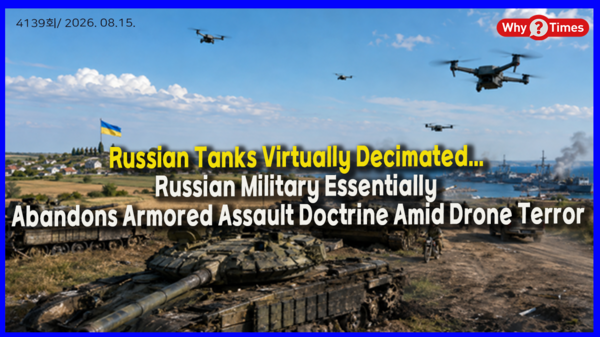
[Russian Forces Virtually Abandon Large-Scale Mechanized Attacks This Summer]
Paralyzed by the fear of drones, the Russian military has virtually abandoned large-scale armored assaults this summer. The Russian armored forces, which once touted themselves as the world’s strongest, have degenerated into a "demechanized military" that deploys motorcycles, civilian trucks, and even solitary infantrymen in place of tanks. Meanwhile, the Ukrainian military announced that it struck Novorossiysk—a key stronghold of Russia's Black Sea Fleet—damaging four warships, and reclaimed 745 km² of territory along with 26 villages on the southeastern front. This is precisely why analysts suggest the Putin regime, having lost tanks, warships, and elite troops simultaneously, is now in a position where it can hardly maintain the frontline without North Korean troops.
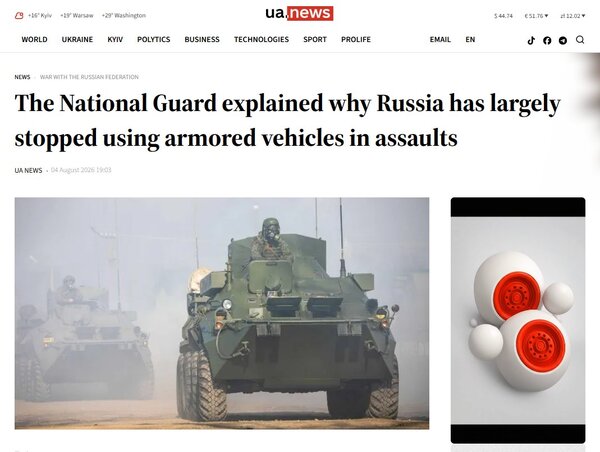
UA.News, an independent Ukrainian online media outlet, recently drew attention by reporting: "Ruslan Muzychuk, spokesman for the National Guard of Ukraine, stated that the frequency of armored vehicle usage by the Russian military in offensive operations is steadily declining, and that they virtually conducted no large-scale mechanized attacks during this summer's operational period." The report added: "Instead, the main tactic has solidified into small infantry squads or individual soldiers covertly approaching to accumulate force at specific points before attempting localized breakthroughs." UA.News further noted, "This tactic exploits the fact that while armored vehicles are immediately detected by reconnaissance drones, small infantry units moving along forests and trenches are relatively harder to spot."
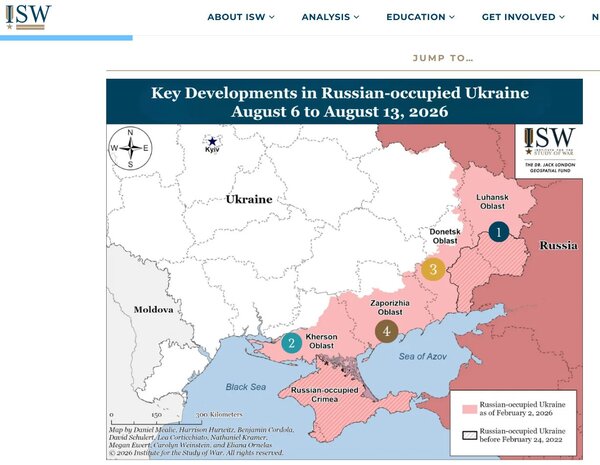
This claim has been repeatedly confirmed by recent battlefield developments. The Institute for the Study of War (ISW), a U.S.-based think tank, analyzed in its latest campaign assessment: "Russian forces across the front are favoring infiltration operations using small infantry groups rather than large-scale armored units." The ISW added, "Some Russian infiltration teams penetrated up to 10 km inside Ukrainian defensive lines," noting that "while armored vehicles are instantly spotted by reconnaissance drones, small numbers of infantry can evade surveillance networks by moving through forests, trenches, and between buildings."
However, the penetration of Russian infiltration teams inside Ukrainian lines does not mean they have fully captured those areas. The ISW emphasized, "A distinction must be made between Russian infiltration areas and actual control zones," pointing out that "while small infantry groups can slip through gaps in Ukrainian defenses, it is difficult to hold captured ground without heavy weapons, reliable supply networks, and follow-on forces." This serves not as evidence that the Russian army has restored its capacity to breach frontlines, but rather as proof that it is relying on tactics that trade soldiers' lives to probe small openings in lieu of armored units.
[The Ultimate Resort: Consuming Human Lives to Preserve Tanks]
Traditional Russian offensive doctrine dictated that tanks and armored vehicles would shatter enemy defensive lines, after which follow-on mechanized units would widen the breach. However, on the Ukrainian battlefield, reconnaissance drones track tanks in real time from their departure to their movement routes, after which FPV drones, landmines, and artillery destroy them one by one. The moment a large-scale armored formation massed, it effectively handed the Ukrainian military a prime target.
Ultimately, Russian command opted to push soldiers into the battlefield one or two at a time instead of risking expensive tanks and armored vehicles. Small infiltration teams crawl through forests and ruins for days to sneak behind Ukrainian positions, receiving food and ammunition via drones while waiting for forces to build up. However, a significant portion of these troops are detected and eliminated by Ukrainian drones before ever reaching their destinations. This is virtually a human-wave tactic that uses people as expendable assets to protect tanks.
While such tactics can yield temporary infiltration gains in certain sectors if heavy casualties are accepted, converting an infiltration area into actual captured territory requires armored vehicles, artillery, combat engineers, and logistics units to follow up. It is at that exact stage where the Russian military is blocked by Ukraine's drone defense network. "Demechanized warfare" is less an innovation by the Russian military and more a desperate stopgap chosen by an army that has lost its capability to breach lines behind armor.
[First Large-Scale Armored Assault in Months Destroyed in a Matter of Hours]
An event proving this occurred on July 22 around Shaknove in Donetsk Oblast. Forbes reported: "The Russian military launched its largest mechanized assault in months, deploying tanks, armored vehicles, BM-21 Grad and Tornado-S multiple rocket launchers, as well as civilian truck and motorcycle units." The outlet noted, "Unlike early in the war, they attempted to evade drone attacks by widening vehicle spacing and dispersing across multiple axes, while launching Gerbera and Lancet drones beforehand to disrupt Ukrainian unmanned aerial vehicle (UAV) operations."
However, Forbes added: "Ukrainian reconnaissance drones detected the Russian approach early on, after which FPV drones, heavy bomber drones, artillery, and minefields hit the Russian armored column sequentially. This attack reportedly resulted in the destruction of 7 Russian tanks, 6 armored vehicles, 2 multiple rocket launchers, and 47 vehicles of various types, along with over 150 casualties." A large-scale armored assault that the Russian military had painstaking prepared crumbled in just a few hours.
Tanks have not vanished entirely. The Russian military uses some tanks as mobile artillery firing indirectly from up to 10 km behind the front line, or operates them in a "roaming tank" fashion where they fire a few rounds and relocate. However, this signifies that tanks have been demoted from main assault weapons that break through enemy lines to rear fire-support assets. The recent drop in confirmed losses of Russia's cutting-edge T-90 series tanks is likely not a result of improved survivability, but rather a consequence of reduced forward deployment itself.
[Ukraine Strikes 4 Warships, Pursuing Black Sea Fleet even to Its Haven]
Equally shocking as the exhaustion of ground forces is the defensive posture of the Russian Navy. The Associated Press noted: "On the 12th, the Ukrainian military combined jet-powered Palianytsia drones, Neptune anti-ship missiles, and naval drones to attack the Novorossiysk Naval Base, a key stronghold of Russia's Black Sea Fleet," adding that "Novorossiysk was a de facto haven where main vessels of the Russian Black Sea Fleet had relocated to escape Ukrainian attacks on the Crimean Peninsula."
The Kyiv Independent also reported: "The Ukrainian military announced that two Project 11356 frigates—Admiral Makarov and Admiral Essen—one Buyan-M class corvette, and one Vasily Bykov-class patrol ship suffered damage." It noted, "While Russia did not officially confirm the warship damage, air defense facilities and pier/port infrastructure were attacked, and traces of fire near the submarine pier were captured in satellite imagery." If Ukraine's announcement is verified, it means the Russian Black Sea Fleet suffered damage to four combat ships in a single strike.
This implies that after being pushed out of the Crimean Peninsula, the Russian Navy can no longer be guaranteed safety even in ports on the Russian mainland. Ukraine, which virtually lacked naval power at the start of the war, has driven the Russian Black Sea Fleet into port using self-developed missiles and naval drones. Russia is now in a position where it must expend more resources on protecting the ships themselves rather than deploying the Black Sea Fleet to attack Ukraine.
[Ukraine Recaptures 745 km² and 26 Villages... Braking Russian Offensive]
The dynamics of the ground war are also shifting. Ukrainian President Volodymyr Zelenskyy stated: "Through offensives conducted on the Oleksandriivka front from January to August this year, we have recaptured over 745 km² of territory and 26 villages." Regarding this, Reuters pointed out: "The recaptured areas include 12 in Dnipropetrovsk Oblast, 10 in Donetsk Oblast, and 4 in Zaporizhzhia Oblast. Ukrainian forces also conducted search-and-clearance operations over 300 km² in the rear where Russian infiltration teams had entered."
The independent battlefield tracking group DeepState also confirmed that "Ukrainian forces recaptured 19 villages and pushed Russian troops back in 6 other areas." However, assessments of recent territorial changes vary depending on the analytical organization. While DeepState data indicates that Russian forces made a net expansion of some territory from August 4 to 11, analyses applying ISW data show that Russia suffered a net loss of occupied territory during the same period. What is certain is that despite deploying vast amounts of manpower and equipment, the Russian military is failing to unilaterally push the Ukrainian front.
[North Korean Troops Instead of Tanks... A Decisive Scene Showing Russia's Exhaustion]
In this context, assertions that Russia is requesting additional large-scale troop deployments from North Korea are drawing attention. Defense News noted: "North Korea has already sent approximately 14,000 to 15,000 troops to the Kursk region of Russia since 2024 to support Russian military operations to reclaim territory," adding that "Russia and North Korea officially acknowledged the participation of North Korean troops in the Kursk battles in April 2025."
President Zelenskyy recently warned that "North Korea could send up to 50,000 additional troops to Russia." Regarding this, The Guardian pointed out: "If combat troops are deployed on a large scale following North Korean artillery shells and KN-23 series ballistic missiles, Russia's war can no longer be called Russia's war alone," adding that "it signifies that Russia is transitioning into a structure where it can hardly sustain its offensive without North Korean weapons and manpower."
If a military power with a population of 140 million must be supplied with artillery shells, missiles, and soldiers by North Korea—a nation of 26 million—this is not a display of alliance, but a scene demonstrating the exhaustion of the Russian military. The reason Russia requests North Korean troops is not simply because having more manpower is advantageous; it allows the Russian leadership to offload the domestic political burden of casualties and additional mobilization onto North Korean soldiers.
[Why Times Insight]
Russia's "demechanization" should not be interpreted merely as a tactical shift. Tanks have disappeared from the front lines due to drones, and the Black Sea Fleet—after being driven out of Crimea—has taken hits even in its mainland refuge. On land, Ukraine has reclaimed 745 km² and 26 villages, while Russia is attempting to bring back North Korean troops to fill its depleted ranks. The three pillars of waging war—tanks, warships, and manpower—are shaking simultaneously.
Of course, it cannot be concluded that Russia will collapse immediately or lose all war-fighting capabilities. Russia still maintains large-scale missile and drone strikes as well as long-range firepower. However, today's Russian military is not an army charging toward victory; it resembles an army hiding its tanks, expending its infantry, and plugging gaps with North Korean forces just to hold onto the front line.
It is precisely at this point that assessments of Putin's dwindling political longevity emerge. The war Putin initiated by staking the legitimacy of his regime has, far from proving the greatness of the Russian military, turned into a war sustained only by reliance on North Korean shells, missiles, and troops. While Ukraine strikes Russian warships and reclaims lost territory, the sight of the Russian military shoving infantrymen one or two at a time into deadly battlefields instead of tanks symbolically shows where the initiative of the war is shifting. It is not that Putin's time to win is diminishing—the time he has left to simply endure the war is rapidly running out.


-중국 푸단대학교 한국연구원 객좌교수
-전 EDUIN News 대표
-전 OUR NEWS 대표
-제17대 대통령직인수위원회 정책기획팀장
-전 대통령실 홍보기획비서관
-사단법인 한국가정상담연구소 이사장
-저서: 북한급변사태와 한반도통일, 2012 다시우파다, 선거마케팅, 한국의 정치광고, 국회의원 선거매뉴얼 등 50여권



