Update2026.10.24 (토)

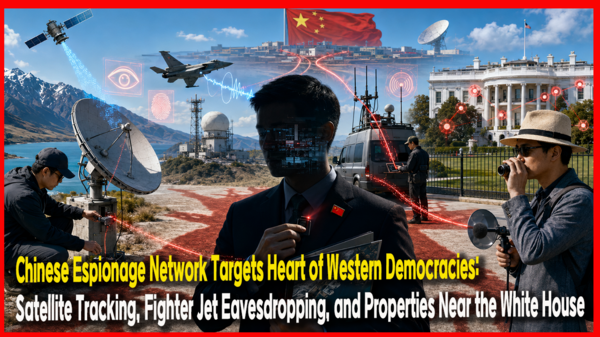
[New Zealand: "China is the only state conducting espionage at scale"]
New Zealand’s intelligence service has officially designated China as the sole nation conducting espionage "at scale" within its borders. A Chinese state-linked institution attempted to leverage a private local contractor to deploy ground-based space infrastructure capable of collecting intelligence of military value.
This issue extends far beyond New Zealand. In South Korea, two former members of China’s People's Liberation Army (PLA) were recently arrested on charges of gathering military intelligence on South Korean and US forces, demonstrating that Beijing’s information warfare directly targets critical security infrastructure in South Korea and US Forces Korea (USFK).
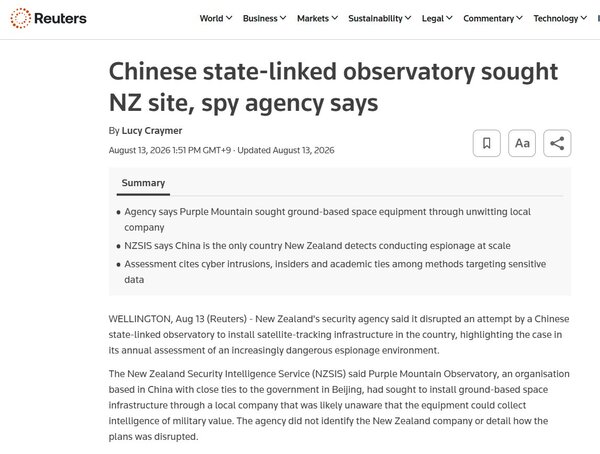
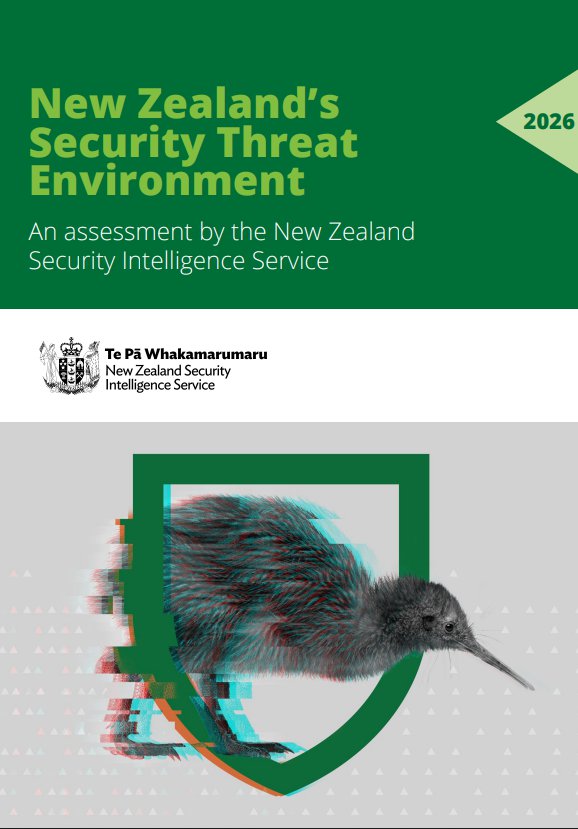
Reuters reported on the 14th that the New Zealand Security Intelligence Service (NZSIS) released its annual assessment, "Security Threat Environment 2026," on the 13th. The report explicitly noted that while multiple foreign states conduct espionage in New Zealand, China is the only one detected operating at scale. Although China remains New Zealand's largest trading partner, Wellington’s intelligence agency publicly identified Beijing as the most active foreign interference actor despite these economic ties.
NZSIS Director-General Andrew Hampton highlighted that malicious activities targeting New Zealand have grown significantly more brazen over the past 12 months. He noted that Chinese intelligence services employ cyber intrusions, insider recruitment, academic partnerships, recruitment agencies, shell companies, and commercial brokers to target confidential information and advanced technologies from government bodies, universities, and private enterprises. This underlines a paradigm shift: Beijing's intelligence apparatus no longer relies solely on traditional, diplomatic-cover spies.
[Purple Mountain Observatory Attempted Space Infrastructure Acquisition via Front Company]
The report highlighted a specific case involving the Purple Mountain Observatory, an institution with close ties to the Chinese government. The NZSIS revealed that the China-based observatory attempted to install ground-based space infrastructure through a local New Zealand company—which likely did not realize the equipment could collect military-grade intelligence. The agency did not disclose the local company's identity or the exact methods used to disrupt the operation.
New Zealand’s geographical position in the South Pacific makes it ideal for ground facilities that track satellites, space objects, and orbital debris. Consequently, equipment installed under the guise of astronomical research or scientific cooperation can be repurposed by the Chinese military to track satellite orbits, monitor US and allied space assets, and analyze military satellite operations. The line between civilian research observation and military space intelligence has effectively vanished.
Furthermore, China’s National Intelligence Law obligates all domestic individuals and organizations to assist state intelligence efforts. Even when Chinese entities operate under the banner of "private companies" or "academic institutions," they cannot be considered independent of the Chinese Communist Party (CCP), the military, or state intelligence. Under Beijing’s Civil-Military Fusion strategy, civilian technology and research data can be co-opted at any moment for national security and military capabilities.
Chinese intelligence operatives have also been detected posing as consultants, think-tank analysts, or recruiters on professional networking platforms to approach current and former civil servants. Initially, targets are offered standard consulting fees for summarizing open-source data. Once trust is established, operatives request internal documents, policy deliberation details, profiles and networks of government officials, and non-public meeting notes. This represents classic "gray-zone intelligence operations," where academic exchanges, job offers, and private business deals serve as gateways for recruitment.
[South Korea Infiltrated: Ex-PLA Personnel Intercept Fighter Jet Communications]
In South Korea, the situation is equally alarming. On the 11th, the Gyeonggi Nambu Provincial Police Agency announced the arrest of two Chinese nationals—both former PLA soldiers—on charges of collecting military intelligence on South Korean and US forces. One suspect in his 60s was caught operating a Software Defined Radio (SDR) receiver, an antenna, and a laptop from a hotel room just one kilometer from Gunsan Air Base, intercepting communications between allied fighter jets and the control tower.
Police are investigating whether the suspect collected intelligence across various domestic military installations starting in 2024. Long-term interception of military radio traffic enables analysts to determine sortie schedules, training patterns, and operational cycles. Even if individual radio transmissions are not top-secret, accumulating them over time allows foreign intelligence to deduce the operational readiness and training schedules of the ROK-US Combined Forces.
The second suspect, a former PLA member in his 40s, reportedly used personal relationships with South Korean personnel involved in USFK operations—providing cash and gifts in exchange for classified materials on joint ROK-US exercises, US military asset movements, and personnel shifts. This represents a classic intelligence operation combining electronic eavesdropping with insider recruitment. Police are currently tracing whether the collected data was transmitted to Chinese authorities and whether an overarching command-and-control structure exists behind the operation.
This is not an isolated incident. The National Intelligence Service (NIS) reported to the National Assembly that since June 2024, there have been at least 11 recorded cases of Chinese nationals illegally photographing critical national facilities, including South Korean military bases, airports, seaports, and the NIS headquarters itself. In one instance, Chinese international students used drones to film a US aircraft carrier docked in Busan; in another, individuals caught repeatedly photographing fighter jets near Suwon and Osan resumed the same activities shortly after being released.
These actions cannot be dismissed as mere tourism or accidental photography. Because the targets and methods repeat, accumulating photographs of military bases and US assets allows foreign entities to map perimeter security, guard posts, aircraft placements, entry/exit times, and response protocols. Repeated low-intensity intelligence collection serves to test counterintelligence responses while dulling societal vigilance.
In another instance, the South Korean military discovered that approximately 1,300 Chinese-manufactured surveillance cameras installed on military bases were designed to transmit video feeds to specific servers in China, leading to their immediate removal. Although no actual data leaks were confirmed, the fact that security equipment meant to protect military installations could serve as an external surveillance pipeline sent shockwaves through the defense establishment. Chinese intelligence operations utilize not just human assets and drones, but telecommunications hardware, CCTV systems, software, and data servers.
[Legal Loophole: South Korea Unable to Prosecute Chinese Operatives for Espionage]
Despite the severity of these actions, the arrested former PLA personnel were charged under general assistance to the enemy (general treason) provisions rather than espionage laws. Under South Korea's historical Criminal Act, espionage charges applied strictly to acts committed for an "enemy state"—which legally applied only to North Korea. Consequently, intelligence activities conducted on behalf of China or other foreign nations could not be prosecuted under espionage charges.
While an amended Criminal Act that expands prosecution to espionage conducted for any foreign government or entity is set to take effect on September 13, it cannot be applied retroactively to this case.
This has resulted in an institutional paradox: even when ex-PLA personnel intercept ROK-US fighter jet communications and collect joint exercise intelligence, they cannot be legally punished as "Chinese spies." South Korea’s counterintelligence framework focused almost exclusively on North Korea for decades, effectively leaving the door open to espionage by foreign intelligence agencies from nations like China and Russia.
The implementation of the amended espionage law alone will not be enough. Chinese intelligence operations target not only military secrets, but also strategic commercial technologies—such as semiconductors, batteries, nuclear power, shipbuilding, and aerospace—alongside policy documents and ROK-US alliance operational data. The theft of key industrial technology transferred to China must be treated as a national security crime whenever it feeds into Beijing's Civil-Military Fusion strategy.
[Property Purchased 200m From the White House: US Heightens Vigilance]
China’s expanding espionage footprint has also put the United States on high alert. On the 13th, the Daily Caller News Foundation (DCNF) reported exclusively that a foundation led by a Chinese national—who previously served in organizations tied to Chinese public security, national security, and the United Front Work Department—purchased a property located approximately 198 meters from the White House. Former CIA operations officers warned that the building could be utilized for signals interception (SIGINT) and human intelligence (HUMINT) collection.
In response to similar concerns, Reuters noted that the US has expanded the authority of the Committee on Foreign Investment in the United States (CFIUS) to review foreign real estate transactions near approximately 227 military sites. Washington previously ordered a Chinese-owned cryptocurrency firm to divest land purchased near a nuclear missile base. Performing background checks on real estate buyers, ultimate beneficial owners, funding sources, and affiliations with foreign governments, militaries, or intelligence agencies near the White House, intelligence facilities, and military installations has become a standard security measure.
[Why Times Insight] The Moment You Close Your Eyes, "Exchange" Becomes an Infiltration Vector
Whenever espionage allegations arise, Beijing routinely responds by claiming that Western nations are "politicizing normal exchanges." However, the front-company schemes uncovered in New Zealand, combined with the military communications interception and insider recruitment exposed in South Korea, demonstrate that Western concerns are not driven merely by anti-China sentiment. Chinese intelligence operations systematically target channels that open societies find difficult to block: academic institutions, private enterprises, cultural organizations, recruitment platforms, and real estate.
South Korea cannot afford complacency simply because an updated espionage law is taking effect. The government must simultaneously establish:
Security Vetting: Comprehensive security reviews for foreign real estate purchases or long-term leases near critical national infrastructure.
Equipment Controls: Strict controls on drones, high-performance photography equipment, and radio frequency receivers near military sites.
Supply Chain Verification: Rigorous verification of telecommunications and surveillance equipment manufactured in China.
Funding Disclosure: Mandatory disclosures regarding foreign funding and joint research projects at key research institutes.
Reporting Systems: Suspicious recruitment reporting mechanisms targeting current and former public officials.
Around military bases, intelligence facilities, semiconductor plants, nuclear reactors, and shipyards, repeated photography and radio signal collection must not be treated as minor, isolated offenses. Instead, they must be analyzed as coordinated, linked intelligence-gathering operations.
Extending blanket bans on all transactions or research simply because an individual is Chinese is not the solution. What is required is not vague suspicion based on nationality, but precise, criteria-based screening focused on links to the Chinese government, military, or intelligence agencies, ultimate ownership structures, financial flows, and device data transmission pathways. Openness is the core strength of a democracy—but allowing hostile intelligence agencies to weaponize that openness is not tolerance; it is a dereliction of national security duties.

-중국 푸단대학교 한국연구원 객좌교수
-전 EDUIN News 대표
-전 OUR NEWS 대표
-제17대 대통령직인수위원회 정책기획팀장
-전 대통령실 홍보기획비서관
-사단법인 한국가정상담연구소 이사장
-저서: 북한급변사태와 한반도통일, 2012 다시우파다, 선거마케팅, 한국의 정치광고, 국회의원 선거매뉴얼 등 50여권