


Update2026.10.24 (토)

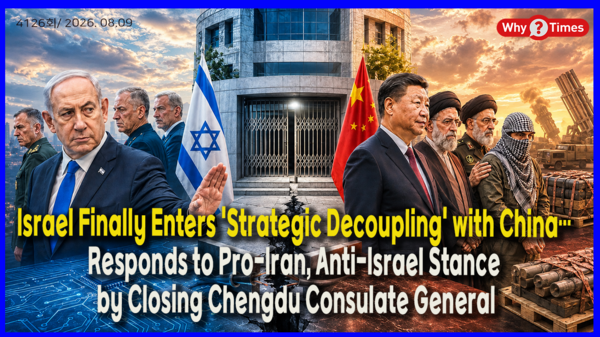
[Israel Decides to No Longer Trust China]
Israel has closed its Consulate General in Chengdu, China. While appearing on the surface as a routine restructuring of overseas diplomatic missions, the underlying rationale stems from Israel’s pragmatic determination that China can no longer be trusted as a strategic partner. In particular, after demonstrating an overtly pro-Palestinian and anti-Israeli stance following the Gaza War, China’s involvement in supporting the reconstruction of the air defense network of Iran—Israel’s primary adversary—has pushed bilateral relations toward a point of no return.
The closure of the Chengdu Consulate General is not a sudden severance. Since 2019, Israel has systematically severed ties involving Chinese capital and advanced technology. This "strategic decoupling" has now progressed beyond technology, investment, and infrastructure to the visible stage of reducing diplomatic missions. While China effectively shielded Iran and Hamas, Israel began viewing China not as an economic opportunity, but as a risk factor capable of threatening its own national security.
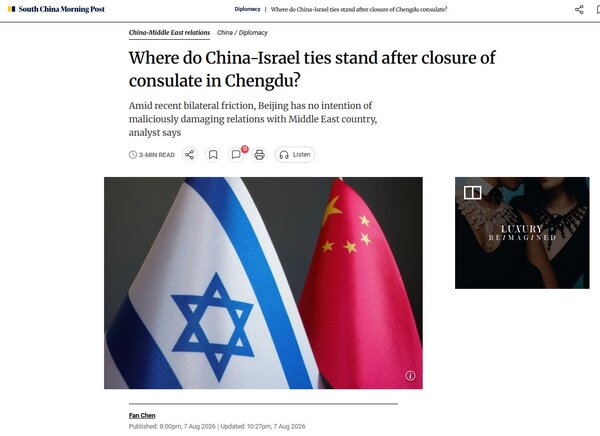
Reports on August 7 confirmed that "The Israeli Consulate General in Chengdu completely suspended operations in July, and Consul General Gadi Harpaz departed China after completing his five-year tenure." It was noted that "In his farewell letter, Consul General Harpaz stated, 'The five years spent in Chengdu were the most memorable of my diplomatic career,' adding, 'Although the Consulate General is closing, the friendship and mutual respect we have built will not vanish.'" However, rhetoric aside, the political signal conveyed by the closure of this diplomatic post is weighty.
The Israeli Ministry of Foreign Affairs had already canceled its job posting for the Head of the Chengdu Consulate General in late 2025. At the time, Oslo and Chengdu were both considered candidates for closure, but China was ultimately selected. Consequently, Israel’s diplomatic network in China has been scaled down to a four-post system: the Embassy in Beijing alongside Consulates General in Shanghai, Guangzhou, and Hong Kong. The Israeli government officially announced the closure of the Chengdu post and the cessation of consular services on June 24.
What matters more than the disappearance of a single diplomatic mission is the fact that the target was China. While deploying new missions to regions like Fiji, Bolivia, and parts of Africa, Israel chose to relinquish a key diplomatic hub in western China. This indicates that China’s value has diminished significantly in terms of strategic priorities regarding where limited diplomatic resources should be allocated or withdrawn.
[China Shields Hamas and Embraces Iran]
China’s Middle East policy served as the decisive factor in worsening bilateral relations. Following Hamas’s surprise attack on Israel in October 2023, China abstained from directly condemning Hamas, focusing its criticism heavily on the Palestinian issue and Israel’s military operations. Chinese Foreign Minister Wang Yi publicly criticized Israel’s military response in the Gaza Strip, stating that it "went beyond the scope of self-defense."
From Israel’s perspective, this was not neutral diplomacy. Failing to unequivocally condemn Hamas—which slaughtered civilians and took hostages—while taking issue solely with Israel’s response was interpreted as effectively bolstering the anti-Israel front constructed by Hamas and Iran. Furthermore, while anti-Semitic and anti-Israel sentiments spread across Chinese online spaces, the lack of active suppression by Chinese authorities deepened mistrust.
The decisive blow involved Iran. While diplomatically demanding that Israel halt its attacks, evidence emerged indicating that China was assisting Iran in restoring the air defense capabilities it lost during the war. Reports on July 29 indicated that "Iran is expected to receive up to 400 Chinese man-portable air defense missile systems within weeks." The deal is valued between $60 million and $70 million, reportedly including QW-12 and FN-16 systems.
These weapons are not mere defensive hardware. They directly threaten the operations of Israeli fighter jets and unmanned aerial vehicles, serving as a means to rebuild the Iranian air defense grid shattered by U.S. and Israeli airstrikes. Although China denies these allegations, Israel perceives the potential targeting of its pilots and military operations by Chinese-made weaponry as a grave security threat.
While advocating for "Middle East peace" on one hand, China is rearming Israel’s chief enemy on the other. In Israel’s view, China is no longer a distant mediator, but a rear-support nation bolstering Iran’s survivability and capacity to sustain war.
[From a Relationship of Technology Transfer to Technology Blocking]
Israel and China once maintained close economic and technological cooperation. China showed interest in Israel’s advanced agricultural, telecommunications, semiconductor, artificial intelligence, and cyber technologies, while Israeli companies viewed China’s vast market and capital as new engines for growth.
However, the atmosphere shifted as Chinese investments expanded into sectors directly tied to national security, such as ports, transportation, insurance, and semiconductors. The United States also issued stern warnings that Israel’s advanced technologies and military know-how could leak to China.
In 2019, Israel established a committee to review the national security impact of foreign investments and subsequently blocked successive acquisition attempts of Phoenix Holdings and Clal Insurance by Chinese-linked capital. In 2022, Chinese companies were excluded from the Tel Aviv Light Rail project, and the ownership threshold requiring foreign investment screening was lowered from 50% down to 20%, and as low as 5% for sensitive matters. Although no specific country was named on paper, this was a defensive shield aimed at Chinese capital.
As a result, Chinese investment in Israel plummeted after peaking in 2018. Israel’s semiconductor exports to China were also scaled back. Israel—which once sold technology to China and attracted Chinese capital—has now transformed into a nation that actively monitors and blocks Chinese investment and technological access.
While the primary driver of this early decoupling was U.S. pressure and concerns over dual-use technology leaks, its nature evolved following the Gaza War. China’s pro-Iran, pro-Hamas posture and anti-Israel diplomacy triggered an explosion of security mistrust within Israel itself. The dynamic transitioned from exercising caution toward China due to Washington to Israel independently designating China as a potential security threat.
[Maintaining Trade while Severing Strategic Trust]
Naturally, Israel and China are not severing all economic ties immediately. Bilateral trade volume reached a record high of $21.7 billion in 2025. China remains an important commercial trading partner for Israel, and Israeli enterprises cannot easily abandon the Chinese market entirely.
However, evaluating bilateral relations based solely on trade volume misses the core issue. Israel is pursuing selective decoupling—maintaining trade in general consumer items and non-sensitive goods, while incrementally scaling back advanced technology, strategic infrastructure, large-scale investments, and diplomatic footprints. In other words, while business with China continues, technology and security directly tied to national survival will no longer be entrusted to Beijing.
The closure of the Chengdu Consulate General is a tangible mapping of this diplomatic shift. Although Israel has not officially labeled China an enemy state, it has removed Beijing from its status as a friendly strategic partner. As China continues to embrace Iran and anti-Israel forces, Israel’s containment line against China is likely to expand further.
[Why Times Insight]
The closure of the Chengdu Consulate General is not the initial scene of Israel’s decoupling from China. It is a continuation of the blockage of Chinese capital and technology underway since 2019, serving as a decisive symbol that accumulated mistrust has spilled over into diplomatic missions.
The more critical shift lies in the rationale behind this decoupling. Where U.S. pressure and technological leak concerns previously dominated, the foreground is now occupied by the assessment that China provides military and diplomatic support to Iran—Israel’s actual hostile threat. China’s pro-Iran policy and anti-Israel diplomacy led Israel to conclude: "China is not only not on our side, but it is a nation restoring the military capabilities of our enemy."
China sought access to Israel’s advanced technology and market while simultaneously attempting to expand its leverage in the Middle East using Iran and Palestine as pivot points. However, this dual strategy ultimately shattered Israel’s trust. The lowering of the Israeli flag in Chengdu is not a routine diplomatic withdrawal. It serves as a stern warning that Israel’s "phased decoupling"—pushing China from a strategic partner into a national security risk—has entered a point of no return.

-중국 푸단대학교 한국연구원 객좌교수
-전 EDUIN News 대표
-전 OUR NEWS 대표
-제17대 대통령직인수위원회 정책기획팀장
-전 대통령실 홍보기획비서관
-사단법인 한국가정상담연구소 이사장
-저서: 북한급변사태와 한반도통일, 2012 다시우파다, 선거마케팅, 한국의 정치광고, 국회의원 선거매뉴얼 등 50여권



