Update2026.10.24 (토)

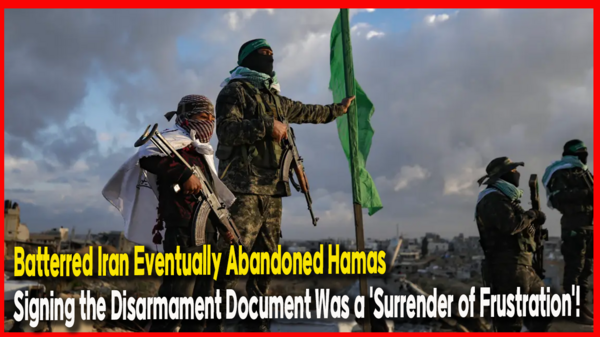
[Hamas Finally Surrenders… The Real Reason for Laying Down Arms Is 'Iran's Collapse']
Hamas has finally signed a document accepting disarmament for the first time since its founding. It has voluntarily laid down the path of armed struggle, which served as the group's raison d'être for decades. However, the essence of this signing is not a resolution toward peace, but rather a "surrender of frustration"—an admission of the reality that they no longer have the strength to fight, nor a benefactor left to support them to the end.
The decisive shift came from Iran. A senior US official flatly stated that Iran abandoned Hamas long ago. In fact, Iran dissuaded Hamas from agreeing to negotiations until the very last moment, but failed to provide the weapons, funds, and military support that Hamas desperately needed. Ultimately, Hamas sat down at the negotiating table, leaving Iran's dissuasion behind. The moment Hamas accepted the reality that a battered Iran could no longer protect them, virtually only one choice remained.
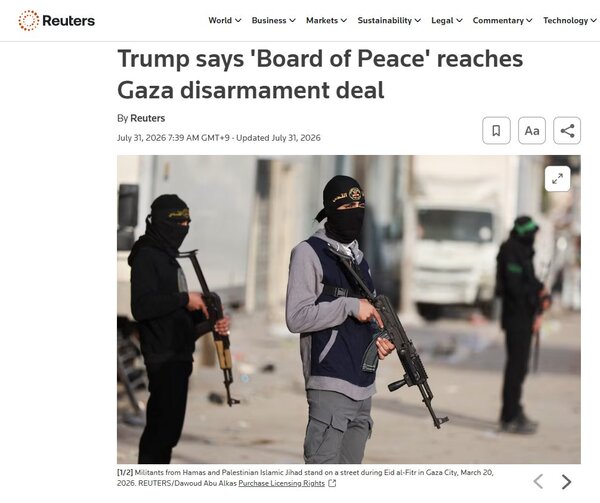
US President Donald Trump announced that the Board of Peace, an international entity he established, reached an agreement for the complete disarmament of Hamas and all other armed groups in Gaza.
Reports further noted that this agreement includes preparing a detailed implementation roadmap within 14 days and sequentially disarming and dismantling Gaza's underground tunnel network under international verification over roughly eight months. For Hamas, this represented the most significant shift in direction since its inception. However, to understand this agreement, one must first look at why Hamas laid down its arms now.
["Iran Abandoned Hamas Long Ago"… The Core of This Crisis]
The essence of this situation is encapsulated in the statement made by a senior US official.
A senior US official noted during a briefing that Iran did not want Hamas to accept this agreement, but Iran abandoned Hamas long ago. They no longer have the capacity to sustain Hamas, and Hamas has come to realize the reality that it must judge for itself what is best for its members and the Palestinian people.
This single statement symbolizes the shifting dynamics in the Middle East. Iran, which had served as Hamas's primary sponsor for decades, demanded until the very last moment that they "fight to the end." However, that was nothing more than a political slogan. Its ability to sustain the war by providing missiles, weaponry, and funds as in the past had already been severely weakened. The reality was demanding the continuation of war without supplying the means to fight it—and Hamas knew this fact better than anyone.
[Khamenei's Funeral… Iran's Final Dissuasion and Hamas's Resolve]
This reality was starkly displayed during Khamenei's funeral. Reports indicated that a Hamas delegation visited Iran to attend Khamenei's funeral, where Iranian officials repeatedly attempted to persuade them not to rush into signing the Board of Peace's proposal. The meeting reportedly took place between Iranian Foreign Minister Abbas Araghchi and Mohammad Ismail Darwish, Chairman of Hamas's highest decision-making body, the Shura Council.
However, Iran only offered words urging them to "continue resisting," while failing to provide any promises of sufficient weapons or funding moving forward. Ultimately, Hamas turned a deaf ear to Iran's dissuasion. This was not merely a change in negotiation strategy, but a decision recognizing the reality that their final sponsor could no longer protect them.
[Battered Iran… Lost Even the Capacity to Care for Hamas]
Why was Iran forced to virtually give up on Hamas? The answer lies in Iran's own predicament. Continuous US and Israeli airstrikes resulted in the death of Supreme Leader Khamenei, severely damaging the command-and-control structure of the Islamic Revolutionary Guard Corps (IRGC). Key energy infrastructure, including the South Pars gas field, was attacked, shaking the nation's economic foundation. Compounded by a plunging rial, hyperinflation, and disruptions in energy production, Iran found itself scrambling merely to preserve its own regime rather than supporting overseas armed proxies.
Ultimately, Iran did not abandon Hamas out of desire, but because it lost the capability to support them to the end. This is precisely the background behind the senior US official's remark that Iran abandoned Hamas long ago. Having lost its sponsor, Hamas ultimately chose 'survival' over 'resistance.'
Hamas's shift in attitude was dramatic. As recently as April, Hamas publicly declared that demands for disarmament were unacceptable under any circumstances. Yet, in just three months, it signed the negotiation document. Naturally, Hamas sought to preserve its final shred of dignity by setting conditions such as Israeli troop withdrawal, ceasefire implementation, and expanded humanitarian aid. However, rather than cards demonstrating leverage in negotiations, these conditions served more as a final line of defense to justify the historic decision to disarm.
US officials explained that a provision offering amnesty to Hamas members who accept Trump's 20-point plan was the key persuasive factor in sealing the deal. Ultimately, the survival of individual members became a far more urgent issue than the group's ideology.
[However, Hamas Has Gained Nothing Yet]
Even more ironic is that while Hamas agreed to lay down its arms, it has yet to secure the payoff in hand. The Israeli government has not officially approved the plan, and its cooperation remains uncertain. Backlash continues within Israel, and the military maintains its stance on continuing operations to eliminate remaining Hamas forces. In short, Hamas surrendered its organizational identity of armed struggle, yet has failed to secure the anticipated ceasefire, troop withdrawal, or political compensation in return.
[Why Times Insight]
To reach the conclusion directly: it is not simply that Hamas collapsed, but that Iran's 'Axis of Resistance' is crumbling. In other words, the essence of this disarmament signature is better understood not as a peace treaty, but as the surrender of an organization that lost its sponsor.
It was not Israeli military operations alone that pushed Hamas to the negotiating table. The decisive factor was the reality that Iran—which had sustained Hamas for decades—fell into a state where it could no longer maintain weapon supplies, funding, or military support. The senior US official's remark that Iran abandoned Hamas long ago is not mere diplomatic rhetoric, but a symbolic declaration demonstrating that the power structure of the Middle East is shifting.
Ultimately, Hamas chose the path of survival over Iran's demands to fight to the end. Yet, in exchange, it failed to secure a guaranteed Israeli withdrawal or a definitive ceasefire. Laying down its arms while being abandoned by its sponsor and failing to get what it wanted from its negotiating counterpart—this is the reality facing Hamas today.
What demands even greater attention is that this incident is not limited to Hamas alone. If Iran's strategic distancing from Hamas was not a deliberate choice but the result of losing the capacity to maintain proxy forces, this disarmament marks more than a defeat for Hamas; it is highly likely to become a turning point demonstrating that Iran's 'Axis of Resistance' strategy—which has shaken the Middle East for decades—has encountered a fundamental bottleneck. This is precisely why this event holds significance far beyond a simple ceasefire negotiation.

-중국 푸단대학교 한국연구원 객좌교수
-전 EDUIN News 대표
-전 OUR NEWS 대표
-제17대 대통령직인수위원회 정책기획팀장
-전 대통령실 홍보기획비서관
-사단법인 한국가정상담연구소 이사장
-저서: 북한급변사태와 한반도통일, 2012 다시우파다, 선거마케팅, 한국의 정치광고, 국회의원 선거매뉴얼 등 50여권