


Update2026.10.24 (토)

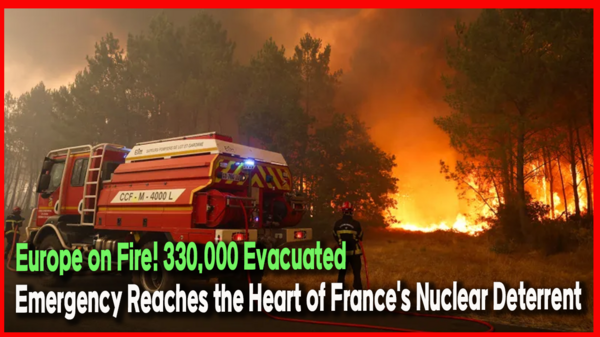
[330,000 Evacuated in France and Spain… Emergency Issued at SLBM, Fighter Jet, and Missile Production Bases]
A massive wildfire sweeping across Europe has expanded beyond forests and residential areas to directly threaten core facilities of France's nuclear deterrent and defense industrial base. Around 330,000 people were evacuated at peak levels across France and Spain, while evacuation orders and emergency protection measures were declared for submarine-launched ballistic missile (SLBM), fighter jet, and missile propellant production complexes located west of Bordeaux. In France, the fire generated pyrocumulonimbus clouds—creating its own gale-force winds and thunderstorms—demonstrating the unmanageable power of a "mega-fire" beyond standard firefighting capabilities. A climate disaster has officially transitioned into a national security crisis that directly shakes Europe's strategic assets and military supply chains.
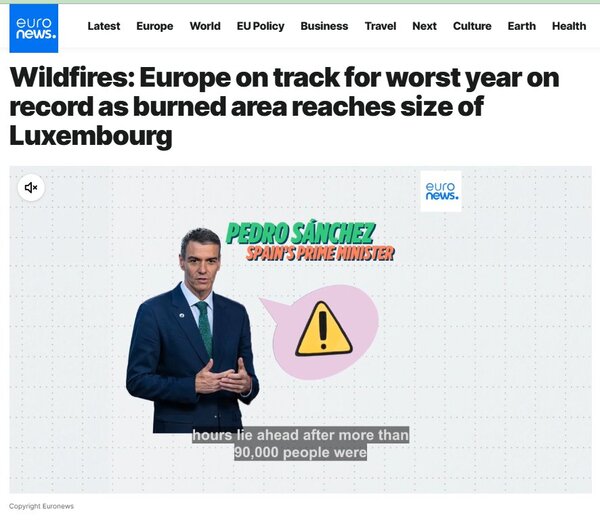
Europe has become the fastest-warming continent on Earth, where rapid temperature increases trigger extreme weather events that amplify the scale and intensity of wildfires. Europe's average temperature rise compared to pre-industrial levels stands at approximately 2.5°C, nearly double the global average rise of about 1.4°C.
The primary concern was the direction of the fire. Originating in the Gironde region of southwestern France, the blaze spread westward toward Bordeaux, placing the heart of France's nuclear capability and defense industry simultaneously inside the threat zone.
[France's Nuclear and Defense Heartlands Grounded Before the Flames]
The Bordeaux region hosts a dense concentration of key facilities supporting France's strategic nuclear forces, aviation, and missile manufacturing. ArianeGroup operates facilities related to propellants for the M51 SLBM deployed on French Navy nuclear submarines; Roxel produces solid rocket motors supplied to European missile manufacturer MBDA; and Dassault Aviation's final assembly line for the Rafale fighter jet is also located in this area.
As the flames approached, ArianeGroup evacuated all personnel within the affected radius and initiated protective protocol measures. Emergency response orders were likewise issued for Dassault Aviation and Roxel facilities. This presented an unprecedented situation where France's proud nuclear deterrent and supply chains for fighter jets and missiles were disrupted simultaneously—not by an enemy attack, but by a wildfire.
A military nuclear research facility operated by the French Alternative Energies and Atomic Energy Commission (CEA) is also located nearby. This site houses "Laser Mégajoule," a massive experimental tool that simulates extreme physical phenomena during nuclear explosions. The facility was completely closed and staff evacuated, though it was confirmed that no nuclear material was stored on-site, eliminating radiation leak risks.
While this does not imply a nuclear accident at a power plant or weapons storage facility, the mere fact that a research complex maintaining the reliability and performance of France's nuclear arsenal was forced to halt operations carries substantial strategic weight.
Firefighting authorities prioritized the protection of strategic facilities alongside life-saving operations. Firefighters cleared vegetation surrounding the sites and constructed massive firebreaks, while military experts and defense personnel deployed specialized equipment. Because nearly 300 defense contractors are concentrated in the Bordeaux and Gironde regions, further spread of the fire poses a realistic threat of expanding beyond temporary plant closures into disruptions across France's entire military supply network.
[The Gironde Fire Burns Forest Four Times the Size of Paris, Forcing 220,000 to Evacuate]
The wildfire in the Gironde region has burned approximately 42,000 hectares of forest—an area roughly four times the size of administrative Paris. Over 240 homes were destroyed, and approximately 220,000 people were evacuated in France alone. Combined with Spain, total evacuations reached roughly 330,000 at their peak, though some displaced residents in France began returning home.
The terrifying nature of this event stems not only from the vast burned area. Europe is experiencing a "whiplash effect," where vegetation grown lush from heavy winter rainfall dries out during intense summer heatwaves and droughts, turning into massive volumes of dry fuel.
When this accumulated fuel ignites, it generates strong updrafts and gale-force wind gusts, creating firestorms that further propel the flames. At the Gironde fire site, pyrocumulonimbus clouds were observed as massive heat columns rose into the upper atmosphere, generating localized storm clouds, lightning, and extreme winds. The fire entered a stage where it creates its own weather, which in turn feeds the fire.
This is why wildfire experts warn that an "era of unquenchable fires" has begun. Once a firestorm forms, direct suppression becomes virtually impossible regardless of firefighting capacity. Authorities are left with no choice but to evacuate residents first, wait for the fire front to pass, and build defensive perimeters around critical strategic infrastructure.
[Flames Spread to Spain, Greece, and Türkiye]
The wildfires were not confined to France. In Spain, over 170,000 hectares burned, with around 100,000 people ordered to evacuate or placed under evacuation warnings, concentrated in Madrid and Ávila. In France, over 116,000 hectares were lost. Combined, the two nations lost nearly 290,000 hectares.
The fires extended into Greece and Türkiye as well. On the Greek island of Crete, firefighters lost their lives battling wind-driven flames, with additional blazes reported on Paros and Lesbos. As fires spread along Türkiye's Aegean coast, Southern Europe and the Mediterranean basin formed a continuous fire front.
Concern is mounting among European officials that this year's wildfire damage could approach the record levels set in recent years, with clear indications that the situation is escalating into one of the worst seasons on record.
[A Long-Term Battle Expected Through November]
The broader problem is that damage surged even before the peak August season fully began. If high temperatures and dry weather persist, wildfire risks could extend through early November. This means European nations face a prolonged battle requiring the continuous deployment of firefighters, military personnel, aircraft, and heavy machinery throughout the remainder of summer and autumn.
The costs extend far beyond forest restoration and home rebuilding. Long-term diversion of military troops, transport planes, helicopters, and public funds to wildfire response burdens the resources European nations need for aid to Ukraine and internal defense expansion. Repeated operational pauses at defense facilities introduce a volatile new variable into Europe's rearmament plans aimed at boosting arms production.
[Why Times Insight]
The core issue of this disaster is not merely the "record-breaking wildfire" itself. The critical takeaway is that a climate disaster has crossed over into a national security crisis, directly threatening France's nuclear deterrent, fighter jets, and missile production chains.
To optimize efficiency, France had concentrated its nuclear, aerospace, and missile enterprises and research facilities in the Bordeaux area. However, as extreme weather becomes normalized, this concentrated industrial layout has turned into a structural vulnerability where a single wildfire can simultaneously paralyze multiple strategic assets. It has demonstrated that even without an enemy firing a single missile, natural disasters can disable nuclear capabilities and defense supply networks.
Europe can no longer treat wildfires purely within the domain of environmental and fire management policies. Site selection for strategic assets, fire protection zones, emergency power grids, and alternative production networks must undergo a complete overhaul. For a Europe rushing to rearm amid the war in Ukraine, a second front—the climate disaster—has officially opened.
The flames will eventually be extinguished. However, the strategic vulnerabilities exposed in France and across Europe will cast a long shadow long after the smoke clears.


-중국 푸단대학교 한국연구원 객좌교수
-전 EDUIN News 대표
-전 OUR NEWS 대표
-제17대 대통령직인수위원회 정책기획팀장
-전 대통령실 홍보기획비서관
-사단법인 한국가정상담연구소 이사장
-저서: 북한급변사태와 한반도통일, 2012 다시우파다, 선거마케팅, 한국의 정치광고, 국회의원 선거매뉴얼 등 50여권



