


Update2026.10.24 (토)

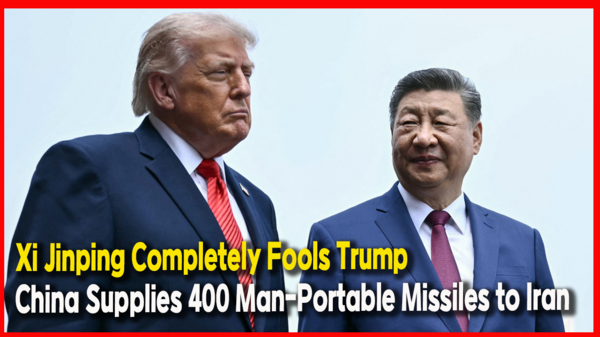
[Xi Jinping's Promise Falters After Just Two Months… Rebuilding Iran’s Air Defense Through a Hong Kong Intermediary]
Just five days after U.S. President Donald Trump publicly reiterated Chinese President Xi Jinping’s promise and expressed that he "takes him at his word," explosive reports emerged that threaten to shatter that trust. China has reportedly agreed to supply up to 400 man-portable air-defense missile systems to Iran, which is currently at war with the United States and Israel. Xi reportedly promised Trump during their May summit that neither the Chinese government nor Chinese companies would supply or sell weapons to Iran. If this transaction is verified, Xi used a Hong Kong intermediary to bypass a leader-to-leader pledge, leaving Trump blindsided after placing his faith in Xi's word.
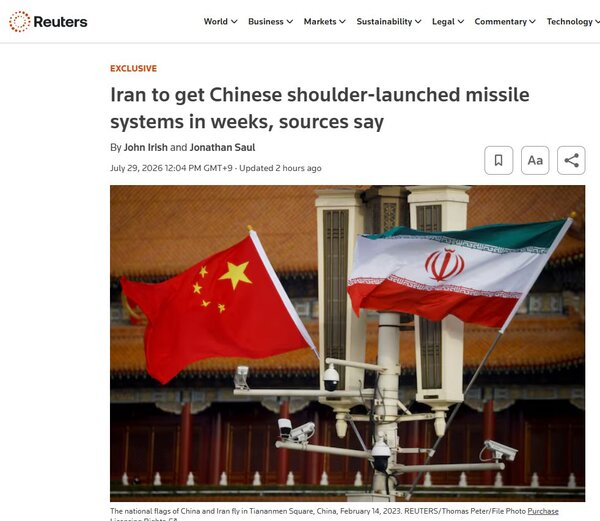
Reuters reported on the 29th, citing three anonymous sources, that "Iran is set to receive the first batch of up to 400 Chinese-made man-portable air-defense systems (MANPADS) within a few weeks." MANPADS refer to lightweight guided missile systems designed to be shoulder-fired by infantry to shoot down low-flying enemy aircraft.
According to Reuters, the deal is reported to be valued between $60 million and $70 million (approximately 83 billion to 97 billion KRW). The shipment includes 300 to 400 infrared-guided Chinese man-portable air-defense missiles, such as the QW-12 and FN-16 models. It has been identified that Hong Kong-based Zhongqing Baoshang International Investment acted as an intermediary facilitating the deal between the Iranian side and the Chinese supplier.
What makes this particularly striking is the timing of the disclosures. As recently as the 24th, President Trump publicly stated, "President Xi told me that he would not, under any circumstances, give or sell weapons to Iran, and that statement included Chinese companies." Yet, mere days later, reports surfaced indicating that hundreds of Chinese missiles are slated for delivery to Iran.
It is difficult to view this deal as unrelated to the agreement between the two leaders simply because the Chinese government did not directly sign the contract. The pledge disclosed by Trump was never limited solely to the Chinese government; it was a comprehensive commitment that explicitly included Chinese enterprises. Consequently, a transaction brokered by a Hong Kong firm and supplied by Chinese manufacturers falls squarely within the scope of that promise.
[Transaction via Hong Kong Entity… Suspicions of Circumventing Commitments Rather Than Exemption]
Rather than serving as grounds for China's exoneration, the structure of routing the deal through a Hong Kong entity heightens suspicions of a deliberate mechanism to bypass the commitment. It is hard to believe that Chinese authorities were entirely unaware of a large-scale contract involving the export of 300 to 400 pieces of military equipment abroad. Furthermore, China is a country that strictly controls arms exports and the overseas transfer of sensitive military hardware. Even if the Chinese government was not a direct party to the contract, it cannot easily escape responsibility for at least condoning or turning a blind eye to Chinese weapons heading to Iran through Chinese suppliers and a Hong Kong broker.
Ultimately, while Xi claimed to Trump that China "would not send weapons to Iran," he now faces suspicions of having left open channels on the ground for Chinese-made weapons to flow through third-party firms. This once again exposes a dual tactic: speaking of peace and trust at summits while utilizing private entities behind the scenes to assist in rearming a belligerent state.
[Rebuilding Iran's Shattered Air Defenses with Chinese MANPADS]
This supply agreement is far more than a simple commercial arms transaction. It effectively constitutes military support aimed at rebuilding Iran’s air defense network, which was severely damaged by U.S. and Israeli airstrikes. Over five months of conflict, the U.S. and Israel launched concentrated strikes against Iran's radar systems, missile bases, drone facilities, and fixed air defense batteries. As a result, critical gaps were punched into Iran's air defense, leaving key military sites and energy infrastructure vulnerable to follow-up air raids.
In this context, MANPADS represent the defense asset Iran can deploy most rapidly. Operated directly from an infantry soldier's shoulder, they do not expose their positions easily like fixed artillery units and can be dispersed in small teams around military bases, oil refineries, and missile launch sites. Threatening low-flying aircraft, helicopters, and certain drones, they can make U.S. and Israeli airstrike operations significantly more complicated and dangerous.
Therefore, 400 Chinese MANPADS represent far more than a mere numerical addition to Iran's arsenal. They possess the capability to undermine the tactical gains achieved by U.S. and Israeli strikes over recent months and plug the vulnerabilities in Iran's air defense, allowing Tehran to sustain a prolonged conflict. This implies that China's involvement in the Iran war—which Trump had previously warned against—could effectively become a reality.
[From Urumqi via Pakistan to Iran]
According to Reuters, the initial delivery plan involves flying the weapons from Urumqi in western China, transiting through Pakistan, and proceeding onward to Iran. While it remains unconfirmed whether subsequent batches will be transported by air or land, Western intelligence sources noted that Iran has also examined overland routes to transport Chinese military supplies and dual-use components more covertly to reduce interception risks.
The Pakistani military's public relations wing refuted claims that Chinese weapons were transiting through Pakistan, calling them "fabricated and completely false." China's Ministry of Foreign Affairs also dismissed the reports as "groundless," asserting that "China has consistently played a role in promoting peace and ending the conflict." The Iranian government and the intermediary firm have likewise not officially confirmed the contract.
Naturally, the transport routes and contract execution will require further verification. However, given that multiple security sources were aware of negotiations regarding the sale of QW-series missiles to Iran—and provided specific missile models, quantities, contract values, the intermediary firm, and expected delivery timelines—it is difficult to dismiss the matter as mere rumor.
[Xi’s 'Beautiful Promise': Did It Ultimately Deceive Trump?]
The origin of this issue dates back to the U.S.-China summit in May. Following that meeting, Trump publicly shared that "President Xi strongly promised not to provide military supplies to Iran." White House officials also characterized it as a "beautiful promise," stating that President Xi pledged not to send any weapons to Iran.
At the time, China did not disclose specific details of the commitment. That very ambiguity is now being leveraged as China's shield. By assuring Trump that weapons would not be supplied while leaving room to argue—if issues arose—that "it is not a direct government-to-government transaction," "it is a private company deal," or "the reports themselves are groundless," Beijing retained an exit route.
However, the terms of the promise as understood by Trump were clear: neither the Chinese government nor Chinese companies would provide or sell weapons to Iran. Under these circumstances, if a transaction of Chinese-made missiles brokered by a Hong Kong firm actually materialized, it represents not a verbal misunderstanding, but a substantive breach of that commitment.
[Why Times Insight]
Xi Jinping pledged to Trump that China would not supply arms to Iran. Yet just two months later, detailed reports emerged that up to 400 Chinese-made shoulder-fired air defense missiles are heading to Iran. The fact that the Chinese government does not explicitly appear on the contract offers no exoneration, as the pledge publicly disclosed by Trump explicitly encompassed Chinese enterprises.
Even more serious is that these weapons are intended to restore Iran’s air defense network shattered by U.S. and Israeli airstrikes, complicating any future air operations. While publicly calling for an end to the war, China faces deep suspicions of supplying weapons behind the scenes to enable Iran to endure a prolonged conflict.
Ultimately, this incident cannot be written off as an isolated rogue action by a private firm. It lays bare a signature diplomatic tactic: making commitments at the leadership level while routinely circumventing them via private entities and Hong Kong brokerage networks. The moment this transaction is fully verified, what Trump hailed as Xi’s "beautiful promise" turns into a deception.
Trump publicly stated that he trusted Xi. Yet before that trust could even cool, Xi moved to place Chinese missiles into Iran’s hands. In short, Xi exploited Trump's trust and deceived him. Now, heading into their upcoming September summit, the leader who must answer for this is not Trump, but Xi Jinping.

-중국 푸단대학교 한국연구원 객좌교수
-전 EDUIN News 대표
-전 OUR NEWS 대표
-제17대 대통령직인수위원회 정책기획팀장
-전 대통령실 홍보기획비서관
-사단법인 한국가정상담연구소 이사장
-저서: 북한급변사태와 한반도통일, 2012 다시우파다, 선거마케팅, 한국의 정치광고, 국회의원 선거매뉴얼 등 50여권



