Update2026.10.24 (토)

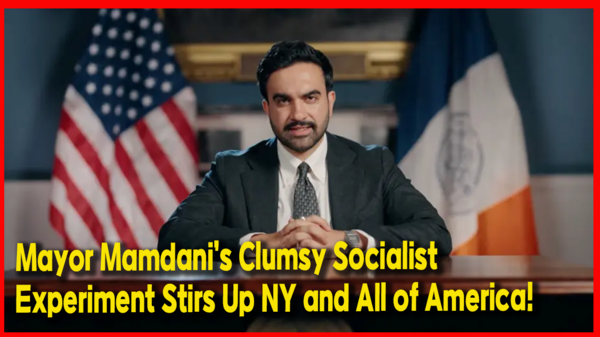
[Targeted the rich, hit middle-class homes and shops: Rhetoric swallows administration]
New York City Mayor Zohran Mamdani’s socialist political experiment is facing a severe backlash just one year into his term. The data released under the guise of taxing high-value second homes owned by the wealthy included a staggering 960,000-plus property records—a chaotic mix that swept in middle-class housing, commercial facilities, and primary residences. Furthermore, Mamdani publicly pledged to arrest Israeli Prime Minister Benjamin Netanyahu—a power he does not possess as NYC mayor—only to retract the statement when reality set in. Prioritizing class warfare and social-media-driven politics over precise administration, Mamdani’s clumsy socialist experiment is now stirring up not just New York, but political dynamics across the entire United States.
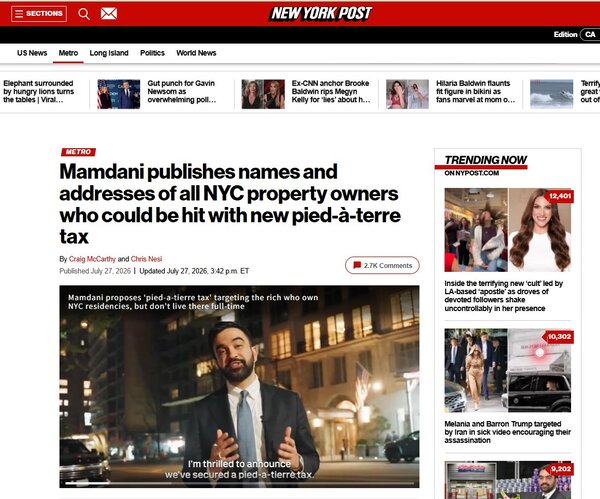
On the 27th, the New York Post reported: “The NYC Department of Finance released online searchable records containing names and addresses of property owners potentially subject to the Pied-à-Terre tax,” adding that “the number of property records included in this database has surpassed 960,000.”
The New York Post further noted: “This tax targets non-primary, high-value second homes in New York, setting the threshold at over $1 million for condos and co-ops, and over $5 million for single- and multi-family homes.” It pointed out that “the problem lies in the massive gap between Mamdani’s political rhetoric—which claimed to target the ‘luxurious second homes of the ultra-wealthy’—and the actual data released to the public.”
[Promised to notify 30,000 cases, but released 960,000 records]
According to the New York Post, the city had originally mentioned around 31,000 properties as high-probability tax targets worthy of notification. However, the released database contained over 960,000 property records and owner information—more than 30 times the anticipated figure. Being included on the list does not automatically trigger an immediate tax assessment; owners can be exempted if they prove that they, a tenant, or an immediate family member actually resides there. City authorities defended the release, explaining that publishing the relevant data was merely following procedures required by state law.
Yet, that very explanation exposes the fundamental flaw of the Mamdani administration. Before even confirming who the actual taxpayers were, the city demanded that citizens prove their own innocence while publicly exposing a vastly broader set of property owners' personal information. Instead of identifying exact targets before levying taxes, the city government published a sweeping list first and effectively shifted the burden onto citizens, telling them, “If you’re not subject to taxation, prove it yourself.”
In relation to this, the New York Post highlighted: “The database included homes in middle-class neighborhoods in the Bronx and Staten Island, as well as commercial properties like shopping centers in Queens.” It added, “NYC Council Member Gale Brewer countered that her own home, where she has lived since 1994, was mistakenly listed, while Republican Council Member David Carr also raised concerns that his residence might have been wrongly included.”
What began as a policy promised to ‘make the ultra-rich owning multiple luxury homes pay their fair share’ resulted, at the implementation stage, in dumping a massive trove of property data onto the public without even clarifying who was genuinely subject to the tax. This cannot be dismissed as a simple computer error or initial implementation confusion. It reveals a structural defect in Mamdani-style politics: political slogans that divide society into the rich and the poor run far ahead, while basic administration—such as precise targeting, privacy protection, and proper appeal procedures—scrambles frantically behind.
[“Check your mailbox”… A declaration of victory aimed at taxpayers]
An even greater controversy arose from the way Mamdani announced the tax policy. On the 24th, three days before the list’s release, Mamdani posted on X (formerly Twitter): “If you own a second home in NYC worth over $5 million, make sure to check your mailbox when you return to the five boroughs. You’ve got mail.” The post racked up over 10 million views in a single day.
Instead of explaining the policy and guiding taxpayers on their rights and appeal processes, the mayor sent a message to citizens facing tax assessments as if declaring a political victory. To Mamdani, tax hikes seemed less like an administrative tool for municipal finance and more like staged political content designed to frame the wealthy as enemies, punish them, and draw cheers from his base.
It is precisely at this point that the danger of Mamdani-style socialist politics becomes evident. Taxes should serve as a means to maintain city finances and public services. However, when taxation is weaponized to publicly pressure and mock a specific class, policy debates instantly devolve into class conflict. The moment ‘whom to punish’ takes precedence over administrative accuracy or fiscal efficacy, governance loses its fairness and inevitably degrades into a tool for political agitation.
Fox News columnist David Marcus criticized the move, stating, “I’ve never seen a politician take such delight in raising taxes.” Steven Fulop, president of the New York Economic Association, also demanded a review, stating, “Publishing individual owners’ names and addresses crosses the line of tax transparency and creates severe safety and privacy concerns.”
City authorities anticipate this tax will generate approximately $500 million annually. However, NYC Comptroller Mark Levine projected that “actual revenues may hover between $340 million and $380 million, and could decrease over time.” Concerns are mounting that this grandly launched ‘tax-the-rich’ scheme may fail to secure expected revenues while generating administrative chaos, privacy leaks, and heightened class hostility.
[Retracting the pledge to arrest Netanyahu: “No authority” after all]
Mamdani’s excessive political staging was not confined to tax issues. Ever since his mayoral campaign, he had repeatedly vowed: “If Prime Minister Netanyahu—against whom the International Criminal Court (ICC) issued an arrest warrant—visits New York, I will arrest him.”
However, as Netanyahu’s potential visit to New York for the upcoming UN General Assembly in September approached reality, Mamdani abruptly backtracked, stating: “It is clear that New York City lacks independent law enforcement authority to make such an arrest.” This retreat came just a day after President Donald Trump publicly declared that “Netanyahu will not be arrested in any form within the United States.”
The United States is not a state party to the ICC, and the arrest or prosecution of a foreign head of state directly involves federal foreign policy and judicial jurisdiction. The Mayor of New York City never possessed the authority to arrest Netanyahu independently in the first place. Nevertheless, during the campaign, Mamdani packaged an unfeasible promise as an actionable policy to rally his base.
He flexed tax authority where he could, and in international politics, he acted as though he wielded executive powers belonging to the President or federal government. The two incidents align perfectly: grand declarations and viral videos took precedence over actual legal authority and administrative feasibility. This is why critics argue he behaves less like a policy-making politician and more like a content creator continuously pumping out slogans his followers want to hear.
This explains why NBA star Kyle Kuzma directly called out Mamdani, describing him as a “mayor cosplaying as the president.” Kuzma pointedly remarked, “He imitates having authority, talent, and achievements that he doesn't actually possess just to create content,” adding that “we live in an era where people are rewarded for appearing to accomplish something rather than actually doing it.” Though bluntly stated, this critique hit the exact vulnerability of Mamdani’s politics—packaging mere declarations as genuine authority and results.
[Mamdani turns New York into a testing ground for American socialism]
Mamdani was elected mayor under the rallying cry that “New York is too expensive,” promising rent freezes, free bus fares, and public grocery stores. Actively leveraging TikTok, Instagram, and YouTube Shorts to target young voters, Politico evaluated him as “a politician built for the smartphone era, not the TV era.”
However, campaign language and actual governance are entirely different realms. While short, provocative slogans hold power online, running a city government that impacts millions of lives requires meticulous design—including legal boundaries, fiscal impact, target screening, privacy safeguards, and due process for appeals. It is on these precise fronts that the Mamdani administration has exposed grave weaknesses.
Mamdani’s core issue is not simply a lack of experience. It lies in his strategy of dividing citizens into the rich and the poor, the privileged and the victims, and utilizing that antagonism as his primary political fuel. As the message to punish the rich outstripped administrative precision, it spiraled into a fiasco involving the public exposure of 960,000 property records before tax targets were even finalized.
The promise to arrest Netanyahu followed the exact same pattern. Ignoring the complex legal frameworks of international relations, he threw out aggressive slogans first, only to admit he lacked such authority when faced with reality. The rhetoric was grand, but the underlying legal and administrative foundation was non-existent from the start.
Furthermore, this failure does not end with Mamdani alone. Conservative factions are expanding their offensive, framing this incident as a clear demonstration of the ideological reality of the Democratic Socialists of America (DSA), to which Mamdani belongs. The more Mamdani pushes reckless policies in New York, the more intense the ideological battle over socialism vs. capitalism, tax hikes vs. property rights, and welfare vs. fiscal responsibility will become across the U.S. political landscape.
[Why Times Insight]
Mamdani’s clumsy socialist experiment has transcended a mere municipal administrative hiccup in NYC to become a major flashpoint for all of American politics. Instigating class hostility under the banner of ‘taxing the rich’ and consolidating supporters through international declarations that exceed mayoral power are now being tested as real-world policies in America’s largest city.
Yet, the results thus far are dismal. The tax intended for the wealthy erupted into a privacy debacle exposing 960,000 property records mixed with middle-class housing and commercial units. Meanwhile, the pledge to arrest Netanyahu collapsed under the admission that he lacked the basic authority to do so. Meticulous governance has vanished, leaving behind only ridicule, polarization, and politics tailored for social media algorithms.
Mamdani promised to make New York a fairer city. However, what he is demonstrating now is less a fair reform and more an immature brand of class politics that divides society, sparks confrontation, and exploits that conflict as personal political capital. When policies fail, citizens bear the financial burden; when radical slogans collapse, public trust in the city is eroded.
New York is the heart of American capitalism and the financial capital of the world. That very city is now being transformed into Mamdani’s giant socialist laboratory. Should this experiment continue down a path of confusion and failure, the fallout will not remain confined to New York. The embers of class politics stoked by Mamdani threaten to re-ignite ideological warfare across the nation, deeply shaking American society as a whole.

-중국 푸단대학교 한국연구원 객좌교수
-전 EDUIN News 대표
-전 OUR NEWS 대표
-제17대 대통령직인수위원회 정책기획팀장
-전 대통령실 홍보기획비서관
-사단법인 한국가정상담연구소 이사장
-저서: 북한급변사태와 한반도통일, 2012 다시우파다, 선거마케팅, 한국의 정치광고, 국회의원 선거매뉴얼 등 50여권