Update2026.10.24 (토)

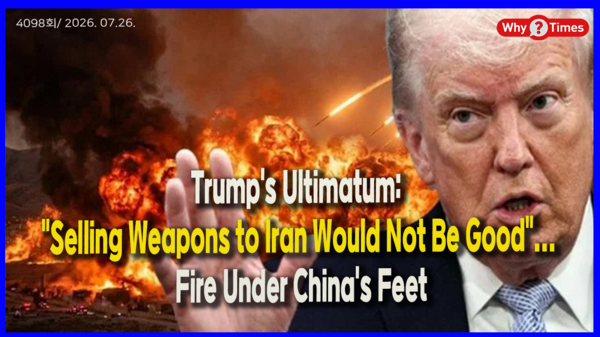
[Trump: "Violating Promises Would Be Very Bad"... Warnings Hidden Beneath Expressions of Trust]
As the armed conflict between the United States and Iran enters its fifth month, the geopolitical board is becoming increasingly complex. On one hand, President Donald Trump issued a virtual ultimatum-style warning targeted at China and Russia, stating that "it would be very bad" if they sold arms to Iran. On the other hand, China—the very target of that warning—finds itself directly caught in the fallout of a war it may have passively allowed: the potential blockade of the Strait of Hormuz. Consequently, Beijing is hastily activating double and triple mediation channels in a paradoxical effort to manage the crisis. Trump's public warning and China's frantic shift in posture may appear at first glance to be separate matters, but they are two pieces of a single picture—a United States bogged down in the Middle East, and a China that sought to exploit the situation only to shoot itself in the foot.
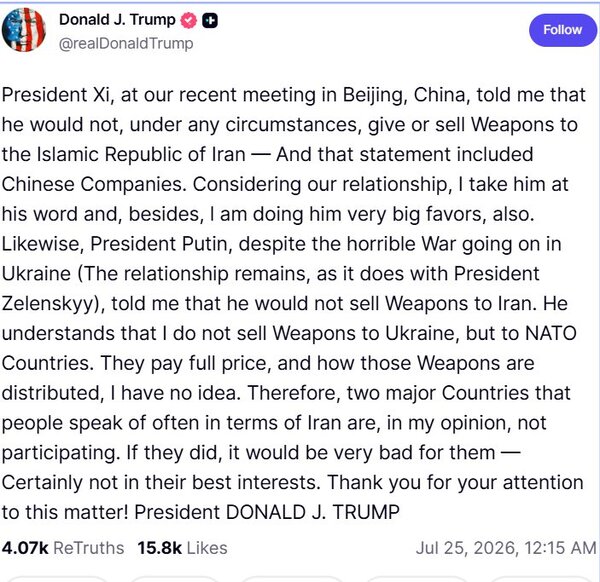
In a post on Truth Social on July 24 (local time), President Trump stated that President Xi Jinping recently promised at a Beijing summit that China "would not under any circumstances supply or sell weapons to Iran," adding that "that promise includes Chinese companies." Regarding President Vladimir Putin, Trump noted, "He also told me that despite the ongoing terrible war in Ukraine, Russia would not sell weapons to Iran."
Up to this point, the remarks might read as an expression of diplomatic trust; however, the sentence that followed defined the true character of the entire statement. Trump declared, "It is my assessment that these two countries are not involved [in supplying weapons]," but firmly added, "If they do become involved, it will be a very bad thing for them." In short, the essence of this statement is not a friendly expression of faith, but a conditional warning and virtual ultimatum that publicly pins Beijing and Moscow to a framework of "you clearly promised," warning of severe consequences if those promises are broken. That the President himself publicly issued such a warning—naming names on an open platform—is an unusually high level of rhetoric.
Conflicting currents detected within Washington add weight to this interpretation. Defense Secretary Pete Hegseth recently testified before Congress that "Russia and China are enabling Iran at different levels," creating a direct contradiction between the President’s expressions of trust and the Defense Secretary’s testimony regarding "enabling."
Furthermore, General Dan Caine, Chairman of the Joint Chiefs of Staff, demurred on providing specific answers citing classified information, which can actually be read as suggesting the existence of unconfirmed intelligence.
In March, allegations emerged that Russia was providing satellite imagery to Iran to track U.S. military positions. On May 29, possibilities were raised that a U.S. Air Force F-15E fighter jet shot down in April may have been hit by a Chinese-made Man-Portable Air Defense System (MANPADS). However, it is worth noting that these remain at the stage of "allegations" and "speculation" rather than confirmed facts.
[China Trapped in a Dilemma... Facing Simultaneous Blockades of Hormuz and Bab-el-Mandeb]
Setting Trump's warning aside, the fundamental problem is that China has backed itself into a corner from which it cannot easily escape on its own. As the world's largest importer of crude oil, China relies heavily on the Strait of Hormuz for its energy supply. As the war drags on, Iranian threats to attack Gulf states and block the strait have begun to deal real economic damage to Beijing. A Pakistani government official was quoted as stating that China is frustrated because Iranian attacks on other Gulf nations and the threat to block the Strait of Hormuz are harming its own interests.
To make matters worse, the Iranian-backed Houthi rebels in Yemen recently declared a maritime blockade against Saudi Arabia. Should Hormuz be blocked, the Red Sea's Bab-el-Mandeb Strait—the primary alternative route—risks being closed as well. From Beijing's perspective, both its main energy supply corridor and its primary detour are threatened simultaneously, leaving it with virtually no fallback position. Furthermore, since Saudi Arabia is a mutual defense ally of Pakistan, if the Houthi blockade becomes a reality, Pakistan's own standing as a self-styled mediator could be severely shaken.
Amid this pressure, Iranian Interior Minister Eskandar Momeni visited Islamabad twice within ten days to hold consecutive meetings with high-ranking Pakistani government officials and Field Marshal Asim Munir, Chief of Army Staff. According to Pakistani government sources, Pakistan's renewed efforts to broker negotiations came at the explicit request of China. Previously in June, the U.S. and Iran signed a 60-day memorandum of understanding (MOU) to cease hostilities mediated by Pakistan and Qatar; however, indirect talks ended without results, leading both sides to blame each other for violations as clashes reignited.
[Wang Yi Belatedly Urges "Door to Negotiations Must Not Be Closed"... Offering "Support" to Iran While Actually Pressuring for an End to the War]
On the same day, Chinese Foreign Minister Wang Yi held a separate bilateral meeting with Iranian Foreign Minister Abbas Araghchi on the sidelines of the Shanghai Cooperation Organization (SCO) Foreign Ministers' Meeting in Kyrgyzstan. Wang stated, "China is deeply concerned over the renewed tension and deterioration of the situation in the Middle East and the Gulf region," adding, "The memorandum of understanding signed over a month ago was a valuable achievement brokered by multiple parties, and past efforts must not be allowed to go to waste." His remark that "since the door to negotiations has opened, it must not be closed again" sounded like support for Iran on the surface, but in reality, it functioned as pressure demanding that Iran return to fulfilling the MOU—amounting to a demand for an end to the conflict.
To this, Foreign Minister Araghchi countered by stating, "The situation escalated because the American side violated the memorandum of understanding," while maintaining that "Iran's commitment to negotiations remains unchanged." Ultimately, China is deploying a dual track strategy: mediating via Pakistan (the practical interest channel) while utilizing SCO meetings (the diplomatic legitimacy channel). Far from being a calculated posture of diplomatic strength, this appears to be a desperate damage-control effort to minimize its own compounding economic losses.
[Why Times Insight]
What these overlapping developments reveal is not mere coincidence, but a clear sign that China's strategic calculus has begun to unravel. While the U.S.-Iran conflict tied down American attention and resources in the Middle East for five months, Beijing likely viewed the situation as a convenient geopolitical lever and allowed it to linger. Defense Secretary Hegseth’s congressional testimony that "China and Russia are enabling Iran," along with suspicions that a U.S. F-15E was brought down by a Chinese-made MANPADS, serve as pieces supporting this narrative.
Here, MANPADS (Man-Portable Air Defense Systems) refer to shoulder-fired, surface-to-air missile systems operated by individual soldiers. Using such capabilities, Iran managed to shoot down a U.S. Air Force F-15E Strike Eagle on the night of April 2–3.
However, as the war dragged into its fifth month and both the Strait of Hormuz and the Bab-el-Mandeb Strait faced simultaneous blockades, the mounting economic losses far exceeded China's initial estimates. Forced out of its role as a passive bystander, Beijing was compelled to transform into an anxious mediator. What China thought was an indefinitely sustainable strategy of passive neglect proved unsustainable. Facing the threat of dual maritime chokepoints closing, the world's top crude importer is now stuck picking up the check for a war it chose to ignore. Requesting Pakistan's mediation and issuing statements at the SCO are not signs of relaxed strategic maneuvering; they are hasty measures rushed out in response to a bill that arrived far earlier than expected. This shift—from passive allowance to management failure, and from management failure to urgent intervention—is the most critical dynamic to observe in this unfolding crisis.
To be sure, this analysis relies on circumstantial evidence, and no direct evidence confirming that China actively incited or pre-approved Iranian provocations has been publicly verified to date. This distinction must be made clear. However, the absence of direct evidence does not equate to complete detachment. Rather, Trump's public warning should be read as rhetoric aimed precisely at that ambiguity—not attempting to legally prove direct intervention, but intentionally exploiting the gray zone between the Defense Department's testimony on "enabling" and his own public "expressions of trust" to apply maximum leverage, dragging a cornered China to the negotiating table. Trump is not attempting to "prove" China's complicity; he is exercising leverage by reminding Beijing of a vulnerable reality it already knows too well.

-중국 푸단대학교 한국연구원 객좌교수
-전 EDUIN News 대표
-전 OUR NEWS 대표
-제17대 대통령직인수위원회 정책기획팀장
-전 대통령실 홍보기획비서관
-사단법인 한국가정상담연구소 이사장
-저서: 북한급변사태와 한반도통일, 2012 다시우파다, 선거마케팅, 한국의 정치광고, 국회의원 선거매뉴얼 등 50여권