
Update2026.07.24 (금)

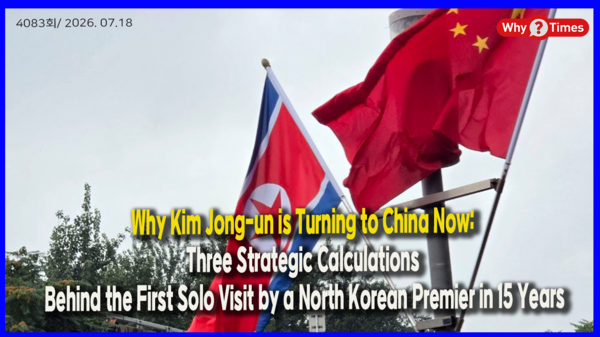
[North Korean Premier’s First 'Solo Visit to China' in 15 Years: What Has Changed?]
North Korea has begun reaching back out to China much faster than anticipated. Pak Tae-song, Premier of North Korea’s Cabinet, made a solo official visit to China without accompanying Supreme Leader Kim Jong-un—marking the first such visit in 15 years—and held a series of meetings with China’s top leadership, including President Xi Jinping. While the trip was ostensibly to attend commemorative events for the 65th anniversary of the Sino-North Korean Treaty of Friendship, Cooperation, and Mutual Assistance, its implications extend far beyond mere diplomatic protocol. Amid the reality that the war in Ukraine will eventually draw to a close, analysts widely interpret this as a strategic move by North Korea—which had previously tilted heavily toward Russia—to rebuild ties with Beijing in anticipation of the post-war era.
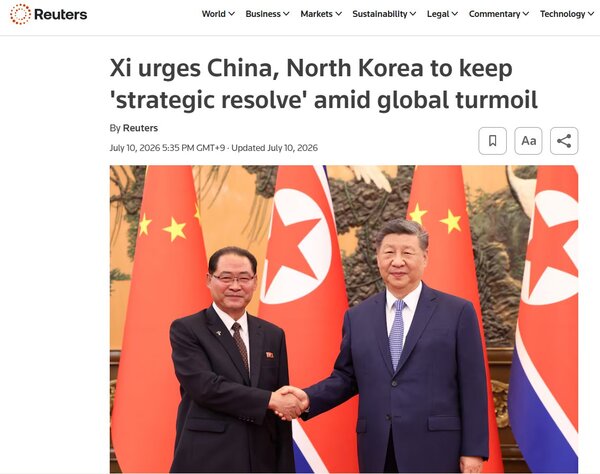
On July 10, Reuters reported that "Premier Pak Tae-song led a party and government delegation on an official visit to China from July 10 to 12." This marks the first time since 2011 that a North Korean premier has visited China independently, without accompanying the supreme leader. More notably, during his stay, Pak held consecutive meetings with China’s inner circle of power, including President Xi Jinping, Premier Li Qiang, Zhao Leji (Chairman of the Standing Committee of the National People's Congress), and Cai Qi (First Secretary of the Secretariat).
Combined with Xi Jinping’s visit to Pyongyang last month and the upcoming visit of Wang Huning (Chairman of the National Committee of the Chinese People's Political Consultative Conference) to Pyongyang from July 15 to 17, North Korea and China are engaging in an unprecedented flurry of three high-level exchanges in just one month. This shift signals more than just a cordial atmosphere; it suggests that both Pyongyang and Beijing have entered into a new round of strategic calculations.
[First Reason: Kim Jong-un’s Calculation That the Russian Windfall Will Not Last Forever]
The primary reason Kim Jong-un is re-engaging with China is that he understands the inherent limitations of relying solely on Moscow. The war in Ukraine has provided an unprecedented economic windfall for North Korea. In a report published last March, the Institute for National Security Strategy (INSS)—a think tank under South Korea's National Intelligence Service—estimated that from August 2023 to the end of 2025, North Korea secured revenue ranging from $7.67 billion to $14.4 billion (averaging around $11 billion) in exchange for arms supplies and troop deployments to Russia.
Given that North Korea’s annual total exports previously hovered around $300 million to $400 million, this massive influx of foreign currency has effectively reshaped the structural foundation of the regime's economy.
The critical issue, however, is that this setup is unsustainable over the long term. The INSS report analyzed that 80% to 96% of the compensation North Korea received—or is scheduled to receive—came not in cash, but in the form of military technology, advanced components, and precision materials. In other words, once the war in Ukraine ends, Russia's incentive to purchase large volumes of North Korean weaponry will diminish, and military tech transfers will naturally taper off.
Most importantly, the moment Russia's strategic dependency on North Korea wanes, Pyongyang's economy will be forced to secure alternative sources of foreign currency. Premier Pak Tae-song’s recent visit to China directly reflects this reality. It does not signify that Pyongyang is abandoning Moscow; rather, it indicates that North Korea is preparing for the post-war era, operating under the assumption that Russia alone cannot guarantee its long-term future.
[Second Reason: Restoring Diplomatic Balance to an Overly Russia-Leaning Foreign Policy]
This visit also carries the weight of normalizing Sino-North Korean relations. Since the outbreak of the war in Ukraine, North Korea has established a near-alliance with Russia. As its military cooperation, economy, and diplomacy were reorganized with Moscow at the center, Pyongyang’s distance from Beijing grew visibly wider.
A symbolic display of this shift occurred early this year. When the Rodong Sinmun covered New Year's greetings from world leaders, it featured President Vladimir Putin’s message in a prominent, standalone layout, while grouping President Xi Jinping’s greetings together with those of leaders from other nations. This clearly illustrated where North Korea's diplomatic weight was being placed at the time.
However, Beijing was far from pleased with North Korea leaning so heavily into Russia's sphere of influence. In an analysis of the China-North Korea-Russia trilateral relationship, the Korea Institute for International Economic Policy (KIEP) described China-North Korea ties as a "transformer" and Russia-North Korea ties as a "balancer." Historically, North Korea has maintained equilibrium between the two giants to avoid tilting too far in one direction, while China and Russia have managed their respective ties with Pyongyang to keep each other in check.
With North Korea-Russia alignment currently peaking, Kim Jong-un now faces a growing strategic imperative to revitalize his other primary geopolitical axis: China.
[Third Reason: Beijing Needs Pyongyang Just as Much]
This visit materialized because China is equally keen on mending ties with North Korea. Amid the intensifying US-China strategic competition, Beijing views North Korea as an indispensable strategic asset that it cannot afford to lose. Analysts consistently point out that China’s deepest concern is "China Passing"—the prospect of being sidelined from the negotiating table if Washington and Pyongyang resume nuclear talks down the road.
Consequently, while Beijing has maintained a deliberate distance from the military cooperation between Moscow and Pyongyang, it is actively seeking to expand bilateral engagement with North Korea, focusing primarily on economic and livelihood sectors.
According to Voice of America (VOA), Premier Pak Tae-song proposed expanding cooperation in economy, trade, science, and technology during his meeting with Premier Li Qiang, while his visit to Tianjin included discussions on broadening educational and cultural exchanges. Following an agreement to normalize border customs checkpoints during last month’s summit, speculation is mounting that the New Yalu River Bridge—which has sat unused for 12 years since its construction—may finally open before the end of this year.
For Beijing, expanding economic cooperation with Pyongyang is a highly pragmatic choice, as it simultaneously addresses two core objectives: revitalizing its own border economies and managing potential instability within North Korea.
[A Strategy of Building a "Safety Net," Not Abandoning Russia]
Even so, it is premature to interpret these maneuvers as a sign that North Korea is distancing itself from Russia. While Kim Jong-un stated in his congratulatory message for the 65th anniversary of the Sino-North Korean Treaty that "friendship and cooperation between the two nations are developing to a new strategic height," he sent no signals indicating a downgrade in relations with Moscow.
Instead, current trends point toward a classic "hedging" strategy aimed at utilizing both the Russian and Chinese axes concurrently. Pyongyang is not walking away from Russia; rather, it is rebuilding its traditional safety net with China to mitigate the systemic risks that would arise from an over-reliance on Moscow.
[Why Times Insight]
Premier Pak Tae-song’s solo visit to China is far more than a routine diplomatic itinerary; it is highly likely the first public signal that Kim Jong-un has begun factoring in the post-Ukraine war landscape.
While North Korea has extracted immense foreign currency reserves and military hardware technology from Russia, Pyongyang clearly recognizes that this environment is temporary. As the end of the war approaches, the risks of over-reliance on Russia will inevitably spike, forcing North Korea to strategically restore its ties with its traditional benefactor, China.
Conversely, China has every reason to embrace North Korea once again. In a prolonged US-China strategic rivalry, North Korea remains a vital geopolitical asset that Beijing cannot relinquish. Re-establishing firm ties with Pyongyang directly aligns with Beijing's national interests, ensuring China remains insulated from being excluded should US-North Korea dialogue restart.
Ultimately, the core takeaway of this visit is not a weakening of the North Korea-Russia alignment, but a shift in North Korea’s survival strategy. Rather than leaning exclusively on a single Russian pillar, Kim Jong-un is actively preparing for the "post-Ukraine war era" by restoring the Chinese pillar. If this visit translates into tangible outcomes—such as the opening of the New Yalu River Bridge, the normalization of border trade, and expanded economic cooperation—Pak Tae-song’s trip will be remembered not as a mere diplomatic event, but as a critical turning point that ushered Northeast Asian geopolitics into a new phase.

-중국 푸단대학교 한국연구원 객좌교수
-전 EDUIN News 대표
-전 OUR NEWS 대표
-제17대 대통령직인수위원회 정책기획팀장
-전 대통령실 홍보기획비서관
-사단법인 한국가정상담연구소 이사장
-저서: 북한급변사태와 한반도통일, 2012 다시우파다, 선거마케팅, 한국의 정치광고, 국회의원 선거매뉴얼 등 50여권