
Update2026.07.24 (금)


[Drones Struck Critical Vulnerabilities and Robots Advanced; Russian Forces Caught Completely Off Guard]
Throughout history, the nature of warfare has been transformed not merely by new weapons, but by new methodologies. Gunpowder brought an end to the era of knights, tanks breached trench warfare, and aircraft carriers shifted the paradigm of naval combat. Today, the war in Ukraine is forging yet another monumental turning point. We have officially entered an era where amphibious operations are executed not by humans, but by drones and robots.
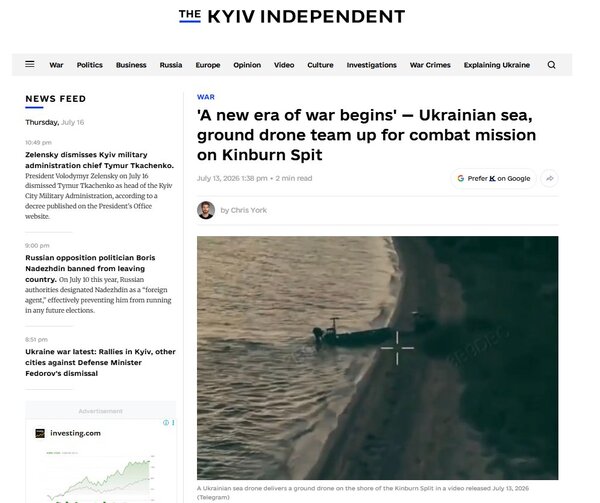
Without deploying a single soldier, the Ukrainian military successfully coordinated Unmanned Surface Vessels (USVs) and Unmanned Ground Vehicles (UGVs) to transport and land assets onto a Russian-occupied coastline, subsequently executing combat missions. This marks the first publicly disclosed instance where the entire process—from landing to engagement—was carried out exclusively by unmanned systems. Military analysts view this not merely as a novelty technological demonstration, but as a historic experiment that fundamentally reshapes the concept of amphibious operations.
On July 15, the local Ukrainian media outlet The Kyiv Independent reported a striking development: "The 123rd Separate Territorial Defense Brigade of the Ukrainian Armed Forces announced on July 14 that a USV transported an armed UGV to the Russian-occupied coast of the Kinburn Spit in southern Mykolaiv Oblast, where it landed and successfully completed a combat mission." The brigade stated via Telegram, "To the best of our knowledge, this is the first combat mission of its kind attempted worldwide," explaining that "a ground robotic system was transported to the enemy-occupied shore via an unmanned maritime platform, landed, and fulfilled its combat objective."
The brigade emphasized via Telegram, "Leaving the most dangerous tasks to machines is the modern approach to warfare."
This announcement instantly captured the attention of military experts worldwide. As Why Times has repeatedly analyzed, Ukraine previously forced the Russian Black Sea Fleet to alter its operational behavior through naval drones and expanded the battlefield into the Russian rear using long-range drones. More recently, they introduced sophisticated multi-domain attack tactics combining maritime and aerial drones. Now, they have begun applying yet another novel method of warfare to actual combat: unmanned amphibious operations.
[Bypassing Russia's Most Trusted Coastal Defenses]
The Kinburn Spit, where this operation took place, is a highly strategic chokepoint that controls access to both the Black Sea and the mouth of the Dnieper River. Because securing this area allows for the monitoring of maritime access routes leading to Mykolaiv and Kherson, Russia heavily fortified the region from the earliest stages of the 2022 invasion.
Russian forces deployed a dense network of drone surveillance, monitoring equipment, artillery firepower, and sea mines, effectively rendering conventional amphibious operations impossible. Any manned landing craft approaching the shore would face a high probability of immediate, concentrated strikes from enemy drones and artillery.
This time, however, there were no soldiers on board. According to an analysis of released footage by the American military media outlet The War Zone, the USV, propelled by an external motor, approached the target shoreline and lowered its bow ramp. A wheeled UGV housed inside then autonomously disembarked onto the land to engage in combat.
The War Zone particularly highlighted that the released footage contained simultaneous perspectives filmed from three distinct platforms: an aerial reconnaissance drone, the USV, and the UGV. This demonstrates that the operation was not a mere test of individual equipment, but a practical battlefield implementation of an integrated unmanned operational framework connecting air, sea, and land into a single network.
The most critical takeaway is that machines, rather than humans, bore the inherent risks of the landing. Historically, amphibious operations have been among the deadliest military maneuvers, demanding the highest sacrifices from troops. By assigning this perilous first phase to robots, Ukraine is capturing the undivided attention of global military strategists.
['Kangaroo Tactics'… The Era of Drones Carrying Robots to Land]
Military experts are calling this operation a "marsupial drone tactic," or "kangaroo tactics." Much like a kangaroo carrying its joey in its pouch, the USV acts as a "mothership," safely transporting the UGV to the designated target. Upon arrival, the USV lowers its ramp, allowing the robot to land autonomously to perform remote reconnaissance, engagement, and target identification.
While USVs and UGVs have been deployed individually in the past, this marks the first time the two platforms have been linked into a single, cohesive combat system to execute a live landing and combat mission. This signifies more than just the evolution of a single weapon; it represents the realization of a new operational concept that integrates air, sea, and land into a unified, unmanned network.
The UGV used in this operation is also drawing significant attention. While initial speculation suggested it might belong to the "Rys" (Lynx) series by the Ukrainian firm Roboneers, the manufacturer DevDroid later revealed that the deployed hardware was a previously unreleased, new platform. Reports indicate it was equipped with the "Wolly 7.62" Remote Weapon Station (RWS), reinforcing assessments that Ukraine's unmanned combat systems are advancing at a much faster pace than previously anticipated.
[The Unmanned Landing: A Solution Born from the Failure at Krynky]
This operation was not a sudden, spontaneous idea. It was born from lessons bought by the Ukrainian military at a devastating cost. The American business magazine Forbes noted, "Plans to recapture the Kinburn Spit had been under consideration since immediately after the liberation of Kherson in late 2022, but were not executed at the time." Instead, Forbes reported, "The Ukrainian military launched a manned amphibious operation across the Dnieper River into the Krynky region on the left bank, which yielded disastrous results."
Forbes added, "Exposed to Russian drones, artillery, and airpower, Ukrainian forces suffered massive casualties with limited strategic gains. Krynky left Ukraine with the painful lesson that personnel are the first to be sacrificed in amphibious operations."
That very lesson paved the way for the Kinburn Spit operation. Ukraine began rewriting its amphibious doctrine: instead of putting boots on the ground first, robots are sent in to secure the area before human troops follow. In essence, this operation was less about testing a new weapon and more about overcoming a failed tactic with an entirely new concept.
[Ukraine Rewrites the Textbook of Warfare Yet Again]
In analyzing the war in Ukraine over the past four years, Why Times has repeatedly emphasized one fact: Ukraine does not fight because it possesses more weapons than Russia. Rather, it is a nation that excels at being the first to apply pioneering methods of warfare to the battlefield. This was true for the naval drones that effectively neutralized the Black Sea Fleet, and the long-range drone strikes penetrating 2,000 to 3,000 kilometers deep into Russian territory. Networked combat—combining drones, artificial intelligence, and satellite data—was also first demonstrated at scale by Ukraine.
This unmanned amphibious operation follows the exact same trajectory. The amphibious operations of the future may no longer feature thousands of marines storming beaches in landing craft. Instead, it is highly likely to shift to a model where dozens or hundreds of USVs approach the shore first, unleashing a swarm of UGVs and loitering munitions to dismantle enemy defensive positions before human troops ever step foot on the beach.
This operation offers profound implications for scenarios worldwide, including island defense in the Taiwan Strait, the South China Sea, the Baltic Sea, as well as the defense of islands off the western coast of the Korean Peninsula. Moving forward, militaries around the globe will likely conduct comprehensive re-evaluations of not only their amphibious operation doctrines but also their island defense and coastal infiltration strategies.
Admittedly, limitations remain. Current small-scale UGVs have restricted payload capacities and firepower, making it difficult to operate heavy weaponry or hold positions for extended periods. Furthermore, the exact extent of material damage inflicted on Russian forces during this operation has not been independently verified, and the Russian Ministry of Defense has yet to issue an official statement. However, technological breakthroughs always stem from small, initial successes. Today's limitations are merely tomorrow's opportunities for improvement.
[Why Times Insight]
The operation at the Kinburn Spit was not just an event where a single robot made landfall. It shook the centuries-old assumption that "warfare is inherently conducted by humans." Moving forward, the core of military might will likely depend less on the sheer size of personnel and more on how many unmanned systems can be networked and integrated seamlessly. The decisive factors of victory are shifting away from troop numbers toward technology, algorithms, and system integration capabilities.
Through this war, Ukraine has done more than just create another new weapon; it is redesigning the very framework of warfare. The changes that began in the Black Sea will not end there. Today it is the Kinburn Spit, but tomorrow it could be the Taiwan Strait, the South China Sea, or eventually, the waters surrounding the Korean Peninsula.
Warfare invariably shifts where the future is experimented with first. And right now, the nation turning that future into reality ahead of everyone else is none other than Ukraine.


-중국 푸단대학교 한국연구원 객좌교수
-전 EDUIN News 대표
-전 OUR NEWS 대표
-제17대 대통령직인수위원회 정책기획팀장
-전 대통령실 홍보기획비서관
-사단법인 한국가정상담연구소 이사장
-저서: 북한급변사태와 한반도통일, 2012 다시우파다, 선거마케팅, 한국의 정치광고, 국회의원 선거매뉴얼 등 50여권