
Update2026.07.24 (금)


[From Airstrikes to Occupation: America’s Strategy on Iran Begins to Shift]
The United States has finally begun to play its ultimate card. Despite months of airstrikes, naval blockades, and economic sanctions, Iran has continued to weaponize the Strait of Hormuz to pressure the U.S. and the international community. In response, President Donald Trump has publicly stated for the first time that "sometimes a ground war is necessary." This is not merely the addition of another military option. It is highly significant as a clear signal that the U.S. strategy toward Iran is shifting from "pressure and containment" to a "decisive conclusion."
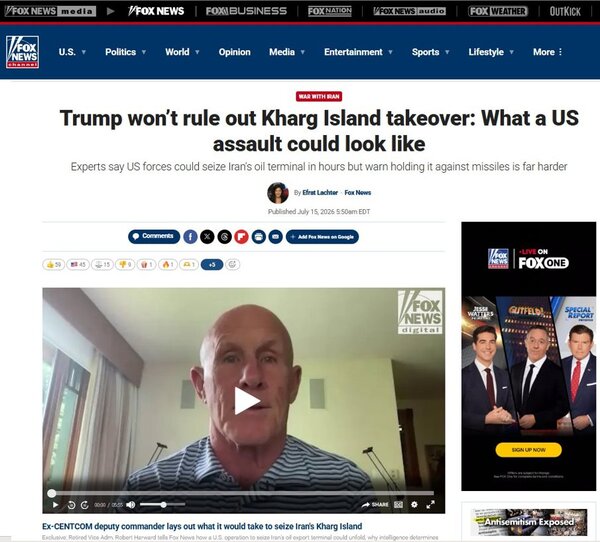
On the 16th, FOX News reported on its interview with President Trump, noting, “The possibility of deploying ground troops, which had previously been the subject of rampant speculation, has now come directly from the president's mouth for the first time.”
When asked about the potential deployment of ground forces to Kharg Island—Iran's largest crude oil export terminal—President Trump replied, "Sometimes a ground war is necessary." He added, "The U.S. military could do it directly, but there are others who can carry out the operation on our behalf," leaving open the possibility of limited ground operations utilizing allies or pro-U.S. forces.
He particularly emphasized, “The U.S. military has already struck Kharg Island several times, but we have intentionally left the oil facilities untouched.” He added, "The only way to negotiate with an adversary like this is through strength, and that strength is military power."
Speaking at the U.S. Army War College in Pennsylvania on the same day, President Trump remarked, “We are doing very well with Iran,” but warned, “I don’t like setting deadlines. Iran has to behave themselves.” While seemingly leaving room for negotiation on the surface, this was actually a tactical move to ramp up military pressure to the next level.
[Why Ground Troops Now? Even the U.S. Admits the Limits of Airstrikes]
The most critical aspect of these remarks is not the term "ground forces" itself, but why it is being raised right now. The U.S. has repeatedly launched airstrikes against Iran's missile sites, air defense networks, port facilities, and naval bases. However, airstrikes alone have failed to fully restore control over the Strait of Hormuz, and Iran continues to pressure the U.S. while maintaining its crude oil export capabilities.
Above all, there are strategic objectives that cannot be achieved through airstrikes alone. Kharg Island is a prime example. While it serves as the linchpin of Iranian oil exports, bombing its facilities does not guarantee control. Unless the island is physically seized and held, operations can resume at any time.
The same applies to nuclear facilities. Highly enriched uranium stored deep underground is incredibly difficult to eliminate via bombardment. In fact, reckless bombing runs the risk of causing a catastrophic radiological disaster. Ultimately, to fully secure nuclear materials, boots on the ground are required to retrieve them. Secretary of State Marco Rubio’s recent congressional remark that "someone has to go in and get it" is interpreted as an acknowledgment of this harsh reality. Consequently, there is a growing consensus within Washington that while airstrikes can exert pressure, they cannot end the war.
[Seizing Kharg Island is Not a New Concept]
Indeed, U.S. deliberations over ground operations are not a new development. CNN reported back in March that "Iran is significantly reinforcing its troops and air defense networks on Kharg Island." This indicates that Tehran caught wind of Washington’s amphibious assault contingency plans early on and has been preparing accordingly.
The Jerusalem Post also reported that "two U.S. Marine Expeditionary Units (MEUs) capable of rapid amphibious operations have been deployed to the Middle East, with additional elements of the 82nd Airborne Division slated for deployment." This is interpreted not as a mere force build-up, but as a deliberate step to establish readiness for limited ground operations at any given moment.
U.S. outlet Axios provided even more granular details, reporting: "The military options under review by the White House and the Pentagon include not only the seizure of Kharg Island, but also taking control of Larak Island—which commands the entrance to the Strait of Hormuz—securing Abu Musa and the Tunb Islands, interdicting and seizing Iranian oil tankers, and even deploying special forces to nuclear facilities to secure highly enriched uranium."
Al Jazeera, quoting military experts, analyzed that “once air superiority is established and air defenses are suppressed, the 82nd Airborne Division is highly likely to secure entry points such as airports and harbors. Subsequently, special operations forces, including Navy SEALs and Delta Force, would carry out missions to secure nuclear materials and seize key facilities.”
In other words, President Trump’s recent remarks are not sudden political rhetoric, but rather the public unveiling of military plans that have been meticulously prepared for months.
[White House Situation Room Discusses 'Escalating the War,' Not Just 'Expanding Airstrikes']
Almost simultaneously with President Trump’s remarks, even more telling movements were detected at the White House. Citing multiple sources, Axios reported that on the 14th, President Trump convened a lengthy meeting in the White House Situation Room with key national security figures—including Vice President JD Vance, Secretary of Defense Pete Hegseth, Secretary of State Marco Rubio, Chairman of the Joint Chiefs of Staff Dan Caine, CIA Director John Ratcliffe, and Special Envoy Steve Witkoff—to discuss military operations far more extensive than previous plans.
The Times of Israel also reported, “The targets currently under consideration appear to include strategic facilities that the U.S. had previously deliberately avoided striking.” This is not just a matter of expanding target lists; it signifies a fundamental shift in the objectives of the war itself.
Previously, Washington's objective was to pressure Iran to bring it to the negotiating table. Now, however, the gravity is shifting toward neutralizing Iran's military capability entirely, ensuring it can never again blockade the Strait of Hormuz or resume its nuclear program. In short, the strategy is transitioning from "retaliation" to "neutralization"—from "management" to "conclusion."
[CENTCOM’s Twice-Daily Airstrikes: A Prelude to Ground Operations?]
Changes are already manifesting on the actual battlefield. On the 15th, U.S. Central Command (CENTCOM) launched two separate rounds of airstrikes against Iran in a single day. In the morning, forces struck coastal defense installations and cruise missile sites on Greater Tunb Island. By evening, precision strikes targeted command-and-control facilities, air defense networks, and missile and drone bases across several regions, including Bandar Abbas. This marks the first time since the resumption of hostilities that two airstrikes have been executed in a single day.
The choice of targets warrants even closer attention. Rather than merely bombing missile sites, the U.S. military is systematically neutralizing coastal defense networks, command-and-control systems, and air defenses. This closely resembles a classic "shaping operation" typically conducted ahead of an amphibious assault or special forces infiltration. While this does not guarantee immediate ground deployment, weight is increasingly being given to the interpretation that the U.S. is preparing the battlefield to keep that option readily available.
[Iran Prepares Its Own Final Card: A 'Dual Blockade' Shaking the Red Sea]
While the U.S. ramps up military pressure, Iran is preparing its own final card. The UK's Daily Telegraph, citing local sources in Yemen, reported that "the pro-Iranian Houthi rebels are moving to coordinate with the Somali militant group al-Shabaab to control both sides of the Bab al-Mandab Strait." If Iran, which already threatens the Strait of Hormuz, successfully destabilizes the gateway to the Red Sea, global energy transit networks would effectively face squeeze points from both sides.
The Bab al-Mandab Strait is a chokepoint through which more than 10% of global maritime trade passes. If both the Strait of Hormuz and Bab al-Mandab are choked off simultaneously, oil tankers and cargo vessels would be forced to detour around the Cape of Good Hope, sending logistics costs and energy prices soaring. This explains why the U.S. is eager to bring the conflict to a swift close: as time drags on, the economic toll could vastly eclipse the military burden.
[Why Times Insight]
President Trump's assertion that "sometimes a ground war is necessary" is far more than mere hawkish rhetoric. It is highly likely a signal that Washington is beginning to acknowledge the reality that airstrikes alone cannot achieve its wartime objectives. In other words, what the U.S. is currently reviewing is not the expansion of bombardment, but how to conclude the war.
If even a limited ground operation on Kharg Island or nuclear facilities materializes, it would mark the first time since the 2003 Iraq War that the U.S. engages in a "war of territorial occupation" in the Middle East. Should this occur, the conflict will transcend a simple retaliatory campaign or a response to a naval blockade, shifting instead into a war that redraws the strategic order of the Middle East.
Yet, the costs of such an endeavor would be staggering. The moment ground forces are committed, the U.S. will no longer have an easy exit strategy. It must shoulder the burdens of maintaining occupied territory, force protection, massive financial costs, and casualties, alongside enduring long-term asymmetric retaliation from Iran and its proxies. Furthermore, should Iran's "dual blockade" targeting both the Strait of Hormuz and the Red Sea become reality, the conflict could easily spill over from a military clash into a global crisis shaking the world economy.
Ultimately, the choice currently facing the Trump administration is not whether to deploy ground troops, but how to bring this war to an end. That decision will serve as a critical turning point determining the trajectory of not only Iran, but the entire Middle East, the international energy market, and the global economy.

-중국 푸단대학교 한국연구원 객좌교수
-전 EDUIN News 대표
-전 OUR NEWS 대표
-제17대 대통령직인수위원회 정책기획팀장
-전 대통령실 홍보기획비서관
-사단법인 한국가정상담연구소 이사장
-저서: 북한급변사태와 한반도통일, 2012 다시우파다, 선거마케팅, 한국의 정치광고, 국회의원 선거매뉴얼 등 50여권