
Update2026.10.24 (토)


[Clash Just 10 Days After Ceasefire... Strait of Hormuz Ignites Again]
The ceasefire agreement struck between the United States and Iran just ten days ago has effectively hit its greatest crisis. Following consecutive attacks on oil tankers in the Strait of Hormuz, the U.S. immediately launched airstrikes against Iranian missile and drone bases, prompting Iran to retaliate by targeting U.S. military bases in the Gulf region. President Trump issued a stern warning, noting that "the Islamic Republic of Iran may no longer exist," signaling the potential expansion of military action. Analysts suggest this clash is the explosive culmination of the "control over Hormuz" dispute, an issue the memorandum of understanding (MOU) ultimately failed to resolve.
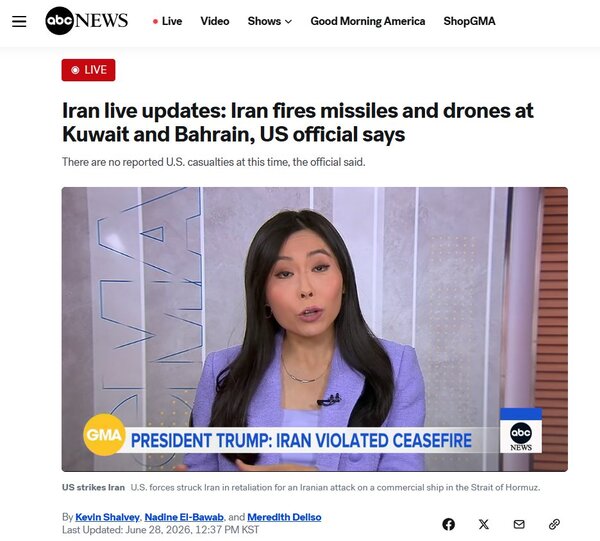
On June 28 (local time), America’s ABC News reported: "President Trump wrote on Truth Social today, 'U.S. aircraft just struck Iranian missile and drone storage facilities, alongside coastal radar bases, in response to yet another violation of the ceasefire agreement,' adding, 'It is highly likely they will never learn their lesson.'" The network further reported that Trump noted, "'A point may come where we can no longer respond reasonably, and it may be time to militarily finish what we started so successfully,' declaring that if it comes to that, 'the Islamic Republic of Iran will no longer exist.'"
These remarks followed U.S. airstrikes on Iran for two consecutive days. ABC News pointed out: "U.S. Central Command (CENTCOM) announced it carried out additional airstrikes against Iran on the evening of June 27, a measure responding to an Iranian drone attack launched earlier that morning. In response, Iran launched an immediate counterstrike."
Citing a U.S. official, ABC News reported: "Iran launched multiple missiles and drones toward neighboring countries, including Bahrain and Kuwait. As of now, no U.S. casualties or significant damage to major facilities have been reported."
U.S. public broadcaster NPR stated: "The flashpoint of the crisis was a drone attack on June 25 (local time) near the Strait of Hormuz." It noted that the Singapore-flagged container ship Ever Lovely was struck at sea near Dahit, Oman, prompting the International Maritime Organization (IMO) to temporarily suspend its plan to evacuate 11,000 seafarers from the Strait of Hormuz. NPR, quoting a U.S. official, pointed out that the vessel was hit by a drone operated by the Islamic Revolutionary Guard Corps (IRGC).
At the time, President Trump stated at the White House, "I don't like the fact that they fired a shot yesterday—well, four shots to be exact." When asked why Iran would retaliate when he had consistently emphasized that negotiations were going smoothly, he responded, "They are a bit different," before cutting off further questions from reporters. Vice President JD Vance, who spearheaded the ceasefire negotiations, also warned on social media: "Iran claims there is a disagreement over the application of the MOU. Call us. Violence will be met with violence."
The Iranian side immediately fired back. Al Jazeera reported: "The Iranian Navy claimed this route was established without prior coordination with Iran, calling it unacceptable and entirely dangerous. It warned that the only authorized transit route through the Strait of Hormuz is the one declared by the Islamic Republic, and that vessel traffic deviating from it is extremely dangerous and prohibited."
Ebrahim Azizi, chairman of the National Security and Foreign Policy Committee of the Iranian Parliament, also warned on social media: "The Strait of Hormuz is under Iran's jurisdiction." He urged the U.S. to "follow the rules and not mistake control for escalation," asserting that "this is not a violation of the ceasefire, but rather the management of the ceasefire."
[Airstrikes for Two Consecutive Days... Second Tanker Hit]
Tensions escalated further just a day later. NPR stated: "In response to the June 25 incident, the U.S. military struck multiple military facilities inside Iran on the night of June 26. At the time, the targeted vessel Ever Lovely was exiting the strait along a route cleared of Iranian-laid naval mines by the U.S. military." It added that a second oil tanker was hit early on June 27.
Newsweek, citing U.S. officials, reported: "Central Command carried out additional airstrikes on June 27," noting that the Panama-flagged oil tanker M/T Kiku, carrying over 2 million barrels of crude oil, was struck by a one-way attack drone while transiting near the strait.
The U.S. military responded immediately with a second round of airstrikes. Radio Free Europe/Radio Liberty (RFE/RL), citing a U.S. defense official, reported: "In the June 26 operation, six U.S. aircraft struck four targets inside Iranian territory, including radar facilities and missile/drone storage facilities in the coastal area of Sirik."
In a statement on June 27, U.S. Central Command stated: "Iran, which struck the Kiku, was given an opportunity to comply with the ceasefire agreement but refused to do so." It added that the U.S. military targeted Iran's military surveillance infrastructure, communication systems, air defense facilities, drone storage sites, and minelaying capabilities.
[Iran Simultaneously Strikes U.S. Bases in Kuwait and Bahrain]
RFE/RL reported that "Iran's retaliation was swift," adding: "The IRGC launched a retaliatory strike between 2:00 AM and 3:00 AM on June 28, firing missiles and drones toward facilities connected to the U.S. military, with Kuwait and Bahrain reporting the influx of projectiles." The IRGC claimed in a statement that it had destroyed eight critical U.S. military facilities, including the Ali Al Salem Air Base in Kuwait and the 5th Fleet facilities at Port Salman in Bahrain. However, RFE/RL explicitly noted that these claims of damage could not be independently verified.
In connection with this, The Times of Israel (TOI) reported: "The IRGC warned that violating the ceasefire acts contrary to Article 1 of the Islamabad Memorandum of Understanding and will result in the complete suspension of all diplomatic procedures." Additionally, the IRGC added via a public bulletin that Ebrahim Al-Fiqar, spokesperson for Iran's Khatam al-Anbiya Central Headquarters, stated that any new attack, regardless of pretext or scale, would face a crushing response.
Reporting on the situation that day, ABC News stated that "Bahrain condemned Iran's despicable attack" and noted that "Kuwait and Egypt also immediately condemned it." Regarding U.S. damage, ABC News cited a U.S. official who stated that while the situation is still evolving, no U.S. casualties or significant damage to major facilities have been reported so far.
[The 'Islamabad Memorandum of Understanding' on the Verge of Collapse]
This clash broke out just ten days after the "Islamabad Memorandum of Understanding" was signed by the U.S. and Iran on June 17. This 14-article agreement stipulates the termination of military attacks, the resumption of 60 days of tariff-free commercial navigation in the Strait of Hormuz, the lifting of the U.S. Navy's blockade on Iranian ports, and a 60-day extension of the ceasefire. President Trump and Iranian President Masoud Pezeshkian signed the document remotely; Trump signed it during a dinner with French President Emmanuel Macron at the Palace of Versailles following the G7 summit, while Pezeshkian signed it in Tehran.
However, the MOU was an "incomplete agreement" that failed to resolve all core points of contention. The text contained no specific agreements regarding Iran's nuclear program or its uranium stockpiles. It merely stated that in a final agreement, uranium enrichment levels would be downgraded from weapons-grade to reactor-grade, entirely omitting any mention of Iran's ballistic missile program or its regional network of non-state allies.
The issue of transit through the Strait of Hormuz emerged as the crux of the conflict immediately after the agreement was signed. Critical Threats, an analytical project under the Institute for the Study of War (ISW), analyzed in a report on June 26—prior to the outbreak of the clashes: "Iran is currently using force in an attempt to maintain control over the Strait of Hormuz. In the short term, it is trying to use force to prevent vessels from using routes not approved by Iran." The same report noted: "U.S. and Gulf Cooperation Council (GCC) ministers issued a joint statement on June 25, emphasizing that free, unconditional, and unrestricted navigation through the strait is essential to regional and international security, explicitly rejecting any attempts to impose tolls, fees, or claims of control over the strait."
Regarding this, Fox News reported: "The Iranian side has maintained its position to reaffirm its right to impose transit fees since the ceasefire took effect." Citing Hossein Ghorbanzadeh, a member of the Iranian negotiating team, the network reported his counterargument: "Once this period (the 60-day fee exemption) ends, the collection of fees from transiting vessels will resume." He pushed back against claims that imposing transit fees solely for passage is "meaningless under international law," arguing that the fees are collected as compensation for services provided to the vessels.
["An Immediate Return to Full-Scale War Unlikely"... But Spark Remains]
A tone of caution persists within the U.S. government, suggesting that these airstrikes will not immediately lead to a full-scale resumption of military operations. ABC News previously noted: "On February 28, President Trump, alongside Israel, declared 'full-scale combat operations' against Iran with massive joint airstrikes targeting military, government, and infrastructure targets." The network also previously reported that Vice President JD Vance stated, "Opening the Strait of Hormuz and ending Iran's nuclear program have already been achieved; now the question is what more we can achieve together."
Nevertheless, concerns continue to mount in legislative bodies. ABC News reported: "Mohammad Bagher Ghalibaf, a key Iranian figure, pushed back against President Trump's threats regarding control over Iran and the Strait of Hormuz."
This clash does not necessarily mean the MOU itself has failed. However, because the agreement failed to clearly define control and navigational rules for the Strait of Hormuz—the most sensitive issue—it ultimately left behind the sparks for armed conflict. The U.S. maintains its stance on defending the freedom of international navigation, while Iran is attempting to establish its practical control over the strait as a fait accompli. Consequently, similar clashes are highly likely to recur in the future if tankers or warships utilize routes not designated by Iran. In other words, analysts suggest this situation is less a collapse of the ceasefire and more the beginning of a posturing match ahead of larger negotiation
s.

-중국 푸단대학교 한국연구원 객좌교수
-전 EDUIN News 대표
-전 OUR NEWS 대표
-제17대 대통령직인수위원회 정책기획팀장
-전 대통령실 홍보기획비서관
-사단법인 한국가정상담연구소 이사장
-저서: 북한급변사태와 한반도통일, 2012 다시우파다, 선거마케팅, 한국의 정치광고, 국회의원 선거매뉴얼 등 50여권