
Update2026.10.24 (토)


[The Iron Fortress Falls: Shock of the Massive Explosion at Moscow’s Core Refinery]
Moscow, the very heart of Russia, has been engulfed in a massive fire following a precise long-range kamikaze drone strike by Ukrainian forces. This devastating blow to its core energy infrastructure signals an unprecedented military collapse of the Kremlin's meticulously crafted myth of territorial security and regime control.
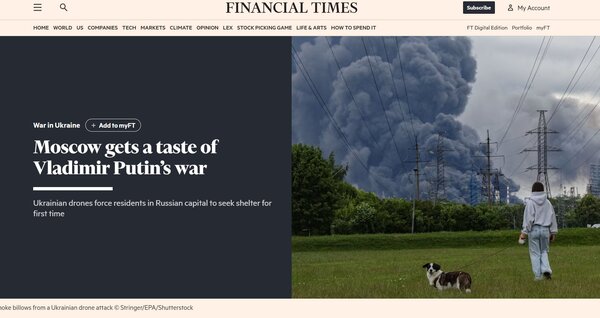
The UK's Financial Times (FT) reported on June 28, "Since Vladimir Putin launched his full-scale war of aggression against Ukraine, the most powerful and precise long-range strike has directly hit the heart of the Russian capital." The report noted that high-performance kamikaze drones developed independently by Ukrainian forces simultaneously struck the Moscow Refinery (MNPZ) in the Kapotnya district, located just 15 kilometers southeast of central Moscow. Operated by the state-owned Gazprom Neft, this refining facility serves as an absolute energy backbone, solely accounting for 40% of the gasoline and 50% of the diesel fuel supplied to the entire Moscow metropolitan area.
FT further explained, "On the day of the strike, consecutive massive explosions erupted across at least five core high-tech refining units inside the plant, sending towering plumes of thick black smoke and toxic fire dozens of meters high, completely shrouding the southern skies of the capital." For years, while border regions adjacent to Ukraine—such as Belgorod and Kursk—were devastated by shelling and drone raids, Moscow residents had maintained their daily lives under ironclad guarantees of safety. However, this strike left locals gripped by extreme terror as the distinct buzz of drones and subsequent explosions shattered the night sky.
Regarding the incident, Konrad Muzyka, director of Rochan Consulting—a Polish military analysis firm—explained: "Ukraine's long-range drone strikes targeting the capital have entered a highly sophisticated phase, completely different from the past in terms of frequency, destructive power, and precision penetration." He pointed out that this represents "a major strategic failure of the air defense systems that the Russian military long boasted about."
Moscow Mayor Sergei Sobyanin hastily announced through state-controlled media that the air defense systems achieved their largest defensive milestone yet by downing 180 drones approaching the capital. However, FT countered this narrative, stating, "The drones that breached the air defense network precisely destroyed the refinery's newest production line, the 'Euro+' advanced refining unit, alongside massive crude oil storage tanks, rendering the Kremlin's claims of an invincible air defense shield completely hollow." According to industry insiders and military analysts, the strike has abruptly slashed the Moscow Refinery's operational capacity by more than half. Due to supply bottlenecks for damaged, Western-made precision components, a total shutdown lasting at least six months appears inevitable.
The Ukrainian government made it clear that this large-scale operation was a legitimate act of self-defense aimed at fundamentally crippling Russia's capacity to sustain the war. Immediately following the successful raid, Ukrainian President Volodymyr Zelenskyy issued a stern warning:
"If Ukraine burns, your Moscow will burn as well."
[Capital Discontent Explodes Over Disconnected Administration and Blocked Civil Defense]
As the massive state infrastructure in the center of the capital burned, the shoddy and incompetent state of Russia's civil defense network—previously masked by Kremlin propaganda—was laid bare. FT reported, "Because critical disaster updates and evacuation orders were not provided in real-time, official Telegram channels operated by the Moscow regional government and local municipalities were paralyzed by fierce backlash from furious residents lambasting government incompetence." Olga, a resident of Khimki, a satellite city north of Moscow, vented her frustration on social media: "I was trembling in fear as I heard the drones buzzing vividly right over my head. I evacuated to the apartment hallway, and it took a full hour before a belated warning was posted on the mayor's official Telegram."
As intense public protests mounted, the explanations offered by local municipal bureaucrats highlighted the deep-seated irresponsibility and military limitations of the Russian bureaucracy. According to an official response posted by a local municipality, officials deflected blame by claiming, "Ukrainian low-altitude penetration drones fly tightly hugged to the ground at an altitude of just one meter, only climbing right before hitting their targets, making advanced detection via radar physically impossible."
Furthermore, one official offered an absurd defense logic that maximized public distrust in the administration, stating, "If we had hastily triggered the air raid sirens in the early hours of the morning, civilians would have fallen into extreme panic and poured out into the streets. This could have resulted in massive civilian casualties caused by falling drone debris and shrapnel, which is why the sirens were not activated."
FT noted that while the Russian government heavily promoted claims that the fuel supply remained completely unaffected and that reserve resources were abundant immediately after the refinery strike, the highly visible physical damage and environmental pollution could not deceive Moscow citizens. "The rapid, incomplete combustion of thousands of tons of gasoline and petroleum products released heavy oil compounds and soot particles into the atmosphere. This mixed with rain clouds, unleashing a toxic 'petroleum rain' phenomenon that blanketed residential areas across southeastern Moscow," the paper reported.
[Social Fragmentation Surfaces and Incompetent Air Defenses Draw Mockery]
This strike on Moscow acted as a detonator, igniting deep-seated regional animosities and a profound distrust toward the privileged class within Russian society. A female resident from Russia's Belgorod region—which borders Ukraine and has routinely suffered from constant shelling, drone strikes, and civilian casualties since the onset of the war—left a telling post on social media: "I’m not proud to say this, but I honestly feel relieved that Moscow residents are finally experiencing the same hellish terror that we in the border provinces have endured for years." This exposure vividly reflects the deep rooted class and regional fractures dividing Russia as the war drags on.
While Kremlin-aligned scholars and state media scrambled to downplay the significance of the attack, Andrei Kolesnikov, an independent political scientist operating out of Moscow, offered a starkly different assessment of the grim reality. Kolesnikov analyzed, "Despite the government's heavy-handed media censorship, now that citizens have witnessed the physical reality of central Moscow burning with their own eyes, the propaganda strategy of pretending the strikes have no impact has completely lost its efficacy." However, he added, "Because Moscow itself is vast, a disparity in the sense of crisis exists between the western districts—where high-ranking officials and the wealthy reside—and the southeastern working-class neighborhoods directly impacted by the refinery blast. This gap could further exacerbate internal friction."
FT reported that despite civilian anxiety reaching its peak, the Russian Ministry of Defense and military leadership failed to present any practical or concrete deployment adjustments or complementary measures to reinforce the capital's air defenses, effectively conceding their incompetence. "Instead, immediately following the strike, temporary military fixes were captured on private Russian military Telegram channels, showing short-range Pantsir-S1 air defense missile systems being frantically hoisted onto the roofs of major government buildings and high-rises in central Moscow via cranes, drawing widespread mockery," FT noted.
According to a big data analysis by Dig, a digital narrative and social media analytics firm, more than 30% of high-exposure posts circulating on Russian internal networks immediately after the refinery hit focused directly on mocking and criticizing the incompetence of the Putin regime and military command. The prevailing sentiment was that "the strike clearly exposed how fraudulent the military's defensive capabilities and the Kremlin's constant boasting of a world-class, invincible air defense shield truly were."
[Putin’s Distorted Reality and the Risk of Escalation Under a Hardline Dictatorship]
Even as the collapse of the air defense framework and the alienation of public sentiment become undeniable, Russian President Vladimir Putin’s dictatorial distortion of reality and hardline stance show no signs of course correction as he fights to maintain his grip on power.
In an official address delivered at a combined graduation ceremony for major military academies shortly after the raid, Putin framed the incident not as a military failure on the front line, but as a despicable psychological warfare operation orchestrated by Ukraine and the West. Speaking before a crowd of newly commissioned elite officers, Putin asserted that the drone strike was "nothing more than a terrorist act driven by a malicious intent to destabilize Russian society and instill doubt among our great citizens regarding our military advances on the front line."
Military analysts interpret Putin's rhetoric as an expression of existential dread—a realization that acknowledging vulnerabilities on the battlefield could trigger the total collapse of his entrenched dictatorial regime. Experts note that whenever Putin faces substantive external military pressure, he historically circumvents crises not through tactical retreats or compromises, but by drastically tightening internal controls and escalating external stakes. Political scientist Andrei Kolesnikov expressed grave concerns over the catastrophic outcomes this rigid decision-making structure within the Kremlin could yield:
"While Ukraine’s strike on the Moscow Refinery served as an eye-opener for internal anti-war factions regarding the regime's vulnerabilities, it simultaneously hands the Kremlin's ultra-hardliners and military hawks the exact pretext they need under the banner of 'the capital is under attack.' This is providing a dangerous excuse to demand indiscriminate retaliation against civilian infrastructure or pressure for the use of tactical nuclear weapons."
Kolesnikov sharply projected that "the security pressure mounting on Putin acts not as a catalyst for reflection, but as an accelerant pushing toward an unprecedented escalation of the war."
Ultimately, the loss of Moscow's status as a safe zone carries a dangerous dual edge. Rather than fostering cohesive internal anti-war pressure, it risks serving as a volatile fuse that drives the desperate Putin regime toward extreme military escalations and the activation of a second mass mobilization framework to ensure its own survival.
For a visual overview of the real-world scale of this escalation, you can watch this report on the Ukrainian Drone Swarm Hit on the Moscow Refinery. This video features geolocated footage demonstrating the precise moments of impact and the severe explosions that disrupted the capital's critical fuel supply infrastructure.


-중국 푸단대학교 한국연구원 객좌교수
-전 EDUIN News 대표
-전 OUR NEWS 대표
-제17대 대통령직인수위원회 정책기획팀장
-전 대통령실 홍보기획비서관
-사단법인 한국가정상담연구소 이사장
-저서: 북한급변사태와 한반도통일, 2012 다시우파다, 선거마케팅, 한국의 정치광고, 국회의원 선거매뉴얼 등 50여권