
Update2026.10.24 (토)


[Official Actions and Legal Background of US Intelligence Agencies]
As US national security and intelligence agencies have decided to track and fully disclose to the public the corruption status and massive hidden assets across the globe belonging to the Chinese Communist Party's (CCP) top leadership—including President Xi Jinping—widespread attention is focusing on forecasts that this exposure will deal a fatal blow to the CCP's leadership structure.
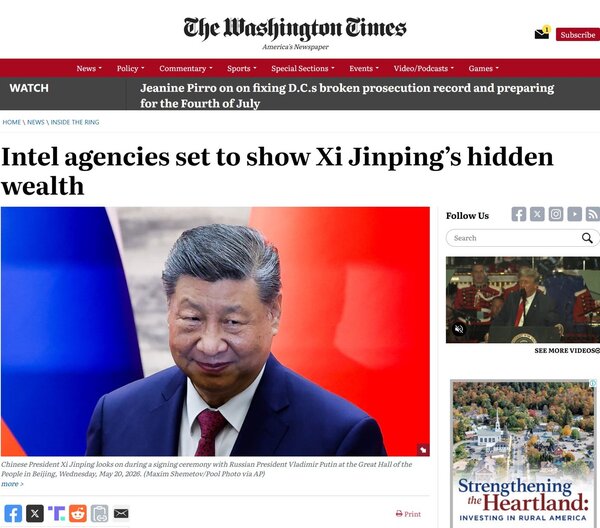
On the 25th, The Washington Times (WT) drew significant attention by reporting, "The Office of the Director of National Intelligence (ODNI), which oversees US national security and intelligence sectors, is facing a high-intensity investigation to identify the secret financial assets and illicit wealth accumulation of Chinese President Xi Jinping and other top CCP leadership." The paper added, "This measure is in accordance with obligations specified in the 'Fiscal Year 2026 Intelligence Authorization Act (FY2026 IAA),' a core subsidiary law of the National Defense Authorization Act (NDAA) which defines US defense and national reconnaissance capabilities. The bill officially took effect after passing the US Congress last December and being signed by the head of the executive branch."
The Washington Times further noted, "An ODNI spokesperson formally acknowledged the intelligence community's official state of readiness in an interview with 'Inside the Ring,' the military and national security reporting section of The Washington Times." On that day, the spokesperson declared, "I can confirm that ODNI is very actively compiling the relevant report internally, as mandated by the FY2026 Intelligence Authorization Act."
WT pointed out, "According to the legal deadline, this report must be formally submitted to the US Congress before December this year and will simultaneously be made public worldwide via the internet."
In response, Radio Free Asia (RFA) stated, "The CCP leadership has maintained power for a long time by outwardly emphasizing control over capitalism, integrity, and a strict anti-corruption drive." RFA added, "However, this upcoming investigation by the US intelligence community focuses heavily on exposing the hypocrisy of top-ranking officials who have amassed astronomical wealth behind the scenes and funneled it overseas." Security experts project that "the disclosure of these assets by US authorities goes beyond simple information sharing; it will serve as a strategic tool to deal a fatal blow to Beijing's morality and justification for governance."
[Expansion of Precise Tracking Targets and Investigative Scope]
WT reported, "Under the newly enacted Intelligence Authorization Act, the targets undergoing microscopic scrutiny by US intelligence are the entire core leadership exercising extrajudicial power within China." The legal provisions directly designate all seven members of the Politburo Standing Committee—the center of the collective dictatorship that practically rules the CCP—as top-priority subjects of investigation. This includes not only General Secretary and President Xi Jinping, who sits at the apex of power, but also the remaining six Standing Committee members who control the administration and parliament. The probe will encompass their personal wealth status, large-scale financial holdings, and direct or indirect commercial ties.
WT further explained, "Moreover, this investigation has been abruptly expanded beyond the seven Standing Committee members to include all 25 members of the Politburo, the core elite group of the CCP." The evidence being gathered by US intelligence analysts encompasses not only assets owned by these leaders under their own names, but also borrowed-name accounts using relatives or third parties, shell companies, and tangible and financial assets indirectly controlled through financial proxies. The scope of the investigation comprehensively covers assets within mainland China, as well as Hong Kong and Macau—where hiding funds to evade regulatory oversight is easier—alongside massive real estate portfolios distributed across major global financial hubs and developed nations.
Regarding this, The Cipher Brief, a prominent US digital media and national security think-tank platform, analyzed: "According to detailed guidelines in the legislation passed by Congress, the report must contain concrete evidence regarding all forms of 'high-value personal assets' and corporate equity managed outside the Chinese system, including stocks, bonds, and fund investments, in addition to standard bank accounts." It reported that "the intelligence community is known to be deploying a combination of advanced financial tracking techniques, human intelligence (HUMINT), and signals intelligence (SIGINT) for this purpose." The Cipher Brief added, "This measure reflects the strong determination of the United States to fundamentally dismantle the sophisticated global money-laundering network built by the CCP leadership to evade legal oversight."
[Anatomy of Concealment Techniques and Overcoming Limits of Past Reports]
In a related development, the Director of National Intelligence (DNI) stated, "The key area that US intelligence analysts are focusing on in this report is blocking the sophisticated detour routes utilized by the CCP leadership to disguise actual asset ownership." The law mandates that the intelligence community unearth and record the real names of financial proxies, front commercial partners, and proxy entities involved in concealing asset ownership. The DNI added, "The intelligence community is increasing the density of the investigation by using existing data previously submitted to Congress by ODNI as a baseline," noting that prior related reports had been published under the title 'Wealth and Corrupt Activities of the Leadership of the Chinese Communist Party.'
RFA also pointed out, "According to early analysis data disclosed in the past, President Xi Jinping has highly concealed massive assets worth at least $1 billion (approx. 1.3 trillion KRW) by using close relatives—such as his older sister, brother-in-law, and daughter—as well as a group of loyal vassals as shields, rather than using his own direct name." It also exposed that "as much as 65% of the Chinese bureaucratic workforce generates unofficial and illegal income through bribery, interest peddling, and embezzlement of public funds outside of their legitimate salaries." However, that early report faced harsh criticism from the US Congress at the time because it relied too heavily on general media reports or open sources rather than the exclusive information of national intelligence agencies, leaving concrete physical evidence and detailed asset distribution channels insufficient.
WT noted, "Consequently, through the newly passed Intelligence Authorization Act, Congress has legally mandated that the intelligence community fully disclose to the public highly advanced 'nonpublic information' secured by them, to the maximum extent possible within protectable bounds." This amounts to a demand for undeniable physical evidence that goes beyond the level of news reporting. WT pointed out, "The statute stipulates that the final report must be prepared in an unclassified, general document format and permanently posted on the ODNI website," adding that "a 'Classified Annex' may be attached restrictively only for top-secret matters that can absolutely never be disclosed externally in order to protect intelligence sources or methods."
[Strategic Strategy and Bipartisan Cooperation in US Politics]
The background behind such a powerful asset disclosure bill gaining rapid momentum and becoming institutionalized in US politics lies in the strategic alignment of both ruling and opposition parties in the US to deter the expansion of the communist regime. The key figures who proactively led this legislative action at the congressional stage are Republican Representative Andy Ogles of Tennessee and Secretary of State Marco Rubio, who was a federal senator at the time the bill was introduced and currently serves as the chief of US foreign policy and national security. They have long prepared precise legislative procedures to exploit the structural vulnerabilities of the CCP regime.
Paul Berkowitz, a veteran China expert and former chief congressional staffer who advised on Asian security and China policy in the US Congress for 31 years, clearly highlighted the strategic value of this legislation. Former Staffer Berkowitz evaluated, "They accurately saw that these massive hidden assets are the fatal Achilles' heel of the CCP regime, and therefore sought to precisely target the unique and vulnerable weakness held by the CCP." WT pointed out, "US political circles have chosen this asset exposure card as a soft-power tool to maximize internal contradictions within the CCP system and cause it to collapse on its own without military conflict."
Furthermore, in the federal Senate, Senator Rick Scott and others have heightened the pressure across all fronts by additionally introducing the 'PICTURES Act,' which demands the inclusion of a large volume of photographs and visual physical evidence to prove the illicit wealth accumulation of the leadership. In an official statement, Senator Scott strongly criticized, "The ruthless Chinese Communist Party regime is built upon a false throne of lies, theft, and tyranny, which undermines foundational American values." He declared, "Xi Jinping and his cronies are not normal national leaders, but merely authoritarian predators and profiteers threatening freedom and human life, and through this bill, we will prove to the world just how corrupt they are." In response to this powerful bipartisan demand from Congress, the intelligence community is focusing all its efforts on securing definitive financial traces and physical evidence beyond a simple text report.
[A Fatal Blow to the Moral Legitimacy of the CCP Regime]
WT noted, "Security experts diagnose that if this report currently being compiled by the US intelligence community is made public to the world as scheduled, the internal repercussions faced by the Beijing regime will reach a catastrophic level." This is because "a communist dictatorship essentially secures its legitimacy of governance by fabricating an image of clean public servants serving the people."
In this regard, former Staffer Paul Berkowitz strongly warned of the potential for a severe alienation of public sentiment inside the CCP. Berkowitz asserted, "The Communist Party has maintained the legitimacy of its rule by packaging itself as humble public servants of the people. If ordinary Chinese citizens find out how unimaginably and disgustingly wealthy their leaders actually are, it will deal a fatal and catastrophic blow to the CCP system."
WT pointed out, "In fact, over the past 12 years since taking power, President Xi Jinping has conducted a massive 'anti-corruption campaign,' purging millions of party members and bureaucrats to consolidate his own power." According to detailed research data from the Congressional Research Service (CRS), during this process, as many as 266 top-ranking officials at the Central Committee level—the core of power—including former Defense Minister Li Shangfu and former Foreign Minister Qin Gang, were relentlessly ousted on corruption charges. "However, it has been revealed that Xi Jinping himself and his relatives—the perpetrators and architects of this anti-corruption drive—have continuously rolled over assets already confirmed to be worth hundreds of millions of dollars under the protection of power, such as indirectly owning an 18% stake (valued at $311 million) in a rare earth mining company and investing $20.2 million in a high-tech firm," WT sharply criticized.
If the reality of wealth accumulation by dictators, which has been thoroughly veiled, is fully disclosed alongside authoritative physical evidence from the US government, it will act as pouring gasoline on the anger of Chinese citizens currently suffering from a severe real estate slump, skyrocketing youth unemployment, and a domestic recession. The sense of betrayal—that while forcing socialist morality and the sharing of pain onto the people, the high-ranking CCP officials have been fattening their own pockets in a capitalist manner—could lead to uncontrollable large-scale popular uprisings or systemic fractures. The Chinese Embassy in the US has remained silent without offering any official explanation or stance regarding these specific movements by US intelligence and reports on hidden assets, seemingly wary of serious diplomatic repercussions. This year-end asset disclosure, led by Director of National Intelligence Tulsi Gabbard and Secretary of State Marco Rubio, is projected to become a powerful nuclear bomb that will shake the very foundations of CCP governance.
-중국 푸단대학교 한국연구원 객좌교수
-전 EDUIN News 대표
-전 OUR NEWS 대표
-제17대 대통령직인수위원회 정책기획팀장
-전 대통령실 홍보기획비서관
-사단법인 한국가정상담연구소 이사장
-저서: 북한급변사태와 한반도통일, 2012 다시우파다, 선거마케팅, 한국의 정치광고, 국회의원 선거매뉴얼 등 50여권