
Update2026.10.24 (토)


[Right-Wing Victories in Colombia and Peru: Brazil's Presidential Election to Decide the Fate of the 'Pink Tide']
The "Pink Tide"—the wave of left-wing governments that swept Latin America in the early 21st century—is receding at a rapid pace. Following a string of recent presidential victories by right-wing candidates in Colombia and Peru, a growing number of nations in the region are moving to strengthen security and diplomatic cooperation with the United States. Coupled with a regime change in Venezuela earlier this year and the subsequent waning of Chinese influence, Latin America is rapidly emerging as a critical new theater in the U.S.-China geopolitical tug-of-war.
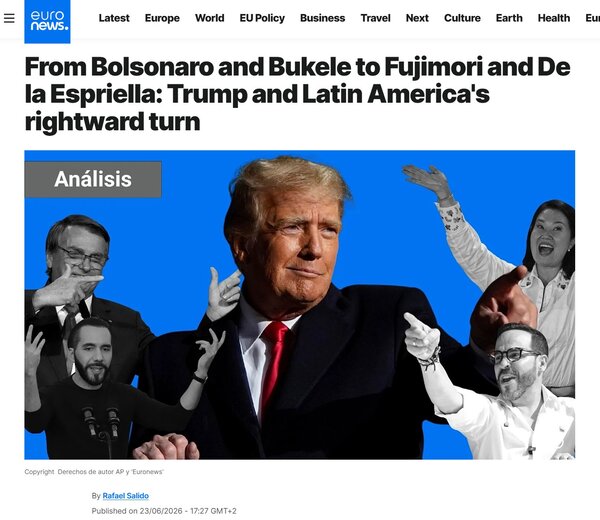
Experts view Brazil’s upcoming presidential election in October as the final bellwether that will fundamentally reshape the region's political landscape. Analysts suggest that if Brazil also shifts to a right-wing administration, the two-decade-long Pink Tide could effectively be relegated to history.
According to a report by Europe's Euronews on June 24, "In the presidential runoff election held in Colombia on June 23, right-wing candidate Abelardo de la Espriella effectively secured victory, defeating left-wing candidate Iván Cepeda by a margin of approximately 200,000 votes." The network added, "De la Espriella, a businessman and attorney with no prior political experience, will take office on August 6, succeeding President Gustavo Petro, who frequently clashed with U.S. President Donald Trump."
Euronews also reported on similar developments in Peru: "In Peru's presidential runoff held on June 7, right-wing candidate Keiko Fujimori is poised for victory, holding a slim lead over left-wing candidate Roberto Sánchez." With over 99.6% of the votes counted, Fujimori leads by approximately 40,000 votes. However, because the Sánchez camp has filed challenges contesting the voting procedures for overseas citizens, the final official declaration of the winner is expected next month.
This sequential rise of conservative administrations across Latin America over the past few years is noticeably redrawing the region’s political map. These new governments share core policy priorities: hardline law-and-order stances, strict control over illegal immigration, market-driven economic policies, fiscal austerity, and a staunch anti-socialist agenda. In foreign policy and national security, they are pivoting toward expanded cooperation with Washington. Latin American nations that once championed an "anti-American coalition" are now shifting their weight back toward the United States, driven by pressing security and economic interests.
[Beyond a Simple Shift to the Right: Trump Constructs a New Security Order]
Analysts argue that viewing this transition purely as a routine ideological shift to the right tells only half the story. The Trump administration is leveraging these regime changes to aggressively accelerate the establishment of a U.S.-centric regional security framework.
As reported by ABC News: "At the 'Shield of the Americas' summit held in Florida this past March, President Trump officially announced the launch of the 'Americas Counter-Cartel Coalition,' a pact involving 17 nations." The core of the agreement centers on designating drug cartels, transnational criminal syndicates, and terrorist organizations as shared national security threats, thereby drastically expanding military and intelligence cooperation.
ABC News further explained, "Invitations to the summit were selectively extended to nations aligned with Washington's Western Hemisphere strategy, with pro-U.S. administrations in Argentina, El Salvador, and Trinidad and Tobago coalescing into a new regional security axis." During the event, President Trump explicitly hinted at impending regime change in Havana, remarking to Cuba that "the end is not far off."
This indicates that current developments transcend a mere political changing of the guard. Instead, they reflect a structural re-engineering by Washington to firmly reintegrate Latin America into its core national security architecture. While previous U.S. efforts were largely limited to countering Chinese economic inroads, the strategy has now expanded into a comprehensive, hard-power strategic competition encompassing military and intelligence integration.
[Venezuela's Regime Change Flipped the Script]
Geopolitical experts point to the regime change in Venezuela earlier this year as the decisive catalyst for this regional transformation. The Hill, a U.S. media outlet specializing in congressional affairs, analyzed the situation: "Following a U.S. military operation in January 2026 that brought an end to the Nicolás Maduro regime, the socialist axis that symbolized the Latin American left for over twenty years has effectively collapsed."
For decades, Venezuela—alongside Cuba—served as the political and symbolic gravity well for Latin America's left-wing factions. Bolstered by strategic, financial, and military backing from China and Russia, Caracas stood as the hemisphere's premier counterweight to Washington. However, the downfall of the Maduro regime has severely fractured the solidarity of the regional left, creating a domino effect that is rapidly reshaping the domestic politics of neighboring countries.
In Chile's presidential runoff last year, right-wing candidate José Antonio Kast secured the presidency by defeating his left-wing opponent by a wide margin. At the time, Argentine President Javier Milei publicly shared a map of South America, commenting that "the left is retreating, and freedom is advancing." Reinforced by the latest election outcomes in Colombia and Peru, the narrative that Latin American politics is undergoing a structural, long-term realignment is gaining significant traction.
[China's Political Grip Weakens, But Economic Presence Endures]
This wave of political realignment presents a formidable challenge to Beijing. Over the past decade, China aggressively utilized its Belt and Road Initiative (BRI) to plow massive investments into Latin American ports, railways, mines, and energy infrastructure, directly challenging traditional U.S. hegemony in the Western Hemisphere.
Lately, however, that momentum has noticeably stalled. The Hill noted that "Panama withdrew its participation from China's Belt and Road Initiative, causing Beijing to lose a substantial portion of its influence over strategic ports adjacent to the Panama Canal."
The publication further detailed: "As of the first half of 2025, Chinese construction contracts secured by the 21 Latin American BRI participant nations accounted for a mere 1.14% of China's global total, with investment shares dropping to 0.4%—a steep decline from previous years." The Hill added that lending to Latin America by Chinese state-owned policy banks has plummeted from an annual peak of $25 billion in 2010 to a recent annual average of just $1.3 billion.
Analysts attribute this retreat to China's domestic economic slowdown, ongoing real estate crises, and local government debt burdens, which have severely constrained Beijing’s capacity for large-scale overseas capital deployment. The era in which China could buy outsize geopolitical leverage through raw financial power appears to be drawing to a close.
Nevertheless, experts warn against interpreting this as a total Chinese exit from the region. The Brookings Institution pointed out: "China has already cemented its status as the primary trading partner for multiple South American nations, eclipsing the United States, and it maintains formidable control over critical sectors like mineral extraction, port operations, and energy grids." The think tank cautioned that "it is premature to assume that a political shift to the right will automatically translate into an economic decoupling from China."
In short, a complex "dual-track structure" is emerging: while Latin American capitals are aligning closer to Washington politically and strategically, they remain deeply tethered to Beijing economically. This systemic entanglement suggests that Latin American states will continue to attempt a delicate diplomatic balancing act between the two superpowers.
[The Ultimate Battleground: Brazil to Dictate the Future of U.S.-China Rivalry]
All eyes are now fixed on Brazil as it moves toward its pivotal October presidential election. Recent polling by AtlasIntel reveals an razor-thin, dead-heat race within the margin of error between incumbent President Luiz Inácio Lula da Silva and Senator Flávio Bolsonaro, who has received the public endorsement of Donald Trump. As Latin America's largest economy with a population exceeding 200 million, one of the world's premier agricultural exporters, and a cornerstone member of the BRICS bloc, Brazil possesses geopolitical and symbolic weight that eclipses any other nation in the region.
Should Brazil transition to a conservative administration, the United States will successfully lock in an unbroken, pro-U.S. alignment stretching from Canada through Mexico all the way to the southern tip of the continent—forming a veritable "Trump Belt." Conversely, a victory for the Lula camp would guarantee Beijing a vital strategic anchor to maintain and project its influence across Latin America via the BRICS framework.
U.S. public broadcaster NPR urged caution regarding sweeping narratives, noting: "Left-wing or authoritarian systems endure in several nations, including Venezuela, Cuba, and Nicaragua, meaning it is necessary to be prudent before diagnosing the region’s shift purely as a wholesale 'democratic wave to the right.'" Some academic quarters also argue that this trend cannot be credited solely to Donald Trump's personal influence; rather, it represents a volatile accumulation of voter frustrations over protracted economic stagnation, rampant insecurity, and illegal immigration crises.
What remains undeniable, however, is that Latin America can no longer be characterized simply as America's uncontested "backyard" or as China's expanding economic satellite. The United States is aggressively reasserting its dominance through the lens of regional security, while China relies on its deeply entrenched economic leverage to defend its positions. Consequently, Latin America has graduated into a premier theater of direct U.S.-China strategic competition, carrying a geopolitical weight on par with Ukraine or the Indo-Pacific. Brazil’s election this October will likely serve as the definitive turning point establishing the trajectory of this new geopolitical order.


-중국 푸단대학교 한국연구원 객좌교수
-전 EDUIN News 대표
-전 OUR NEWS 대표
-제17대 대통령직인수위원회 정책기획팀장
-전 대통령실 홍보기획비서관
-사단법인 한국가정상담연구소 이사장
-저서: 북한급변사태와 한반도통일, 2012 다시우파다, 선거마케팅, 한국의 정치광고, 국회의원 선거매뉴얼 등 50여권