
Update2026.10.24 (토)


[Former Commander of the U.S. Pacific Command Declares: "China’s Military Buildup? A Futile Endeavor"]
While China is ramping up pressure on Taiwan by flaunting its aircraft carriers, hypersonic missiles, and nuclear arsenal, an analysis by a prominent U.S. national security expert suggests that Beijing still significantly lacks amphibious warfare capabilities—the core competency required to actually seize Taiwan. This assessment has reportedly left Chinese authorities deeply disconcerted.
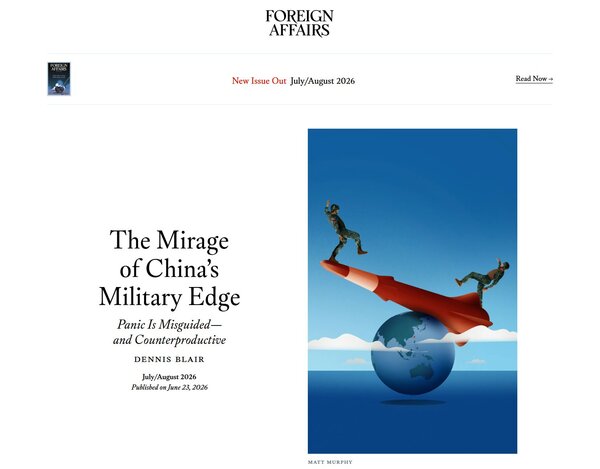
In its July/August 2026 issue, the American foreign policy magazine Foreign Affairs published an article by Admiral Dennis Blair (Ret.), former Commander of the U.S. Pacific Command, who evaluated that "the military buildup of the Chinese People’s Liberation Army (PLA) has not translated into an actual capacity to invade Taiwan." Blair diagnosed that "both the United States and China are deploying long-range hypersonic missiles that are currently impossible to intercept with existing missile defense systems. Because these missiles can precisely strike fixed targets—such as airfields, command posts, naval bases, radar installations, and space control facilities—the entirety of China’s southeastern military infrastructure supporting a Taiwan invasion is exposed to extreme vulnerability." Consequently, his analysis serves as a stern warning to China not to even contemplate an invasion of Taiwan.
Foreign Affairs further noted that "the 'reunification of Taiwan'—a core security policy of Chinese President Xi Jinping’s administration—is fundamentally misaligned with the actual force allocation of the PLA." The analysis argued, "Had Beijing focused solely on the 'unification' of Taiwan, it would have poured all of its defense resources into short-range amphibious and air-assault capabilities. It would have acquired short-range air defense and anti-submarine systems capable of thwarting counterattacks from U.S. and Taiwanese forces, thousands of landing crafts, hundreds of amphibious assault ships, surface-to-air missiles to clear Taiwanese airspace, non-nuclear submarines to hunt enemy submarines along the Chinese coast, anti-submarine mines, and maritime patrol aircraft."
However, Blair points out that reality tells a vastly different story. Foreign Affairs noted, "While China has constructed large amphibious transport docks capable of projecting power globally, their numbers are woefully inadequate to ferry the massive troop volumes required for a full-scale invasion of Taiwan." The article also pointed out, "Although aircraft carriers were built at exorbitant costs, they are useful primarily for peacetime diplomatic signaling and muscle-flexing. In an actual invasion scenario against Taiwan, they require far too much logistical support and defensive screening, rendering them highly impractical for real combat."
Furthermore, Blair observed that "investing in space capabilities is necessary for global operations but ill-suited for a localized conflict like Taiwan." Regarding China's recently expanding nuclear arsenal, the analysis remarked, "While its nuclear forces were originally sufficient to deter U.S. nuclear escalation during a Taiwan contingency, Beijing is now expanding them to pursue a nuclear balance with Moscow and Washington, aiming to ensure that Chinese interests are respected in all regions globally." In short, Blair’s diagnosis is that "China’s military buildup is not as formidable as it appears on the surface."
[Hypersonic Missiles Put China's Southeastern Coast in Crosshairs]
The asymmetric advantage most heavily emphasized by Blair is hypersonic weaponry. Although Beijing has deployed highly sophisticated air defense networks around its key military hubs, the ground-launched hypersonic missiles already forward-deployed by the U.S. military in the Pacific can neutralize these systems. This advantage is poised to widen further as air- and sea-launched variants are fielded in the near future. This American capability could rapidly neutralize China’s seven fortified features in the Spratly Islands of the South China Sea or decimate the pier facilities on the southern coast where the Chinese invasion force would embark.
Blair stresses that this technological edge is not a fleeting phenomenon. He expects this superiority in the field of hypersonic weapons to persist for at least a decade, until next-generation air defense systems—an area where the U.S. also holds the upper hand—emerge. However, he cautioned that this does not imply a permanent advantage. His recommendation is that China must acknowledge the high risks and low probability of success of an attack on Taiwan, and rein in its nationalistic posturing of military might alongside its exaggerated claims regarding American weaknesses. At the same time, he called on the United States to sustain its investments to maintain its military edge and to demonstrate confidence in its own capabilities, rather than giving credence to alarmist and exaggerated rhetoric warning of an imminent American defeat.
[The 100-Mile Trap of the Taiwan Strait... A Dispersed U.S. Military vs. A China Bound to Mass]
Blair’s analysis indicates that geographical conditions also work heavily against China. The geographical nature of a conflict surrounding Taiwan provides the United States with additional advantages. Launching long-range strikes against moving targets—whether at sea or on land—is significantly more difficult than striking fixed targets; it involves complex tracking, and missile guidance technologies remain highly vulnerable to countermeasures.
Conversely, for China to successfully invade Taiwan, it must neutralize U.S. naval vessels and mobile ground systems that are widely dispersed across thousands of miles—stretching from Guam to the Ryukyu Islands, and from Kyushu to Luzon. This presents a complete antithesis to China's operational reality, which demands massing its forces within a narrow strait. From the American perspective, the most critical moving targets to strike would be highly concentrated: a few dozen amphibious invasion ships crossing the Taiwan Strait (which is less than 100 miles wide) and military forces maneuvering within a few hundred miles of the Chinese coast. This narrow concentration of targets constitutes a highly favorable condition for the United States.
Blair made it clear that "this window of opportunity has a expiration date of 'at least ten years.'" He asserted, "Based on favorable trends in hypersonic weapons, unmanned systems, electronic warfare, and cyber warfare, the United States, its allies, and partners stand in a powerful position to deter a Chinese assault on Taiwan for at least the next decade." He analyzed that "for China to overcome this advantage, it would require exponentially higher military expenditures." However, he stressed that "this positive momentum will not maintain itself automatically," warning that "military technology does not stand still, meaning investments in innovation—particularly in space operations and artificial intelligence systems—must continue unabated." His conclusion dictates that "Taiwan, the United States, Japan, and the Philippines must continuously allocate resources and engage in effective military planning and exercises to counter China’s aggressive behavior. Every time China fortifies another reef in the South China Sea, the United States should respond by deploying more hypersonic missiles to the Philippine island of Palawan."
Blair, who served as Commander of the U.S. Pacific Command from 1999 to 2002, Director of National Intelligence from 2009 to 2010, and senior advisor for Taiwan's annual Han Kuang defense exercises from 2003 to 2007, concluded his piece decisively: "Currently, China lacks the capability to conquer Taiwan, and it is highly unlikely to acquire such a capability in the near future."
[Taiwan Enters the $18 Billion Defense Budget Era... Mandatory Service Extended to One Year]
The strengthening of Taiwan's defensive posture mentioned by Blair is corroborated by concrete data. In April, the Stockholm International Peace Research Institute (SIPRI) calculated Taiwan’s 2025 defense budget at approximately $18.2 billion, representing a 14% increase in real terms compared to the previous year. The Taiwanese government announced its intention to raise its 2026 defense budget to 3.32% of its GDP, and Taiwanese President Lai Ching-te has set a target to expand this figure to 5% by 2030. In terms of troop management, Taiwan extended its mandatory military service period from four months to one year starting in 2024, currently maintaining 169,000 active-duty personnel alongside a reserve force of over 1.65 million.
However, there is ongoing debate within Taiwan regarding how the defense budget is calculated. Beginning in 2026, Taiwan adopted a NATO-style accounting method that includes expenditures for the Coast Guard and veterans' welfare. While this has inflated the nominal figures, defense experts offer a cautious assessment as to whether it directly translates into a boost in actual combat capability. Tang Meng-kit, a Singaporean aerospace engineer, noted in an interview with the local media outlet Domino Theory: "While these accounting changes inflate the nominal defense budget, they do not necessarily signify a proportional increase in core military spending or immediate combat readiness."
[U.S. Intelligence Community Assesses "No Planned Invasion for 2027," Yet Threat Perception Continues to Expand]
Confronting Blair’s optimistic assessment, official evaluations from the U.S. Intelligence Community take a much more measured stance. The Annual Threat Assessment report, released earlier this year by the Office of the Director of National Intelligence (ODNI), evaluated that "the Chinese leadership currently does not have a definitive plan to execute an invasion of Taiwan by 2027, nor has it set a fixed timeline for achieving unification." This assessment effectively counters the 2027 invasion theory—widely dubbed the "Davidson Window"—which was originally posited in 2021 by Admiral Philip Davidson, then-Commander of the U.S. Indo-Pacific Command.
Nevertheless, the same report made it explicitly clear that Beijing has by no means abandoned the invasion option itself. The annual report submitted by the U.S. Department of Defense to Congress last December analyzed: "A full-scale invasion accompanied by a massive amphibious operation remains the most decisive yet highest-risk option. It requires a highly complex and sophisticatedly coordinated operation to breach Taiwan's coastal defenses and secure a lodgment sufficient to build up enough combat power to force unification." The Pentagon evaluated that "despite these immense risks and Beijing’s apparent preference for less dramatic options, the Chinese leadership may ultimately conclude that a full-scale amphibious assault is the only 'prudent' choice left to force unification," and is therefore "continuing its preparations for such an eventuality."
The takeaway from Blair’s analysis is not simply that "China is weak." China is undeniably expanding its military power at the fastest rate in the world; however, the direction of that investment is not necessarily optimized for an amphibious assault across the Taiwan Strait. Aircraft carriers, nuclear arsenals, and space forces are assets tailored for a global superpower, but conquering Taiwan demands amphibious assault ships, troop transports, and absolute sea control capabilities. Ultimately, Blair’s core diagnosis is that while Xi Jinping has simultaneously pursued military grandstanding and global influence expansion, China’s actual capability to invade Taiwan has not materialized as rapidly as anticipated. Nonetheless, with the U.S. Department of Defense assessing that China is steadily continuing its amphibious warfare preparations, it is impossible to conclude that the current U.S. advantage is permanent. Consequently, the next ten years are highly likely to be the most critical window in shaping the strategic environment of the Taiwan Strait, driven by the interplay between the speed of China's military buildup and the response capabilities of the United States and its allies.

-중국 푸단대학교 한국연구원 객좌교수
-전 EDUIN News 대표
-전 OUR NEWS 대표
-제17대 대통령직인수위원회 정책기획팀장
-전 대통령실 홍보기획비서관
-사단법인 한국가정상담연구소 이사장
-저서: 북한급변사태와 한반도통일, 2012 다시우파다, 선거마케팅, 한국의 정치광고, 국회의원 선거매뉴얼 등 50여권