
Update2026.10.24 (토)


[Backlash Over Takaichi’s Remarks Triggers Lockout; Airlines Shoulder the Losses]
China is effectively rolling back the de facto ban on group travel to Japan that it imposed late last year, backing down after just eight months. The tourism retaliation, triggered by Prime Minister Sanae Takaichi’s remarks regarding Taiwan, failed to deal a significant blow to the Japanese economy. Instead, it only amplified the financial losses of Chinese airlines and travel agencies. Ultimately, this move is being evaluated as yet another instance where the Xi Jinping administration's "Wolf Warrior diplomacy" prioritized face over practical interest, only to force an unannounced self-retreat.
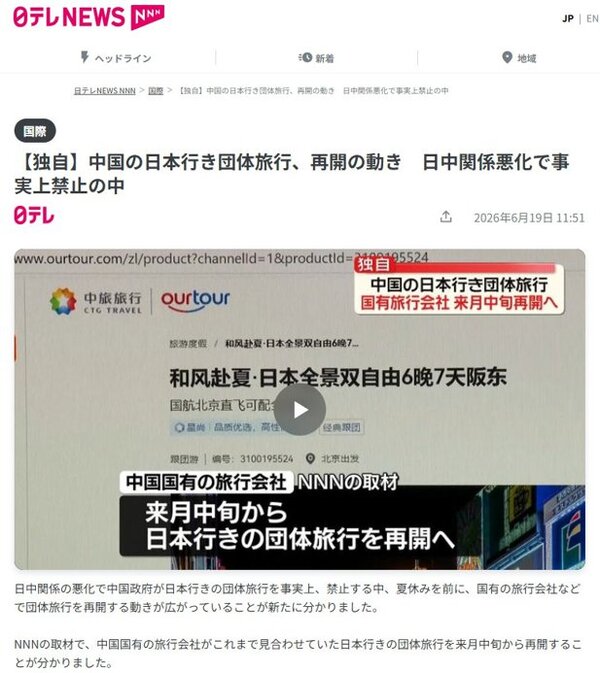
Japan’s Nippon TV (NTV News NNN) reported on the 19th that "a major state-owned Chinese travel agency, which had put a hold on selling group tour packages to Japan, has decided to resume sales mid-next month for a 6-night, 7-day itinerary visiting Tokyo and Osaka." The outlet added that "multiple private travel agencies have also been actively recruiting group tourists to Japan since last month, signaling that the resumption is spreading across the entire industry." Describing the backdrop of this shift, an insider from the Chinese travel sector stated, "The authorities shifted their stance toward tacit approval, telling companies to 'exercise their own discretion.'"
Last November, Prime Minister Takaichi stated in parliament that a Chinese military assault on Taiwan could constitute a "situation threatening Japan's survival." In response, the Chinese government issued an official advisory warning its citizens of "grave risks" to their safety while staying in Japan and urging them to temporarily refrain from traveling there. The Chinese Ministry of Foreign Affairs demanded a retraction, calling Takaichi's remarks a "flagrant interference" in internal affairs.
By December, China’s Ministry of Culture and Tourism instructed travel agencies to reduce the frequency of group tours to Japan to roughly 40% to 60% of previous levels, while some agencies reportedly faced pressure to halt sales entirely. Regarding this development, The Japan Times cited sources noting that "one travel agency was instructed to scale down operations to about 60% of its baseline, while another was requested to cancel sales altogether."
[Who Suffered the Damages? The Bill Was Sent Right Back to China]
An analysis by the American aviation publication Aviation Week, utilizing scheduled flight data from British aviation analytics firm OAG, revealed that "the total seat capacity provided by Chinese airlines on Japanese routes plunged by 23.2%, from 1.85 million seats in early November to 1.42 million in December. In terms of flight numbers, it fell by 24.3%, dropping from 9,813 flights to 7,432." The report further detailed that "while the large state-owned carrier Air China limited its reduction to about 10%, low-cost carriers (LCCs) with fewer international options bore a far heavier brunt; Spring Airlines cut flights by 36%, Juneyao Air by 41%, and Shenzhen Airlines slashed nearly half of its routes."
Bloomberg reported that "the Chinese government requested airlines to extend these capacity cuts until the end of March this year—concluding the winter aviation season—well past the peak Lunar New Year travel window." This hit hard because China’s top three state-owned airlines—China Eastern, China Southern, and Air China—had accumulated losses of 206.4 billion yuan (approximately $28.5 billion USD) over the five-year period from 2020 to 2024 and were aiming for a return to profitability for the first time in six years. This crisis threw those prospects into jeopardy.
In stark contrast, Japan Airlines (JAL) broke historical performance records during the same period. In its earnings report, the JAL Group announced, "For the cumulative three quarters of fiscal year 2025 (April–December), operating profit (EBIT) increased by 24.2% year-on-year to 179.1 billion yen, while revenue grew by 9.2% to 1.5137 trillion yen, marking the highest figures since its relisting." Analysts interpret this as a result of Chinese outbound travelers, whose itineraries could not be easily canceled, shifting their business entirely to Japanese carriers once Chinese flight options were choked off.
Bloomberg noted that "immediately following the boycott last November, a wave of cancellations from China led to estimates that Japan could lose up to $1.2 billion USD in tourism revenue by the end of the year." It pointed out that "out of 1.44 million trips from China to Japan scheduled through late December, roughly 30% were canceled, with 70% of those cancellations occurring right before the departure dates. However, the prevailing assessment is that this shock did not escalate to a level that could destabilize the broader Japanese tourism industry." This resilience is attributed to the fact that the canceled Chinese group tours consisted mostly of low-cost package deals, leaving Japan's higher-end tourism revenues largely unaffected.
[“Wolf Warrior Diplomacy” Fails Under Firm Resistance — The Case of Australia]
Analysts argue that this incident exposes a textbook pattern of the Xi Jinping regime's "Wolf Warrior diplomacy," where geopolitical anger is instantly translated into economic coercion. This methodology, which prizes national face and intimidation over pragmatism, played out in nearly identical fashion during China’s dispute with Australia.
When Australia called for an international investigation into the origins of COVID-19 in 2020, China retaliated by hitting Australian exports—including barley, beef, wine, coal, lobster, and timber—with tariffs and import restrictions. The Lowy Institute observed, "This was the most sweeping punitive trade campaign China has directed at a single nation in recent years, orchestrated at the Politburo level and executed across multiple agencies including the National Development and Reform Commission, the Ministry of Foreign Affairs, Customs, and the Ministry of Commerce." Anti-dumping duties reached 80.5% on barley and up to 218% on wine.
The Lowy Institute went on to highlight, "However, Australia refused to capitulate and confronted China head-on by filing a complaint with the World Trade Organization (WTO)." Australian barley and coal producers successfully diversified into alternative export markets. Consequently, China quietly lifted its anti-dumping duties on barley in August 2023, and trade in coal and timber resumed that same year. Australian Trade Minister Don Farrell remarked that China’s sanctions, which once disrupted 20 billion AUD in annual trade, had dwindled to around 2 billion AUD, signaling that the resolution of the barley dispute would serve as a "template" for resolving outstanding issues like wine. Ultimately, China's trade coercion fizzled out when confronted with Australia's market diversification and international legal pushback.
[A Persistent Pattern Against "Weak Opponents" — South Korea’s Hallyu Ban]
Conversely, a diametric pattern emerged with nations that chose relationship management and de-escalation over firm pushback. When South Korea greenlit the deployment of the THAAD (Terminal High Altitude Area Defense) missile system in 2016, China rolled out informal retaliatory measures known as the Han-hryeong (Hallyu Ban). According to the Review of International Political Economy, "Lotte, which provided the land for the THAAD deployment, saw 74 of its hypermarkets in China slapped with suspension orders under the pretext of fire safety violations. Meanwhile, group tours to South Korea were completely frozen, driving Chinese arrivals down by nearly 50% within 12 months."
The Asan Forum also noted, "Lotte alone suffered a cumulative loss of $1.78 billion USD in 2017. Because Chinese tourists had previously accounted for 47% of all visitors to South Korea and generated 70% to 80% of duty-free revenues, the tourism sector took the most direct hit." The AFP pointed out that "when China instituted a total ban on group tours to Korea in March 2017, the number of Chinese tourists the following month plummeted by nearly two-thirds compared to the same month the previous year."
The critical point of divergence from the Australian example is that from the very beginning of the retaliation, South Korea relied on managing relations and waiting out the tension rather than mounting a robust, front-facing counterstrategy or aggressively utilizing international trade bodies. Instead of a strong stance, Seoul adopted a highly cautious posture, anxious not to further upset Beijing. As a result, the Hallyu Ban persisted informally for years without ever being officially rescinded. While research shows that overall trade volume between China and Australia, as well as South Korea's total exports to China, actually grew during these periods, that growth was strictly confined to vital sectors like semiconductors and petrochemicals—areas where China lacked viable alternatives. In sectors where substitutes existed, such as tourism, retail, and cultural content, the retaliation left deep, long-lasting scars. To this day, elements of the Hallyu Ban remain active. In short, the South Korean case demonstrates that the more a country conducts its diplomacy while treading carefully around China's sensibilities, the larger and more protracted the damages become.
[What the Pattern Teaches: "Stand Firm and Clear Before China"]
Juxtaposing the cases of Australia, South Korea, and this recent development with Japan reveals an unmistakable pattern: China’s economic retaliation quickly loses steam whenever the target nation refuses to compromise its principles or succumb to price pressures, choosing instead to stand its ground or swiftly diversify its markets. Australia pivoted its barley and coal streams elsewhere while holding its ground at the WTO, eventually forcing the removal of tariffs within three years. Japan similarly held firm; Prime Minister Takaichi never retracted her remarks, and Tokyo abstained from counter-retaliation, leaving China to quietly blink first and lift its group tourism blockade after just eight months.
On the other hand, when a country prioritizes diplomatic appeasement and "conflict management" over principled pushback—as South Korea did—China’s coercion drags on indefinitely with no clear exit ramp. This suggests that the Xi Jinping administration's Wolf Warrior diplomacy is not a highly calibrated strategy based on a precise calculation of the target's resolve or alternative capacities. Rather, it resembles an improvisational form of pressure politics: strike hard first, observe the opponent’s reaction, and withdraw if the wall proves too thick. Consequently, the takeaway is clear: when dealing with this style of diplomacy, standing firm on both principles and market alternatives yields faster, more effective results than compliance or attempts to buy time.
Furthermore, Japan's success in breaking this tourism blockade carries weight far beyond the mere resumption of vacation packages. It serves as a reminder that the economic coercion weaponized by the Xi Jinping regime is not nearly as omnipotent as advertised. Beijing presses relentlessly when it senses an opponent will buckle, but steps back with surprising speed when a nation digs in and seeks alternatives. Australia proved it first, and now Japan has reinforced the lesson. Ultimately, the most effective blueprint for dealing with China’s Wolf Warrior diplomacy is not walking on eggshells to appease Beijing, but lowering economic dependence and building the domestic fortitude to stand firm.

-중국 푸단대학교 한국연구원 객좌교수
-전 EDUIN News 대표
-전 OUR NEWS 대표
-제17대 대통령직인수위원회 정책기획팀장
-전 대통령실 홍보기획비서관
-사단법인 한국가정상담연구소 이사장
-저서: 북한급변사태와 한반도통일, 2012 다시우파다, 선거마케팅, 한국의 정치광고, 국회의원 선거매뉴얼 등 50여권