
Update2026.10.24 (토)

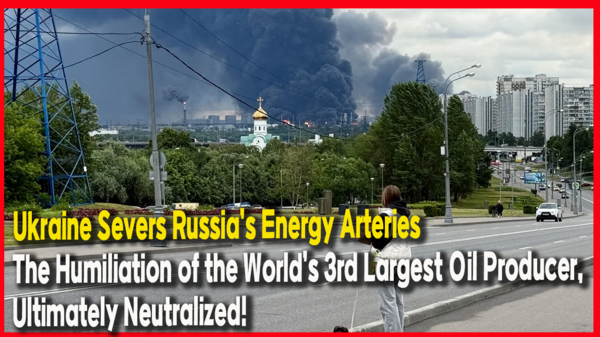
[Moscow Ablaze — The Largest Airstrike Since the Outbreak of War]
In the early hours of the 18th, 194 Ukrainian drones blanketed the skies of Moscow, setting fire to a core oil refining facility in the Russian capital. This was no ordinary strike. It represents the pinnacle of an energy war that has the potential to alter the course of this four-year conflict.
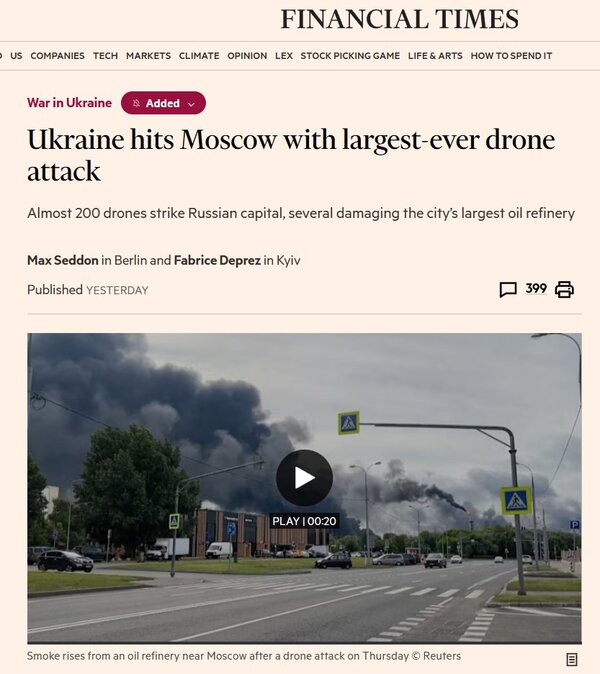
The UK's Financial Times reported on the 18th (local time) that "in the early hours of this day, Ukrainian drones reached a Moscow oil refinery, paralyzing airport operations and forcing the closure of major roads across the city." The outlet added, "Moscow Mayor Sergey Sobyanin stated via Telegram that 194 drones had been shot down, a figure that nearly triples the previous record of 74 set in March of this year."
The Moscow Times also reported, "At least five fires broke out at the Moscow refinery in the Kapotnya district, marking the second strike on the facility in just a week." It continued, "Black smoke blanketed the city center, and nearby residents reported 'black rain' pouring down. Sheremetyevo Airport urgently evacuated passengers and completely suspended operations. Aeroflot and Rossiya Airlines canceled over 170 incoming and outgoing flights, and the governor of the Moscow region announced that 17 people, including two children, were injured."
However, the shockwave of that day runs deeper than mere numbers. It wasn’t just oil refineries that were burning; Russia’s very capacity to sustain the war was going up in flames.
[Russia’s Refining Capacity Already Collapsed by Over 30%]
This airstrike did not happen overnight. Throughout 2026, Ukraine has systematically and relentlessly targeted the heart of Russia's energy sector.
Citing its own reporting and official data, Reuters pointed out, "Most major oil refineries in central Russia have either completely halted or severely scaled back operations due to Ukrainian drone strikes." The report noted, "The combined processing capacity of the damaged facilities amounts to 83 million metric tons annually, or about 238,000 tons per day—equivalent to roughly a quarter of Russia's total refining capacity. These facilities produce over 30% of Russia's gasoline and about 25% of its diesel."
Reuters further highlighted, "Due to repeated attacks, more than 30% of Russia's primary refining capacity has been put into a state of temporary suspension, driving production down to its lowest levels in years."
Of particular note is the evolution of Ukraine’s tactics. Isaac Levi, a Russia analyst at the Center for Research on Energy and Clean Air (CREA), observed, "Since the beginning of this year, a clear pattern of repeatedly striking the same facilities has emerged." He added, "Previously, refineries were repaired within three to five days, but that is no longer the case." In fact, the Tuapse refinery and export complex on the Black Sea coast was struck three times in April and twice in May. According to CREA data, Tuapse’s oil shipments in May plummeted by 91% compared to a year earlier.
Russian Deputy Prime Minister Alexander Novak was ultimately forced to make a public admission. During a press conference at the St. Petersburg International Economic Forum, he stated, "Russia's current crude oil production has fallen compared to the beginning of 2026," adding that "multiple oil refineries are undergoing emergency repairs." This marked the first time a Russian official publicly acknowledged that Ukrainian drone strikes were reducing domestic refining output.
[The Reality of the Frontline: Russian Forces Unable to Refuel]
The energy collapse is not confined to statistics. Its impact is flowing directly into the frontlines of the war. Militarnyi, a prominent Ukrainian online military media outlet, noted, "Fuel has practically run out in Russian-occupied Donetsk, and the shortages have escalated beyond the civilian sector to affect Russian military units deployed in active combat. This reality has been conceded even by the Russian propaganda channel 'Romanov Light'." According to the outlet, "Not a single gas station with fuel could be found along the Donetsk-Avilo-Uspenka highway, and reports indicate that Russian soldiers were also unable to secure fuel at gas stations in the Rostov region."
The Moscow Times stated, "As of the 10th, gasoline shortages and fuel supply disruptions have hit more than 25 regions within Russia, a sharp increase from 15 regions just a week prior on June 4." It added, "Expanding the scope to occupied territories, identical restrictive measures are being enforced across six occupied Ukrainian regions, including the Crimean Peninsula, Sevastopol, and the Luhansk, Donetsk, Kherson, and Zaporizhzhia regions."
Commenting on this situation, Andriy Zakrevsky, deputy director of the Ukrainian Association of Energy and Natural Resources, said, "The consequences of the fuel crisis are only just beginning to surface." He emphasized, "Russia is a vast country where logistics play a pivotal role. Reports of fuel supply issues are already coming in from transportation companies. If the shortage worsens, it will begin to cripple urban transit, freight shipping, and the entire supply chain." He confidently concluded, "The Russian authorities can no longer reverse this trend quickly. This narrative has already begun, and turning it back will be extremely difficult."
Thus, Ukraine’s objective is not merely the destruction of oil refineries. The Russian military is a force designed for large-scale artillery and armored warfare, meaning this conflict is ultimately a war of fuel consumption. Tanks, armored vehicles, military trucks, fighter jets, and strategic bombers all depend on oil. Ukraine is choosing a strategy that collapses the fuel supply chain moving the military, rather than targeting the military units themselves.
[The World's Largest Oil Producer Imports Fuel — An Unprecedented Humiliation]
What stands out most is that one of the world's leading oil producers has ultimately begun importing oil. Reuters reported, "Russia is scheduled to import Asian gasoline via vessels through its western ports this month," noting that "the direct catalyst was the temporary shutdown of the Taneco and Moscow refineries due to drone attacks."
It is worth considering just how shocking this development is. Kyiv Post pointed out, "Russia is the world's third-largest producer of crude oil, and energy exports form the bedrock of its national finances and war chest." It emphasized, "Yet, that very country is failing to supply fuel to its own citizens and is seeking import channels in Asia." The outlet further noted, "Russia also pursued fuel imports from Belarus and Kazakhstan, but both nations were found to lack the surplus production capacity to meaningfully plug the deficit. Consequently, Moscow extended its ban on gasoline exports until the end of July to prioritize domestic supply."
Ukrainian media outlet Militarnyi explained, "In May, Russia's diesel fuel production decreased by approximately 10% compared to March, which translates to a reduction of 60,000 tons in just a single month." It added, "The Russian government simultaneously implemented a temporary ban on aviation fuel exports from June 1 to November 30."
[The Decisive Blow of Medium-Range Drones — Crimea and Supply Routes Severed]
While Moscow's oil refineries are the targets of long-range drones, medium-range drones are precisely severing the supply arteries of the Russian military. Meduza, an independent Russian media outlet, reported, "Ukrainian drones heavily targeted traffic on the R-280 'Novorossiya' highway—the primary overland supply route to the Crimean Peninsula—causing widespread fuel shortages across the entire peninsula." It added, "Mikhail Razvozhayev, the Russian-appointed governor of Sevastopol, announced that AI-92 and AI-95 grade fuels were completely depleted at city gas stations. Meanwhile, Ukrainian Defense Minister Mykhailo Fedorov framed this operation as a 'logistical blockade' aimed at pressuring the Russian military's rear and suppressing its offensive capabilities."
Commenting on this, The Washington Times noted, "The current fuel shortage in Crimea is the worst since the 2014 Russian annexation." It added, "As of late May, authorities restricted sales to 20 liters per vehicle once a week via a prepaid coupon system. Analysts assess that Ukraine’s offensive is a two-pronged strategy using long-range and medium-range capabilities to simultaneously squeeze Russia's production and transport capacities."
[“The Kremlin’s Options Are Vanishing”]
Connecting the strategic implications of this entire trend to Western diplomacy is a core calculation for Zelenskyy. ABC News reported, "President Zelenskyy put these drone strikes front and center ahead of the NATO meeting in Brussels, leveraging them as a mechanism to force Russia to the negotiating table." Zelenskyy stated, "Our Western partners are also taking note of the precision and effectiveness of our medium-range strikes and long-range sanctions." ABC News further noted, "In Brussels, Zelenskyy held talks with NATO and EU leaders and signed a joint agreement with Germany to co-develop air defense systems capable of countering ballistic missiles, naming it the beginning of an 'Anti-Ballistic Missile Coalition'."
In response, Ukrainian Foreign Minister Andrii Sybiha wrote on X (formerly Twitter), "Russians asking what is happening should direct that question to Putin. Your country started a war of aggression against ours. Now that you know, ask Putin when he will end the war."
Does this mean Russia is on the verge of complete collapse? The Moscow Times adds a critical warning: "The Russian fuel shortage remains at a manageable level, but the Kremlin's options are shrinking. Refinery attacks directly impact the infrastructure underpinning Russia's economy and war efforts, serving as a significant pressure tool that forces the diversion of resources into repairs, defense, and logistical adaptation. In the long run, an intensifying campaign of attacks could eventually yield systemic effects."
Ultimately, the core of the drone warfare framework built by Ukraine over the past two years is not the direct destruction of the Russian army, but rather the attrition of Russia's capacity to sustain the war. They must repair refineries, redeploy air defense systems to the rear, import deficient fuel, and fund ballooning military expenditures through tax hikes. These are all costs incurred in the rear, not on the frontlines.
In the end, the real crisis confronting Russia is not a few drones, but the "economics of a war of attrition." Ukraine is no longer just attacking the Russian military; it is simultaneously placing pressure on the energy, logistics, and financial systems that keep the entire Russian state functioning.
As the conflict enters its fifth year, a long line of vehicles waiting outside a gas station in the rear may prove far more dangerous than artillery fire on the frontlines. And that very scenario may be the version of the war that Putin fears most.


-중국 푸단대학교 한국연구원 객좌교수
-전 EDUIN News 대표
-전 OUR NEWS 대표
-제17대 대통령직인수위원회 정책기획팀장
-전 대통령실 홍보기획비서관
-사단법인 한국가정상담연구소 이사장
-저서: 북한급변사태와 한반도통일, 2012 다시우파다, 선거마케팅, 한국의 정치광고, 국회의원 선거매뉴얼 등 50여권