
Update2026.10.24 (토)

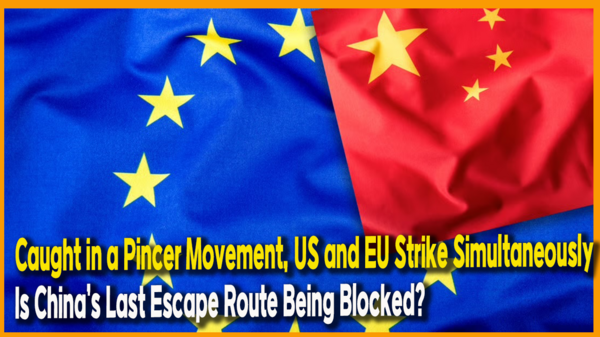
[EU Meeting Cancellations and Chinese Big Tech Blacklisting… Western Pressure Expands Simultaneously across Multiple Fronts]
China is facing synchronized pressure across all geopolitical fronts from the West. High-level dialogues with the European Union (EU) have been abruptly canceled, while the United States has dismantled a spy network suspected of being operated by Chinese intelligence agencies. Furthermore, Washington is turning up the heat by blacklisting China’s flagship corporations—including Alibaba, Baidu, and BYD—as Chinese military-linked companies. This trajectory reveals that Western encirclement has evolved beyond mere diplomatic friction or isolated trade disputes into a comprehensive blockade spanning national security, advanced technology, and core industries.
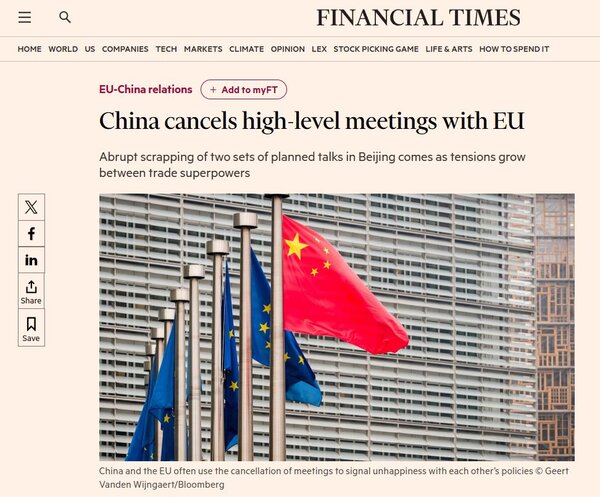
On June 11, the UK's Financial Times (FT) reported, "China abruptly canceled two major diplomatic meetings with the EU scheduled for this month, a move that comes amid escalating tensions between the two trading superpowers over surging Chinese exports. The canceled sessions included a ministerial-level digital dialogue slated to take place in Beijing, as well as a separate meeting involving Olof Skoog, Deputy Secretary-General of the European External Action Service (EEAS)."
The FT further noted, "While Chinese officials provided no rationale for the cancellations, such tactics are commonly employed by both sides to signal displeasure with the counterparty's policies. Last year, the EU similarly refused to host a pivotal economic meeting ahead of a major summit, citing a lack of progress in ongoing trade disputes." In essence, while the cancellation of these meetings represents a "signal of dissatisfaction" initiated by Beijing, the root cause lies in the EU's unprecedentedly hawkish anti-China drive. Meanwhile, the European Commission attempted to de-escalate the situation, stating that the canceled meetings are "being rescheduled" and that "contacts and dialogue between the EU and China continue across multiple dimensions."
However, the core issue is not the cancellation of the meetings themselves. The true significance lies in the rapid and profound shift in sentiment taking place within the EU.
[A Daily Deficit of €1 Billion… The EU's Patience Reaches Its Breaking Point]
According to the FT, "EU pressure is mounting comprehensively across the legislative landscape. The European Commission recently introduced amendments to its Cyber Security Act aimed at shutting out Chinese firms like Huawei from telecommunications networks and solar energy infrastructure. It has also blocked public funding for imported green energy hardware, such as Chinese-dominated solar inverters." Last month, the Commission labeled its bilateral trade deficit with China—which stands at a staggering €1 billion (approximately 1.6 trillion KRW) per day—as "unsustainable," issued warnings regarding new tariff impositions, and initiated three separate anti-dumping investigations in June alone.
The FT emphasized that "internal sentiment within the EU has already crossed a critical tipping point. In a speech delivered on June 9, Belgian Prime Minister Bart De Wever openly mocked the EU's reliance on roundabout phrasing like 'geo-economic imbalances' instead of naming China directly in its official agenda, remarking that European leaders seemed 'too terrified to even utter the name China.'"
In the past, diverging economic interests among member states routinely derailed aggressive anti-China policies. Today, however, a powerful consensus is solidifying around the urgent need to counter Chinese industrial overcapacity and de-risk supply chain dependencies. Although Beijing attempted to wield meeting cancellations as leverage, the political climate in Brussels is moving in the exact opposite direction of what China intended.
[The FBI’s Takedown Signals Far More Than a Routine Spy Case]
Precisely as frictions with Europe reached a boiling point, Chinese intelligence operations in the United States surfaced once again. Reuters reported, "The Federal Bureau of Investigation (FBI) and the Department of Justice announced on June 10 (local time) the seizure of 13 websites utilized by Chinese intelligence operatives to recruit current and former U.S. government officials and military personnel holding security clearances. According to prosecutors, these domains masqueraded as legitimate consulting firms to entice individuals into selling sensitive government data in exchange for financial compensation."
The tradecraft deployed was highly sophisticated. The Associated Press (AP) reported, "According to FBI affidavits filed in court, these fraudulent websites simulated legitimacy by utilizing fabricated or stolen identities alongside AI-generated profile photos, advertising 'consulting' opportunities tailored specifically for former and current U.S. government employees. Spies belonging to Chinese military intelligence posed as corporate recruiters or think-tank staff to advertise bogus foreign policy and defense analyst positions, subsequently pressuring applicants to provide 'non-public' information. The covert operators shielded their identities through the use of cryptocurrency and end-to-end encrypted online payment networks." The servers hosting these domains were physically located across Arizona, New York, Germany, and the United Kingdom.
What demands close attention is that this incident transcends conventional intelligence-gathering or industrial espionage. While China has historically prioritized industrial espionage and cyber hacking, intelligence analysts note that Beijing has recently intensified its Human Intelligence (HUMINT) operations, specifically targeting the subversion of current and former government and defense personnel.
This case serves as concrete validation of long-standing warnings that Chinese intelligence organs are systematically exploiting private consulting fronts and digital recruiting platforms to infiltrate the U.S. national security apparatus. Crucially, this enforcement action was made public just one week after the Five Eyes intelligence alliance issued a joint warning regarding China's online recruitment tactics. By choosing this moment to dismantle and publicly expose the operational mechanics of the network, Washington is intentionally raising the stakes and increasing pressure on Beijing's intelligence apparatus.
[The Pentagon’s Crosshairs Target BYD, the Crown Jewel of China’s Manufacturing Ambitions]
U.S. countermeasures are expanding well beyond the intelligence theater, striking directly at the crown jewels of Chinese industry. CNBC reported, "The U.S. Department of Defense added a sweeping cohort of premier Chinese corporations—including Alibaba, Baidu, and BYD—to its Section 1260H List, designating them as entities linked to the Chinese military or its defense industrial base. While this designation does not trigger immediate, explicit sanctions, it bans the Pentagon from entering into direct contracts with these entities starting late this month, and will entirely cut off procurement of their products or services via third-party vendors by June 2027."
The inclusion of BYD is particularly significant. As the world's largest electric vehicle (EV) manufacturer, BYD stands as the vanguard of China's state-backed "New Three Industries" strategy (EVs, lithium batteries, and photovoltaics)—the absolute symbol of China's rise as a manufacturing superpower.
By designating BYD as a military-linked entity, Washington is sending a powerful signal: it no longer views China’s industrial policy through a purely commercial lens, but treats it fundamentally as a national security threat.
The blacklisting of Alibaba and Baidu follows an identical logic. With Tencent already on the list, China's top three artificial intelligence (AI) platform giants are now formally classified as military-linked entities. Through these listings, the U.S. is systematically targeting China’s overarching Military-Civil Fusion (MCF) strategy and its broader AI ecosystem.
While Chinese corporations have lodged fierce protests, the consensus in Washington is absolute: China's technological competence and industrial scale will no longer be decoupled from the architecture of national security.
[An Unfought War That Never Pauses… The Realities of 'Managed Containment']
The three major developments of the week—China's abrupt cancellation of the EU meetings, the FBI's dismantling of the espionage network, and the Pentagon's expansion of its corporate blacklist—might appear to be disparate events.
In reality, they form a cohesive, unified trajectory. Both the U.S. and Europe have fundamentally redefined China: no longer merely a difficult trading partner, but a structural competitor across the domains of national security, advanced technology, and global supply chains.
Even during intervals where political figures like Donald Trump and Xi Jinping meet to deliberate trade truces or discuss investment frameworks, the institutional machinery of counterintelligence, export controls, defense procurement, and industrial policy continues its relentless pressure. This is the precise definition of Washington’s "managed containment" strategy.
For Beijing, the escalating hostility on the European front represents a severe strategic crisis. Historically, if the U.S. market closed, China could pivot to Europe; if Europe faltered, it could rely on America. Today, that escape hatch is being sealed shut as the U.S. and Europe move in lockstep. While the United States tightens the screws on technology and national security, Europe is systematically shutting its markets and industrial ecosystems.
The existential threat facing the Chinese economy is not a temporary dip in export metrics. It is the rapid evaporation of the strategic and operational space within which it can maneuver inside the global economic order.
Ultimately, the compounding crises confronting China are not the product of an external conspiracy, but the logical consequence of its own policy choices. Its Military-Civil Fusion strategy has triggered the blacklisting of its tech champions; its aggressive reliance on online HUMINT operations has provoked a massive FBI crackdown; and its export strategy, driven by industrial overcapacity, has met a blunt counterforce in the form of European trade barriers.
Should the European Council summit solidify a more hawkish, institutionalized anti-China policy, Beijing will find itself transitioning from a temporary trade conflict into a prolonged state of structural, strategic isolation. The gravest challenge currently facing Beijing may not be its internal economic slowdown, but rather a remade international order where the world’s two largest democratic markets are closing their doors simultaneously.

-중국 푸단대학교 한국연구원 객좌교수
-전 EDUIN News 대표
-전 OUR NEWS 대표
-제17대 대통령직인수위원회 정책기획팀장
-전 대통령실 홍보기획비서관
-사단법인 한국가정상담연구소 이사장
-저서: 북한급변사태와 한반도통일, 2012 다시우파다, 선거마케팅, 한국의 정치광고, 국회의원 선거매뉴얼 등 50여권