
Update2026.06.11 (목)


[Beyond Huawei to "All of China"… Taiwan Government Weighs Drastic Measures]
Taiwan, a pivotal stronghold in the global race for AI supremacy, is considering a drastic move to directly sever the supply chain of advanced semiconductors heading to China. The impact is expected to be profound, as discussions lean toward expanding controls to encompass the entirety of China, rather than merely targeting Huawei or specific blacklisted entities. If implemented, this measure will virtually block the final loophole Chinese AI firms have utilized for indirect procurement. This marks a critical turning point where Taiwan shifts from passively cooperating with U.S. tech blockades to acting as a direct enforcer.
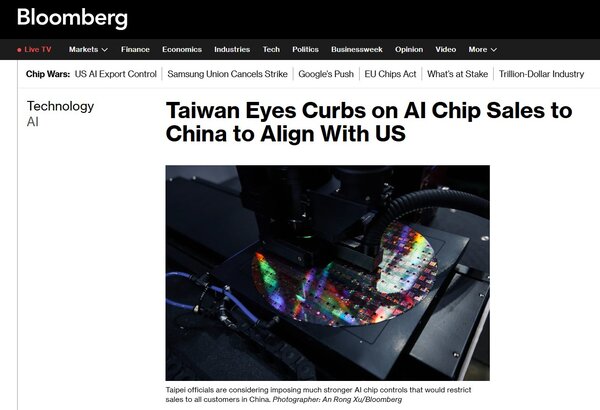
On June 10, Bloomberg reported that Taiwanese authorities are reviewing much stricter export controls on AI chip sales to China to align with Washington’s efforts. The core objective is to establish legal mechanisms to prevent advanced hardware, such as AI servers equipped with NVIDIA chips, from leaking from Taiwan into China.
Significantly, this proposal focuses on broadening the scope of restrictions from specific blacklisted firms to the entire Chinese market. Currently, Taiwan only restricts transactions with a select few entities like Huawei. However, under the proposed framework, selling AI chips to any customer within China could be subject to regulation. For the first time, this would enable Taiwan to impose criminal penalties for smuggling advanced AI chips.
Bloomberg assessed that this would be the most comprehensive national security policy enacted since the inauguration of the Lai Ching-te administration. Market reactions were notably stable; following the report, TSMC shares rallied on Wall Street. This indicates that investors viewed the move not as a short-term business risk, but rather as a step that strengthens the strategic value of Taiwan’s semiconductor industry.
More importantly, this initiative goes beyond routine smuggling crackdowns. Since taking office, the Lai administration has defined China as a "foreign adversary" and has accelerated decoupling policies across economy, security, and technology. This latest move underscores Taiwan’s resolve to leverage its greatest strategic asset—semiconductors—as a vital tool for national security.
[Legal Blind Spots: Reality of Only Charging Smugglers with "Document Forgery"]
Taiwan’s decision to take decisive action stems from a surprising legal vacuum. While the U.S. has strictly restricted exports of advanced NVIDIA AI chips to China since 2022, Taiwan has lacked the direct legal mechanisms to penalize such actions within its own borders.
In fact, when Taiwanese authorities arrested suspected AI chip smugglers for the first time last May, the only applicable charge was document forgery. Even as advanced semiconductors were actively flowing into China’s military and AI industries, prosecutors could not charge them for the act of smuggling itself.
The new control framework is specifically designed to plug this loophole. The technical thresholds are highly likely to mirror U.S. standards. According to sources, Taiwan is considering adopting the U.S. export control framework to restrict AI chips and servers that exceed specific performance thresholds.
[The Trigger: Smuggling via the "Japan Route"]
The catalyst for this policy shift was a major smuggling case uncovered last month. On May 21, the Keelung District Prosecutors Office detained three individuals on charges of forging export documents for Supermicro servers embedded with restricted AI semiconductors. Authorities seized approximately 50 servers valued at around $15 million. This marked Taiwan’s first public crackdown targeting AI chip export violations.
What shocked officials most was the smuggling route. Investigators believe the servers were shipped via Japan to Hong Kong, with mainland China as the final destination. While Southeast Asian nations like Singapore and Malaysia have typically served as primary circumvention hubs, this was the first time Japan was exposed as a transshipment point.
This reveals that China’s advanced chip smuggling networks are constantly adapting, seeking new detours to evade international surveillance. Investigations confirmed that at least one prior shipment had successfully slipped through. Prosecutors believe the suspects deliberately manipulated cargo manifests to route the hardware to China, fully aware that the servers were subject to U.S. export controls.
NVIDIA CEO Jensen Huang also issued a rare public warning, urging Supermicro to tighten its internal controls and stressing that partners must strictly adhere to regulations.
[All-Out Pressure from Washington: Demand for a "Gatekeeper" Role]
Taiwan’s actions are closely aligned with intensifying pressure from Washington. U.S. officials have recently expressed deep concern over Chinese companies utilizing overseas subsidiaries and shell companies to bypass sanctions and procure advanced AI chips.
Indeed, the Trump administration has recently pushed forward measures to block Chinese tech subsidiaries abroad from accessing advanced semiconductors. The U.S. Congress is also pressuring the administration to stop Chinese firms from using foundries like TSMC to secure customized AI chips.
From Washington's perspective, Taiwan is not just an ally; it is the ultimate gatekeeper of the global advanced semiconductor supply chain. In other words, Taiwan's cooperation is indispensable for the U.S. technological blockade against China to succeed.
While Taiwan put Huawei and SMIC on its blacklist last year to restrict trading, this new measure operates on an entirely different level by targeting China as a whole rather than isolated companies.
[Taiwan's Dilemma: The Woes of the World's AI Server Factory]
Naturally, Taiwan faces internal concerns. The island is the powerhouse of global AI server manufacturing. Major players like Foxconn, Quanta, Wistron, Wiwynn, and Inventec virtually dominate the global AI server market. Consequently, there are worries that if controls are expanded too aggressively, Taiwanese firms will have to bear massive regulatory compliance costs and business uncertainties.
Historically, the Taiwanese government has been cautious about weaponizing its semiconductor industry for diplomacy and security. However, as China's military pressure and U.S. demands escalate simultaneously, analysts note that maintaining the status quo is becoming increasingly untenable.
[Pouring Cold Water on a $220 Billion AI Ambition… Huawei to Take the Hardest Hit]
A fierce backlash from Beijing is inevitable. China plans to invest approximately 2 trillion yuan (approx. $220 billion USD) over the next five years to build a nationwide AI data center network, with Huawei serving as the core provider.
The challenge lies in Huawei's current capabilities. Although Beijing has officially declared its intent to end its reliance on NVIDIA, Huawei's Ascend chips still fall short in both production volume and performance to meet the exploding domestic AI demand. Consequently, while Chinese tech firms publicly champion the Huawei-centered ecosystem, they have remained heavily reliant on smuggled or rerouted NVIDIA chips behind the scenes.
Ultimately, Taiwan’s comprehensive controls will do more than just bust smuggling rings; they could choke off the informal supply chains that have kept China's AI industry afloat. The hardest hit will likely be the domestic AI ecosystem currently being forged around Huawei.
[Why Times Analysis] From 'Silicon Shield' to 'Silicon Spear'
If realized, the implications of this measure extend far beyond a mere tightening of export regulations.
First, Taiwan will transition from a "passive compliance follower" to an "active enforcer" in the U.S.-China tech war. Until now, Taiwan’s semiconductor industry has been referred to as a "Silicon Shield" to deter a Chinese invasion. Moving forward, it will take on the role of a "Silicon Spear" aimed directly at China's technological ambitions.
Second, this signals a new security and trade bargain between Washington and Taipei. Taiwan assumes the role of supply chain gatekeeper as desired by the U.S., and in return, Washington strengthens its security commitments and economic cooperation with Taipei.
Third, the U.S.-led tech blockade against China is entering a new phase. Thus far, Washington has pressured China by leveraging chip designers like NVIDIA, equipment manufacturers like ASML, and EDA software firms. Now, with Taiwan directly stepping in to sever supply chains, the strategy is shifting toward controlling the final bottleneck of semiconductor production and distribution.
China has successfully exploited loopholes via third-country transshipments, shell corporations, and overseas subsidiaries. However, with Taiwan fully locking the gates, Beijing's circumvention strategies face a fundamental, structural crisis.
Ultimately, this initiative is not a routine smuggling crackdown; it is a major turning point in the U.S.-China AI hegemony war. It signals a transition from an era of "the U.S. blocking China" to one of "the U.S. and Taiwan blocking China together." The moment Taiwan’s Silicon Shield morphs into a Silicon Spear, Beijing's AI ambitions will face an existential threat concerning supply chain survival.
-중국 푸단대학교 한국연구원 객좌교수
-전 EDUIN News 대표
-전 OUR NEWS 대표
-제17대 대통령직인수위원회 정책기획팀장
-전 대통령실 홍보기획비서관
-사단법인 한국가정상담연구소 이사장
-저서: 북한급변사태와 한반도통일, 2012 다시우파다, 선거마케팅, 한국의 정치광고, 국회의원 선거매뉴얼 등 50여권