
Update2026.10.24 (토)

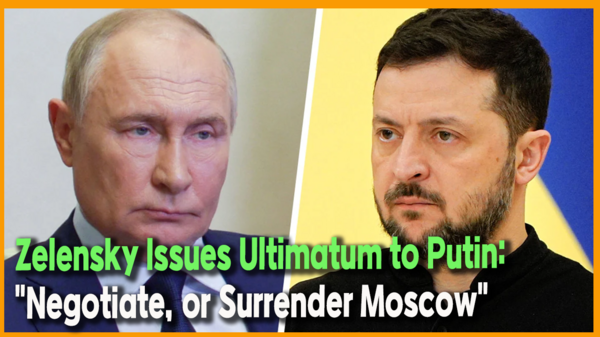
[June 8: "Next Flight to Moscow"... Public Warning via the FP-9]
Ukrainian President Volodymyr Zelensky has issued what amounts to a virtual ultimatum to Russian President Vladimir Putin. While directly proposing a showdown through an open letter, Ukraine launched an unprecedented drone swarm targeting the Russian heartland and, alongside the UK, France, and Germany (E3), laid out five peace conditions that Russia must accept. Combined with the revealed combat readiness of Ukraine’s domestically developed FP-9 ballistic missile, the Kremlin now finds itself forced to choose between the negotiating table and the imminent risk of strikes on its own capital.
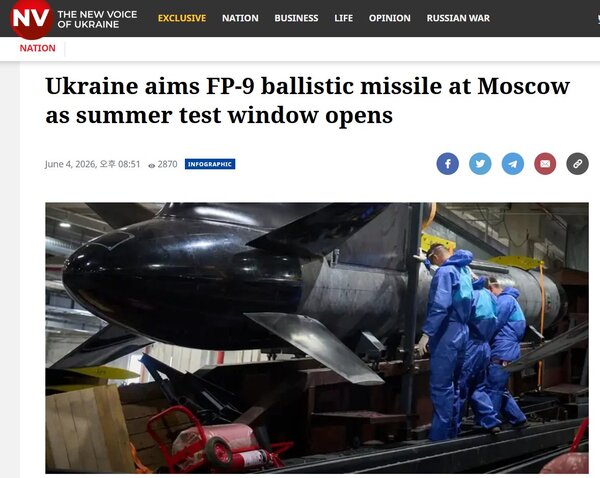
On June 9, The New Voice of Ukraine, an English-language Ukrainian media outlet, reported highly anticipated remarks from Denys Shtilerman, co-founder and chief designer of Ukrainian defense firm Fire Point. Shtilerman stated that Ukraine’s domestically produced FP-9 ballistic missile will undergo engine tests and begin test flights this month. He noted, "As soon as a test flight confirms everything is working properly, the next flight should be launched toward Moscow," forecasting that the first strike on Moscow could take place this summer, or by early fall at the latest.
The announcement of the FP-9's completion has drawn intense global attention because it coincides perfectly with Zelensky's ultimatum to Putin. From June 4 to 8, Ukraine unleashed a series of coordinated actions, pressuring Russia simultaneously across diplomatic, military, and technological fronts. Rather than isolated incidents, these actions formed a calculated escalation where each step compounded the weight of the last. This pressure campaign culminated on June 8 with the public warning that Moscow will come within Ukrainian ballistic missile range this summer.
The New Voice of Ukraine further detailed that "the FP-9 is a short-range ballistic missile capable of carrying an 800-kilogram warhead over a range of 800 to 855 kilometers, flying at speeds exceeding 1,200 meters per second." This operational range places not only Moscow but also Putin’s hometown of St. Petersburg squarely within its crosshairs. The outlet highlighted that "Shtilerman directly pointed to Moscow’s energy facilities as potential targets," framing it as a precise, symmetrical retaliation for years of Russian strikes on Ukraine's power grid.
[June 7: Europe Completes the Diplomatic Encirclement in London]
Just a day before the ballistic missile threat was made public, on June 7, Zelensky finalized a diplomatic encirclement at 10 Downing Street in London. Euronews reported that "British Prime Minister Keir Starmer, French President Emmanuel Macron, and German Chancellor Friedrich Merz joined Zelensky in issuing a joint statement detailing five peace conditions Russia must meet."
The E3 & Ukraine's 5 Peace Conditions:
An immediate and complete cessation of hostilities.
Recognition of the current line of contact as the starting point for negotiations.
Legally binding security guarantees for Ukraine—including the deployment of multinational forces within Ukrainian territory.
Maintaining the freeze on sanctioned Russian overseas assets until full war reparations are paid.
Protecting pan-European security interests and fundamentally preventing future Russian aggression.
Commenting on the declaration, the Kyiv Post noted, "The four nations emphasized that both the US and Europe must 'actively' participate in resolving this war. This serves as a declaration of Europe’s resolve to independently fill the vacuum while the Trump administration's diplomatic focus is divided by the war in Iran." The outlet added, "These five conditions act as both a demand to the Kremlin and a legal justification to expand military aid and anti-Russian sanctions ahead of the G7 Summit in Évian and the NATO Summit in Ankara." It was the exact moment military pressure was reinforced by a solid diplomatic framework.
[June 6: 339 Drones Unleashed—Kronstadt Ablaze]
The night before the diplomatic declaration, on June 6, Ukraine demonstrated the weight of its words with overwhelming kinetic force. The Russian Ministry of Defense announced that "within a single 13-hour window, Russian forces intercepted and destroyed 339 Ukrainian drones over 13 regions, including Moscow and Leningrad, as well as the Black Sea." This was a figure Russia itself conceded was "unprecedented."
Coincidentally, this occurred on the final day Putin was hosting the St. Petersburg International Economic Forum (SPIEF) in his hometown. Right at the moment the Kremlin was using the global stage to flaunt Russia's economic resilience, the Kronstadt naval base—located just a stone's throw from the venue—burst into flames.
The Kyiv Post confirmed that "Zelensky and the Special Operations Forces (SSO) officially verified that domestic drone units flew 1,000 kilometers to strike the Baltic Fleet base and naval ammunition depots in Kronstadt." This operation, conducted jointly by the SSO’s 'Deepstrike' unit, the Unmanned Systems Forces, and the Security Service of Ukraine (SBU), bypassed local air defenses to ignite the naval hub.
The Kyiv Post continued, citing satellite imagery analysis: "Approximately 5,000 tons of ammunition triggered a chain-reaction explosion at the Leningrad Oblast naval arsenal. Simultaneously, an oil depot in Krasnodar (500 kilometers away), the Feodosia naval oil terminal, and an airbase hosting MiG-31 interceptors were hit in tandem."
The strike on Kronstadt carried immense symbolic weight. Kronstadt is a core bastion of Russia's Baltic Fleet and a historical symbol of St. Petersburg's defense. The fact that a strategic base right on Putin's home turf was compromised while he boasted of economic stability proved that the war is no longer a border conflict—it has migrated to the very core of Russian power. The BBC, quoting a source within the Ukrainian drone unit, reported that they "could fly through Russian airspace as if it were their own territory."
[June 4: The Open Letter—The First Move of the Ultimatum]
According to Euronews, "The starting point of Zelensky's ultimatum to Putin was an open letter sent on June 4." For the first time since the launch of the full-scale invasion in 2022, Zelensky dispatched a direct, open letter to Putin, proposing face-to-face talks in a neutral country, stating: "The choice is now yours. Enough war. Ukraine proposes an end to this war."
The text of the letter released by the Ukrainian Presidential Office contained a sharp, unyielding warning alongside the offer to negotiate:
"Whatever you say about NATO, geopolitics, or the Russian language, this war is your personal choice—a war without real justification. That is how history will remember it."
Zelensky then directly targeted internal Russian instability:
"We can all see that Russians are finally becoming uncomfortable with this reality. They do not like our drones and missiles. They do not like gasoline shortages and constantly rising prices."
CNN analyzed that "in the letter, Zelensky directly targeted Putin’s personal future." The Kyiv Independent also evaluated it as a strategic message aimed not only at Putin but at the Russian elite and the wider international community. The outlet noted, "Kyiv’s objective was to create a public record showing that Ukraine proposed negotiations, and the refusal came from Moscow. It was a diplomatic trap designed to provoke a rejection and pin the blame on the Kremlin. As expected, Putin dismissed the letter as 'rude' during the SPIEF plenary session, stating he 'saw no reason to meet.' And that very night, Kronstadt burned."
[Why Now: The Window Closes Before Winter]
The pivotal question remains: Why now? While Ukraine has sought negotiations throughout the war, it has never demanded them with such coercive leverage. The shift occurs because Zelensky assesses that, for the first time, the strategic environment is tilting in Ukraine's favor.
Ukrainska Pravda reported that "strategic calculations underpin the timing of this ultimatum," citing Zelensky’s assessment that "Russia began losing the battlefield initiative in December 2025."
In recent months, Ukraine's long-range drone strikes have consistently penetrated deep into the Russian rear, and assessments are mounting that the pace of Russia's advance has noticeably stalled. Bloomberg also reported that European allies view the current period as a critical "window of opportunity for negotiations." Crucially, given Russia's pattern of systematically targeting Ukraine’s energy infrastructure every winter, Kyiv feels compelled to dictate the direction of the war before the freezing temperatures set in.
[The Frontline Speaks: The Reversal of Momentum]
The credibility of this ultimatum is backed by tangible territorial shifts on the ground. AFP, citing data from the Institute for the Study of War (ISW), reported that "Ukrainian forces reclaimed a net 282 km
2
in May, outstripping Russian territorial gains for the second consecutive month." The ISW analyzed that the pace of Russia’s advance has steadily decayed since late 2025 due to the cumulative toll of Ukrainian drone strikes. On June 8, Ukraine's Commander-in-Chief Oleksandr Syrskyi officially announced that "Ukraine has liberated over 600 ㎢ since the start of 2026." The trend of yielding territory to Russia following the stalled 2023 counteroffensive has been decisively reversed.
ISW analyst George Barros explained that "this shift traces back to late 2025, when Ukraine began systematically dismantling Russia’s ground radars, electronic warfare systems, and surface-to-air missile capabilities." It was a strategy designed to blind the Russian military before striking at its vital organs.
This shifting dynamic was symbolically captured during Russia's May 9 Victory Day parade. For the first time in nearly two decades, Putin was forced to oversee a parade completely devoid of heavy armor, including tanks and advanced missile systems. Kremlin spokesperson Dmitry Peskov explicitly blamed Ukrainian "terrorist activities" for the scale-back. The capital of a self-proclaimed military superpower could no longer safely exhibit its own weaponry in its central square.
[Putin’s Dilemma: Costly Choices on Either Side]
Ultimately, Zelensky’s ultimatum is far more than a simple ceasefire proposal. It is a calculated strike to shatter the three-year-old premise that Russia controls the tempo and trajectory of this war.
The open letter served as a diplomatic off-ramp; the Kronstadt raid proved that the Russian heartland is no longer sanctuary; the joint E3 declaration signaled a political commitment to funnel the long-term costs of the war directly onto the Kremlin; and the FP-9 ballistic missile provides the raw military teeth to enforce these threats.
Putin now stands at a critical crossroads. Entering negotiations forces him to compromise on his core wartime objectives. Rejecting them guarantees that the pressure bearing down on Moscow will only intensify. Zelensky’s core question remains elementary:
"Will you end the war, or will you allow the war to consume the Russian heartland?" The ball is now firmly in the Kremlin’s court.


-중국 푸단대학교 한국연구원 객좌교수
-전 EDUIN News 대표
-전 OUR NEWS 대표
-제17대 대통령직인수위원회 정책기획팀장
-전 대통령실 홍보기획비서관
-사단법인 한국가정상담연구소 이사장
-저서: 북한급변사태와 한반도통일, 2012 다시우파다, 선거마케팅, 한국의 정치광고, 국회의원 선거매뉴얼 등 50여권