
Update2026.10.24 (토)

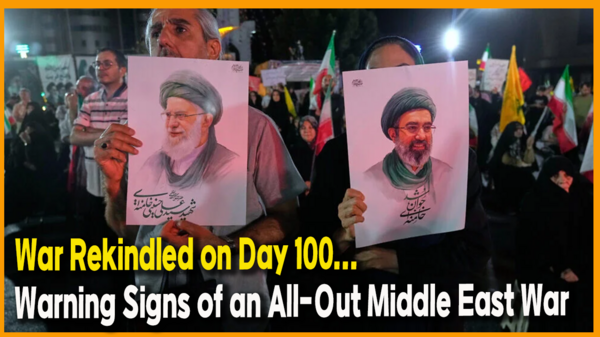
[ Iran and Israel Clash Anew; Hezbollah and Houthis Mobilize]
On June 8, marking the 100th day of the war, Iran and Israel exchanged their largest-scale retaliatory airstrikes since the April ceasefire, pushing the Middle East once again toward the brink of a full-scale war. Following an Israeli airstrike on Beirut, Iran responded with a barrage of ballistic missile attacks. In turn, Israel bypassed President Donald Trump’s public calls for restraint and directly struck a petrochemical facility in southwestern Iran. With Yemen's Houthi rebels joining the fray by declaring a total blockade of the Red Sea, the risk of the conflict widening into a multi-front regional war is rapidly escalating.
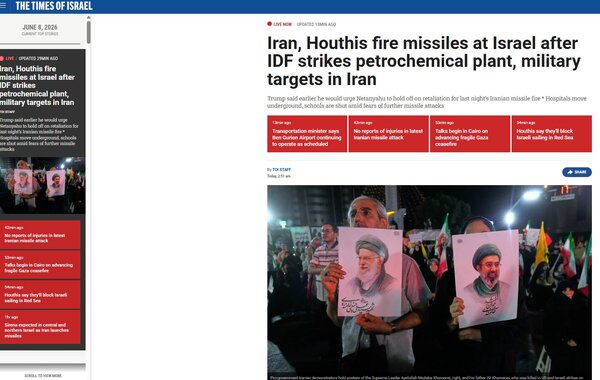
The Times of Israel (TOI) reported on June 8 that "Israel and Iran traded retaliatory airstrikes early Monday, plunging the broader Middle East into a severe crisis that threatens to rekindle a full-scale regional war." The outlet added:
"Tensions flared further as Yemen's Houthi rebels fired missiles toward Israel and vowed to target all Israel-linked vessels in the Red Sea. This confrontation marks the heaviest fighting since the ceasefire agreement brokered on April 8. Warnings are mounting over a total reinflation of the war, especially given Iran's continued leverage over the Strait of Hormuz and its vast stockpiles of highly enriched uranium."
CBS News noted that "the latest flare-up was triggered in earnest on June 7 when Israel launched an airstrike on Beirut’s southern suburbs," which reportedly killed at least two people and wounded 20 others. However, Israel's strike on Beirut was not a unilateral, unprovoked action. The fighting on the Lebanese front had persisted because Hezbollah rejected the U.S.-brokered ceasefire agreement between Israel and Lebanon. Israeli authorities stated that they targeted a Hezbollah command center in Beirut in direct retaliation for pre-emptive attacks launched by the group into northern Israel. In essence, the provocations by Hezbollah—backed and funded by Iran—served as the initial tripwire for this latest chain of escalations.
[Why Now? The Ceasefire Held, but the War Never Ended]
The immediate trigger for the current escalation was the Israeli airstrike on Beirut. CBS News explained that "Israel hit the southern suburbs of the Lebanese capital on Sunday, leaving at least two dead and over 20 wounded," but emphasized that "this was not the opening salvo. Israel struck the Hezbollah stronghold in response to prior attacks launched by the militant group into northern Israel."
Ultimately, the root of this latest flashpoint traces back to Hezbollah, Iran's primary proxy. Because the U.S.-brokered Lebanese ceasefire failed to function effectively on the ground, localized skirmishes between Hezbollah and Israel persisted, eventually triggering a direct confrontation between Tehran and Jerusalem.
Al Jazeera analyzed the situation, stating:
"The fatal flaw of the April ceasefire agreement was that it effectively left the Lebanese front unattended. Even though Iran and the United States shook hands on a pause, clashes between Hezbollah and Israel never ceased, inevitably culminating in the current flare-up."
What makes this confrontation uniquely dangerous is not merely the exchange of missiles. Over the past 100 days since the war began, the Middle East has seen multiple ceasefire attempts and diplomatic talks, yet the core geopolitical disputes have never been resolved. Most notably, Iran's nuclear program remains locked in a tense stalemate.
Newsweek evaluated that "the United States and Iran reached a ceasefire brokered by Pakistan, but the fundamental root causes of the war were never extirpated." Indeed, during the U.S.-Iran negotiations held in Islamabad, the nuclear issue remained the single largest hurdle.
President Trump also publicly conceded recently that "while agreements were reached on most issues, the most critical issue—the nuclear file—has not yet been agreed upon." Consequently, experts assess that the current ceasefire was not a definitive peace treaty to end the war, but rather a volatile "temporary pause."
[Iran’s Retaliation: Six Waves of Ballistic Missile Salvos]
According to CBS News, "Iran responded to Israel's Beirut airstrike ]with an immediate, high-intensity missile retaliation," with the Israeli military confirming that "Iran fired its sixth consecutive wave of missile munitions during this engagement." The Israel Defense Forces (IDF) issued an official statement announcing: "Missiles launched from Iran toward Israeli territory were identified by the IDF, and air defense systems are actively operating to intercept the threats."
The Islamic Revolutionary Guard Corps (IRGC) claimed that the strike was a legitimate response to Israeli strikes on its radar infrastructure. The IRGC released a statement declaring: "This operation was carried out in response to the Zionist regime’s missile strikes targeting three radar sites inside Iran." They warned that "all combat and operational units across all fronts are fully prepared to execute large-scale operations."
An IRGC spokesperson went a step further, proclaiming: "We have proven that the occupied territories and the regional skies are dominated by the roar of the IRGC Aerospace Force’s destructive missiles." Iran asserted that its strikes successfully hit Israel’s Nevatim and Tel Nof airbases.
Commenting on the damage, NBC News reported:
"The IDF stated it intercepted the vast majority of the missiles launched by Iran, and the emergency medical service Magen David Adom confirmed that no fatalities have been reported from the Iranian missile strikes so far. However, intercepted missile debris fell on a Jewish settlement in the West Bank, damaging several homes but causing no casualties. Air raid sirens wailed across Israel, and footage showed residents of Tel Aviv scrambling into bomb shelters."
[Israel’s Counter-Strike Defies Trump’s Calls for Restraint]
The shifting dynamic in Israel's response has drawn significant international attention. NBC News pointed out that "President Trump had publicly urged Prime Minister Benjamin Netanyahu not to retaliate against Iran's strikes and expressed his 'displeasure' with Israel's prior airstrike on Beirut. Yet, just hours later, Israel pressed ahead with strikes inside Iran, targeting key petrochemical facilities."
The Israeli Air Force (IAF) heavily targeted Iran’s energy infrastructure during this counter-strike. The IDF confirmed that it "struck multiple targets within a petrochemical complex located in the city of Mahshahr in Iran’s southwestern Khuzestan province," adding that "further details will be released later." Iran's Fars News Agency, citing local officials, reported that "Israeli forces targeted the Karoon Petrochemical Company, resulting in partial damage to the facility." Observers view this strike as a definitive signal that Israel is prioritizing its own national security calculations over public appeals from the U.S. President.
[The Houthi Factor: Reigniting the Red Sea Blockade]
What exacerbates the volatility of the situation is the rapid expansion of the combat theaters. On the same day, Yemen's Houthi rebels claimed responsibility for "launching a missile attack targeting central Israel" while simultaneously declaring a comprehensive ban on Israel-related shipping in the Red Sea. The Houthis warned that "all vessels linked to Israel will be treated as legitimate military targets."
The Red Sea, which connects directly to the Suez Canal, is one of the world's most critical maritime choke points. If the Houthis successfully choke off shipping lanes, it will deal a direct blow to global supply chains linking Europe and Asia.
With global energy markets already rattled by the underlying tensions surrounding a potential closure of the Strait of Hormuz, further instability in the Red Sea could trigger severe shocks across international crude oil and logistics markets.
[100 Days of War: The Collapse of Escalation Deterrents]
Al Jazeera reported that "over the 100 days of war, the human toll has been heavier in Lebanon than in Iran," noting that "at least 3,593 fatalities have been recorded in Lebanon, compared to 3,468 confirmed deaths in Iran." The network further detailed:
"Israel has forcibly displaced more than 1 million people in Lebanon, expanding its occupied territories in the south and flattening entire villages. On the Israeli side, cumulative casualties from Iranian airstrikes stand at 28 dead and 4,292 injured. The single largest mass-casualty event occurred on March 1, when a strike on a residential area in Beit Shemesh killed nine civilians."
Newsweek highlighted the severe economic ramifications:
"The economic fallout is profound. Iran's disruptions around the Strait of Hormuz have effectively choked off 25% of the global crude oil supply and 20% of liquefied natural gas (LNG) shipments. In May, average U.S. gasoline prices spiked to $4.35 per gallon, nearing records set after the 2022 war in Ukraine. Economists project that this inflationary trend will persist throughout 2026, even if the war were to end tomorrow."
Throughout the 100 days of conflict, the Middle East has cycled through repetitive rounds of ceasefires and negotiations without resolving a single core issue. Iran's nuclear program remains intact, Hezbollah and Houthi rebels remain heavily armed and operationally active, and the world's critical maritime veins—the Strait of Hormuz and the Red Sea—remain deeply unstable. The latest clashes underscore a grim reality: the war was merely paused, never concluded.
[Outlook: Diplomatic Breakthrough or Round Two of All-Out War?]
With global energy supplies under direct threat, Iran retaining its vast stockpiles of highly enriched uranium, and the Houthi rebels expanding their operational front, the risk of the conflict erupting into an uncontained regional war is hitting unprecedented highs.
On June 7, Trump attempted to apply diplomatic leverage, stating, "Netanyahu will have no choice but to accept the U.S.-Iran agreement; I am the decision-maker." However, given that Israel has now twice ignored explicit requests for restraint from Trump, analysts note that the limits of Washington's diplomatic leverage and control are becoming glaringly visible.
Ultimately, the June 8 clashes are not just a routine exchange of retaliatory fire; they expose how fundamentally fragile the April ceasefire architecture truly was. The fact that Israel chose to strike the Iranian mainland in defiance of public warnings from the U.S. President signals a weakening of American mediation and leverage over its ally.
Conversely, Iran is mobilizing its multi-front pressure strategy by bringing its proxy forces, Hezbollah and the Houthis, back to the forefront. If upcoming nuclear negotiations fail to achieve a diplomatic breakthrough, the clashes on June 8 are highly unlikely to be remembered as a mere post-ceasefire skirmish—but rather as the opening salvo of Round Two of an all-out Middle East war.


-중국 푸단대학교 한국연구원 객좌교수
-전 EDUIN News 대표
-전 OUR NEWS 대표
-제17대 대통령직인수위원회 정책기획팀장
-전 대통령실 홍보기획비서관
-사단법인 한국가정상담연구소 이사장
-저서: 북한급변사태와 한반도통일, 2012 다시우파다, 선거마케팅, 한국의 정치광고, 국회의원 선거매뉴얼 등 50여권