
Update2026.10.24 (토)

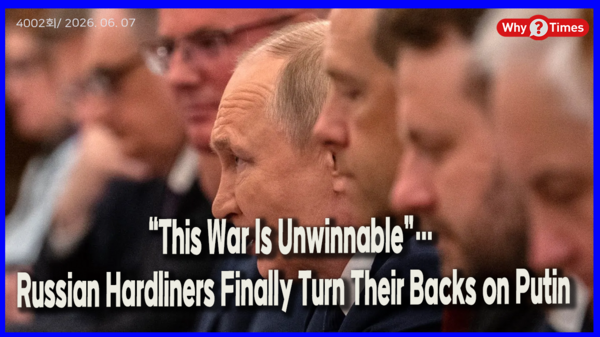
[The Achilles' Heel of an Autocracy — “The Greatest Threat Is the Internal Elite”]
The public demands by core members of Russia's hardline faction to end the war in Ukraine signify more than just a routine drift in public sentiment; they serve as a clear signal that the structural vulnerabilities of the Putin regime are starting to manifest externally. The fact that internal actors within the system, who had previously taken the continuation of the war for granted, are now speaking out indicates that the "equation of silent loyalty" that has held until now is beginning to fracture.
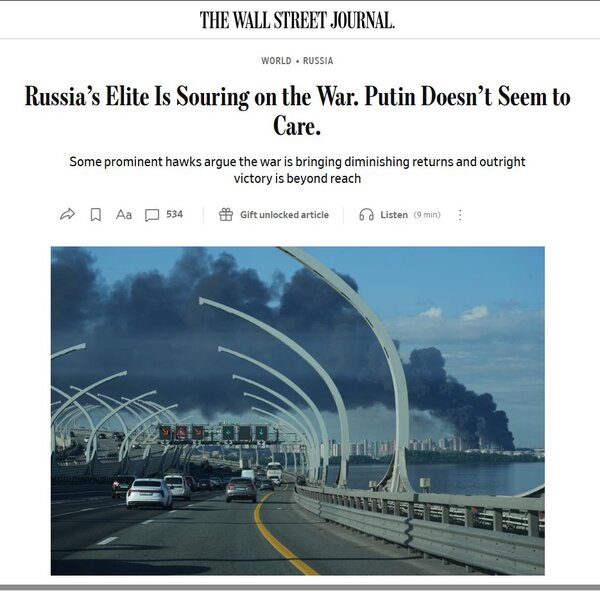
On June 4, The Wall Street Journal (WSJ) reported in an article titled “Russia's Elite Is Souring on the War. Putin Doesn't Seem to Care” that “the voices calling for an end to the war are starting to emerge not only from liberal-leaning business elites but also from some of Russia's most prominent hardline figures.” The WSJ added, “These figures are publicly revealing their belief that Moscow lacks the capacity to achieve a total victory over Ukraine. What makes this rift unprecedented is that these very individuals were once the war’s most fervent supporters.”
In its June 4 report, The Week, a prominent global weekly current affairs magazine published in the UK and the US, noted, “A perception is now forming at the very core of Russian power that ‘the war is unwinnable and could destroy the Russian economy.’” Furthermore, the Levada Center, an independent Moscow-based polling organization, revealed that “62% of Russian citizens support peace negotiations with Ukraine, while only 27% remain in favor of continuing the war.”
[The Achilles' Heel of an Autocracy — “The Greatest Threat Is the Internal Elite”]
The Atlantic Council, a prestigious Washington, D.C.-based think tank specializing in international relations and foreign affairs, pointed out, “Studies on authoritarian regimes consistently draw one conclusion: the single greatest factor threatening the stability of a dictatorship is the existing elite establishment.” The Atlantic Council analyzed that “Putin understands this fact better than anyone and has spent years working to minimize the risk of a potential coup.” It added, “While pushback among Kremlin power brokers is possible, the current Russian ruling class is too deeply entangled with Putin to mount a full-scale challenge.” Indeed, Dmitry Kozak, a long-time Kremlin ally who opposed the full-scale invasion of Ukraine and advocated for de-escalation, was met with a quiet dismissal rather than open defiance.
However, the current situation suggests that this established formula is wavering. Aleksey Chadaev, a system loyalist and hardline figure, warned that “maintaining the current wartime trajectory will not merely result in a failure to win, but will lead to a total defeat.” He argued that “Russia must pause first before reorganizing for the next phase of conflict.”
Meanwhile, Vasily Kashin of the Higher School of Economics in Moscow flatly stated, “The goal of eliminating the anti-Russian, pro-Western regime in Ukraine is, in principle, unachievable at this stage.” He explained, “To achieve this, Russia would have to completely occupy the entire country, including western Ukraine, for an extended period, which is technically impossible for Russia.”
[The 'Death Zone' of Finance and Economy — The Material Base to Sustain the War Erodes]
Regarding this, the European Union Institute for Security Studies (EUISS), the official think tank of the EU, stated, “The direct catalyst igniting internal discontent is the rapid deterioration of the economy.” The EUISS revealed, “From January to April 2026, the federal budget deficit of the Russian Federation reached 5.9 trillion rubles (approximately 2.5% of GDP), already exceeding the 5.6 trillion ruble deficit projected for the entire year of 2025.” This means Russia surpassed the government's initial 2026 full-year target of 3.9 trillion rubles by 1.5 times in just four months. Putin himself recently betrayed his displeasure during a meeting of high-ranking officials, acknowledging that the economy contracted by 1.8% in the first two months of 2026.
Alexandra Prokopenko, a fellow at the Carnegie Russia Eurasia Center, used mountaineering jargon to describe this scenario as a “death zone.” She explained, “Just as a body consumes itself faster than it can self-repair at high altitudes, the Russian economy—while not on the verge of immediate collapse—is trapped in a 'negative equilibrium,' barely scraping by while eating away at its own future capacity.” Prokopenko pointed out a more fatal dilemma: “The more critical issue is that Putin cannot descend from this mountain. With the economy already locked into a structure over-reliant on the defense industry, military demobilization would lead directly to an economic crisis.”
The Royal United Services Institute (RUSI) of the UK assessed that “Russia has already failed in four out of its five strategic objectives—including political dominance, economic sustainability, regime stability, and international standing—and its energy revenues plummeted by 34% year-on-year as of November 2025, forcing it to rapidly increase borrowing.” Analysts also point out that the actual burden of the war is nearing 9% of GDP. This is more than triple the 2% to 3% burden that the Soviet Union bore during its war in Afghanistan.
[“The War Sustains This Regime” — But the War Triggers a Backlash]
In relation to this, local Ukrainian media outlet RBC-Ukraine reported, “Beginning in the spring of 2026, a shared realization that 'things cannot continue like this' began to take shape simultaneously among hardline war supporters (Z-patriots), the elite class, and ordinary citizens who had previously been indifferent to politics.” The outlet noted that “this is due to the depletion of reserve funds, which led to the first economic contraction since 2023, combined with the fact that the absence of any meaningful victories on the frontline has become obvious to everyone.”
Russian economist Vladimir Milov warned, “The 'unholy trinity' of recession, inflation, and a fiscal crisis hitting all at once will make 2026 the worst year since the outbreak of the war.” Even the government’s own forecasts predict 5.2% inflation against a mere 2% wage growth for this year, and the economic stimulus effect of 'Military Keynesianism' triggered by increased military spending is evaluated to have already run its course.
[Historical Precedent — Russian Military Defeat Has Always Shaken the Power Structure]
In an opinion piece for the Financial Times (FT), Gideon Rachman diagnosed, “Russian history tells Putin that he needs to worry not only about the direction of the war but also about his own position.” Historically, Russia's military setbacks have led to abrupt shifts in Moscow's power structure. The defeat in the Russo-Japanese War of 1905 led to public unrest and debates over a constitutional monarchy, while failures in World War I served as the backdrop for the Russian Revolution.
RUSI pointed out, “In reality, Russia has now been fighting Ukraine longer than the Soviet Union fought during the Great Patriotic War, yet it has failed to secure the entire Donbas, and in April, it actually lost territory.” It noted, “The trap Putin has set for himself is psychological.” For a regime that has derived its authoritarian legitimacy from the 'restoration of Russia's greatness,' the moment it acknowledges a strategic defeat, it faces the risk of political collapse.
[Imminent Collapse Is a Premature Judgment — Elites Fear the Post-Putin Era More]
Conversely, Foreign Policy magazine noted that “there is a distinct caution among analysts against excessive optimism.” It stated, “Putin, who has held power for 25 years, has built a system engineered to withstand rumors, backlashes, and internal power struggles. Many phenomena currently interpreted as signs of weakness could actually be leveraged to further tighten the mechanisms of repression that have kept him in power for decades.”
The Center for Strategic and International Studies (CSIS) pointed out, “The Russian elite are well aware that with all political institutions hollowed out over Putin’s 25-year rule, he has become the 'sole factor' maintaining the relative balance of interests within the ruling class.” Therefore, “the elite fear what comes after his departure far more than the continuation of his destructive military adventures.” CSIS further predicted that because the war hardliners and security agencies share a common destiny with the current regime, they will aggressively block any transition from within.
[Conclusion — What Shakes Putin Is Not the Frontline, But the Inside of the Regime]
The changes currently observed in Russia do not imply an immediate collapse of the regime. Putin still maintains control over the state security apparatus, the military, and intelligence agencies, and the Russian elites likewise dread the 'post-Putin chaos.' Consequently, a coup or a regime transition is unlikely to occur in the near future.
Nevertheless, this fracture is drawing intense attention because, for the first time, open questions are being raised from within the forces that prop up the system, rather than from the opposition. Until now, the Putin regime has sustained its legitimacy through war. However, as the war drags on, the economy weakens—and as the economy weakens, the discontent of both the elites and the public grows.
The dilemma is that Putin no longer has an easy exit ramp. Continuing the war destabilizes the economy and public finances; ending the war destabilizes the legitimacy of the system that promised victory. Ultimately, Putin is transforming from a leader who maintained power through war into a leader whose power is being shaken by war.
Russian history demonstrates that internal fractures have produced far greater upheavals than external defeats when bringing down a regime. The current grumbling from Russian hardliners may not be the signal for a coup just yet. However, it could very well be the beginning of the warning siren that the Putin regime has always feared the most.

-중국 푸단대학교 한국연구원 객좌교수
-전 EDUIN News 대표
-전 OUR NEWS 대표
-제17대 대통령직인수위원회 정책기획팀장
-전 대통령실 홍보기획비서관
-사단법인 한국가정상담연구소 이사장
-저서: 북한급변사태와 한반도통일, 2012 다시우파다, 선거마케팅, 한국의 정치광고, 국회의원 선거매뉴얼 등 50여권