
Update2026.10.24 (토)

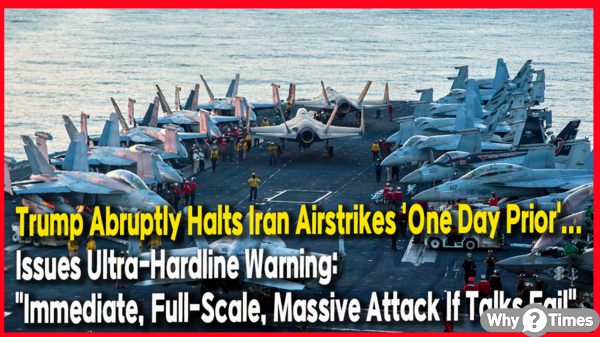
[Trump Abruptly Suspends Operation Just One Day Before Planned Airstrikes Upon Urgent Requests from Three Gulf Nations]
U.S. President Donald Trump abruptly halted a prepared military strike against Iran just moments before it was set to be executed. This sudden suspension came at the urgent request of leaders from allied Gulf nations—including Qatar, Saudi Arabia, and the United Arab Emirates (UAE)—who expressed deep concerns over the potential escalation into an all-out war and strongly urged a halt to military action. Accepting their requests, President Trump left the door open for negotiations with Tehran. Concurrently, however, he warned that the U.S. remains fully prepared to launch a massive military assault should a satisfactory agreement fail to materialize.
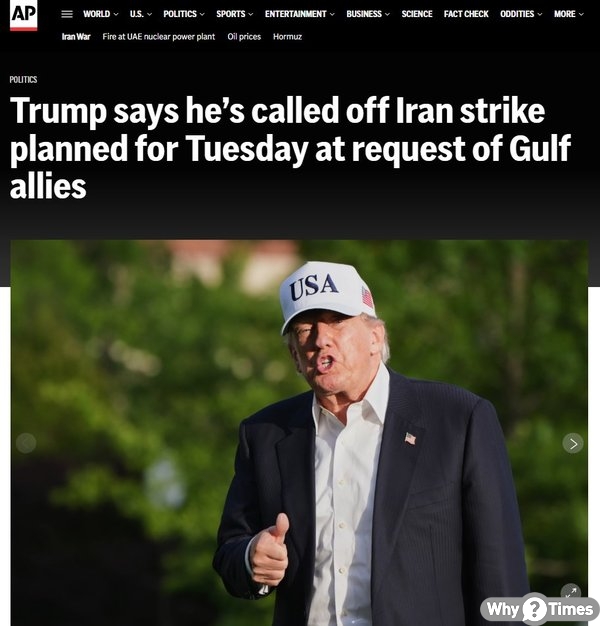
On May 19, the AP reported, "President Trump announced in a post on Truth Social on May 18 (local time) that the Emir of Qatar, the Crown Prince of Saudi Arabia, and the President of the UAE requested a postponement of the scheduled military strikes, citing that 'serious negotiations with Iran are underway.'" The report added, "Out of respect for the requests of these three leaders, Trump instructed Defense Secretary Pete Hegseth, Chairman of the Joint Chiefs of Staff Daniel Kane, and the entire U.S. military to stand down from the airstrikes against Iran originally scheduled for May 19."
The AP further noted, "While it was widely known that President Trump had been weighing the option of resuming military action against Iran for several years following a Pakistan-mediated ceasefire, this marks the first time it has been revealed that a specific strike date—May 19—had been finalized and the operation officially approved." The news agency also highlighted that over the weekend, Trump had issued a stark warning, stating, 'Time is running out for Iran. Move quickly, or there will be nothing left.'
"Even as he announced the cancellation of the airstrikes, President Trump did not lower the intensity of his rhetoric," the AP reported. "Trump stated that he has instructed the U.S. military to 'remain postured and ready to immediately execute a full-scale and massive attack on Iran' if an acceptable agreement is not reached. He emphasized that above all, 'NO NUCLEAR WEAPONS FOR IRAN' will serve as a core baseline condition for any deal."
[Mirroring the Eve of War: Over 100 C-17 Sorties Constantly Shuttling Between the Middle East and Europe]
Simultaneously with the declaration of the strike postponement, an ominous development caught the attention of military experts. Multiple OSINT (Open Source Intelligence) observers reported, "Data from flight tracking platforms such as Flightradar24 revealed that between May 16 and 18, approximately 11 U.S. Air Force C-17 Globemaster III strategic transport aircraft were spotted heavily shuttling between major Middle Eastern hubs—including Al Udeid Air Base in Qatar and Al Dhafra Air Base in the UAE—and core European hubs like Ramstein Air Base in Germany." They also noted that "the concomitant operations of C-5 Super Galaxy large transport aircraft and KC-135 and KC-46 aerial refueling tankers were confirmed alongside them."
What makes this movement particularly alarming to military analysts is the historical precedent: right before the U.S. and Israel initiated 'Operation Epic Fury' on February 28, a concentrated surge of over 100 C-17 round-trips was retrospectively analyzed as the logistics preparation phase for the outbreak of war. The OSINT community explained, "Analyses indicate that the transport aircraft activity in mid-May almost perfectly mirrors the operational pattern observed immediately prior to the outbreak of the war back then."
[“A Ceasefire on Life Support”… The Negotiation Clock Pushed to the Brink of Airstrikes]
This postponement of airstrikes materialized amidst an extremely tense and fast-moving diplomatic standoff. The conflict originally erupted on February 28, 2026, when the U.S. and Israel launched a surprise strike on Iranian nuclear facilities under 'Operation Epic Fury.' Supreme Leader Ali Khamenei was killed in the bombardment, and Iran immediately retaliated by blockading the Strait of Hormuz. As the strait—through which roughly 25% of the world's maritime crude oil trade passes—was shut down, Brent crude oil prices skyrocketed to around 114 USD per barrel. Following roughly 40 days of hostilities, a ceasefire was brokered by Pakistan on April 8, but subsequent negotiations have repeatedly stalled.
On May 11, President Trump publicly rejected Iran’s latest proposals, declaring, "I cannot accept Iran's latest peace offer," and proclaimed that "the ceasefire is on life support." At the time, Trump went as far as to claim, "I have the best plan. Iran has been completely defeated militarily." In response, Axios reported that the U.S. Central Command (CENTCOM) had drawn up a "short and sharp" strike plan against Iran to break the diplomatic deadlock, while U.S. administration officials remarked, "Everybody knows where we are headed."
The AP noted, "Immediately following President Trump's announcement of the airstrike cancellation, oil prices dipped," adding that "just prior to the announcement, petroleum futures were trading at 108.83 USD per barrel."
[Trump’s Five Preconditions vs. Iran’s Demands… The Chasm Remains Polar Opposites]
At the core of the diplomatic stalemate is a fundamental clash between the conditions proposed by each side. U.S. public broadcaster PBS reported, "In responding to Iran’s latest ceasefire proposal, the United States laid down five extremely stringent preconditions."
The U.S. Five Preconditions:
No payment of any reparations or war damages.
Allowing Iran to operate only a single nuclear facility.
The extraction and transfer of 400 kg of Iran’s enriched uranium stockpile directly to the United States.
A refusal to unfreeze Iran's overseas assets.
A permanent ceasefire across all fronts is contingent upon the commencement of follow-up negotiations.
PBS explained, "Iran’s demands point in the exact opposite direction. Iran is puting forward a comprehensive ceasefire, the complete lifting of sanctions, the full return of frozen overseas assets, U.S. reparations for war damages, and guaranteed freedom of navigation in the Persian Gulf and the Strait of Hormuz as its core conditions."
Iranian Foreign Ministry Spokesman Esmaeil Baghaei confirmed during a press conference on May 19 that Tehran "has already transmitted its response to the latest U.S. proposal," though he withheld specific details. He stated, "We have not asked for any concessions. What we have demanded are simply Iran's legitimate rights. The U.S. side stubbornly insists on a unilateral perspective and unreasonable demands."
Iranian President Masoud Pezeshkian also stated on social media on May 19 that "dialogue does not mean surrender," adding, "Iran will engage in negotiations based on dignity, authority, and the defense of national rights, and will never surrender the legitimate interests of its people and nation." In relation to this, the AP cited two regional diplomats reporting that Pakistan had attempted to broker a Memorandum of Understanding (MOU) last week to lay the groundwork for ending the war and initiating subsequent dialogue, but the effort fell through and mediation attempts are ongoing.
The AP further stated, "Iran has proposed a plan to downblend a portion of its highly enriched uranium and transfer the remainder to a third country," noting that "Russia has previously expressed its willingness to accept it." However, this proposal still falls considerably short of the U.S. demand for the direct transfer of the entire 400 kg stockpile to the United States.
[Global Energy Crisis and Pressure via Control over Hormuz Subsea Cables]
As negotiations drag on, the global economy is taking a direct hit. The Executive Director of the International Energy Agency (IEA) classified the situation brought about by this war as "the most severe global energy security crisis in history." Iran's blockade of the Strait of Hormuz has severed 20% of the global oil supply, and crude production from Kuwait, Iraq, Saudi Arabia, and the UAE plummeted by at least 10 million barrels per day by mid-March. In the Gulf Cooperation Council (GCC) countries, which rely on this strait for over 80% of their food imports, a "food supply emergency" was triggered, with 70% of food imports blocked as of mid-March.
There have been recent signs of a partial recovery in transit through the strait. Marine data analytics firm Kpler stated, "Between May 11 and 17, 55 commodity-carrying vessels passed through the strait, a nearly threefold increase compared to the 19 vessels recorded the previous week."
Nevertheless, Iran maintains its grip on the strait, and the U.S. military has not lifted its blockade of Iranian ports. Furthermore, following its blockade of the Strait of Hormuz, Iran is showing signs of weaponizing subsea internet cables as a new strategic tool. Iran is reportedly planning to task its newly established 'Persian Gulf Strait Management Authority' with the oversight and management of regional undersea cables. If implemented, cables transmitting massive volumes of global internet traffic and financial data could fall under Iranian jurisdiction. Iran is citing the Egyptian model—which collects transit fees for cables passing through the Red Sea and Mediterranean corridor—as a precedent. The Islamic Revolutionary Guard Corps (IRGC) warned that if these cables are damaged, the global economy could suffer hundreds of millions of dollars in losses daily. The U.S., other Western nations, and the European Union (EU) are strongly pushing back against Iran's attempts to tighten control over the strait, demanding that freedom of navigation be guaranteed.
[Walking a Tightrope on the Brink… The Trigger Could Truly Be Pulled Next Time]
President Trump has a track record of backing down after repeatedly setting deadlines for Iran in the past. On the other hand, he has also abruptly ordered airstrikes immediately after signaling a willingness to negotiate. Even during the early stages of this war, he ordered strikes shortly after hinting at leaving room for diplomatic maneuvers.
This time, however, the atmosphere feels distinctly different. This is the first time an official operational approval date has been publicly confirmed, and large-scale round-trip movements of U.S. transport aircraft between the Middle East and Europe—mirroring the eve of the war's outbreak—are being widely documented by the OSINT community. The chasm between negotiation conditions shows no signs of narrowing: the U.S. refuses to budge an inch on its nuclear red line, while Iran maintains sovereignty and reparation demands as preconditions for talks.
The deadlocked negotiations and the looming possibility of a resumption of hostilities raise fears that the Middle East could be dragged back into an all-out war, further prolonging the global energy crisis triggered by the conflict. The world watches with bated breath to see whether this postponement of airstrikes is a genuine diplomatic breakthrough or simply the final pause before a much larger conflagration.


-중국 푸단대학교 한국연구원 객좌교수
-전 EDUIN News 대표
-전 OUR NEWS 대표
-제17대 대통령직인수위원회 정책기획팀장
-전 대통령실 홍보기획비서관
-사단법인 한국가정상담연구소 이사장
-저서: 북한급변사태와 한반도통일, 2012 다시우파다, 선거마케팅, 한국의 정치광고, 국회의원 선거매뉴얼 등 50여권