
Update2026.10.24 (토)

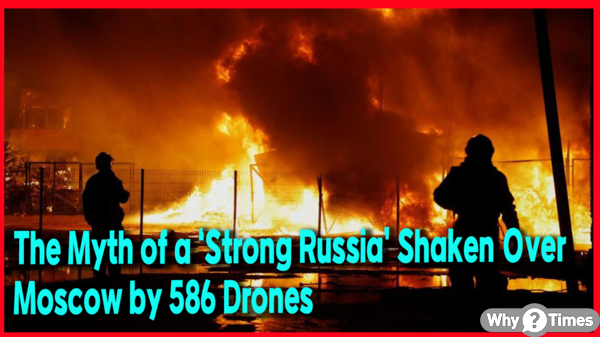
[Kiev Striking the Russian Heart Is a Massive Retaliatory Drone Strike]
Ukraine has struck Moscow with 586 drones. This massive strike served as retaliation for Russia's large-scale airstrikes and a symbolic assault exposing cracks in the Putin regime, which has long championed the narrative of a "Strong Russia." Beyond a mere military reprisal, this attack carries profound political ramifications, demonstrating once again that President Vladimir Putin’s authority—carefully cultivated through the symbol of a "Strong Russia" across a war spanning well over four years—is steadily eroding.
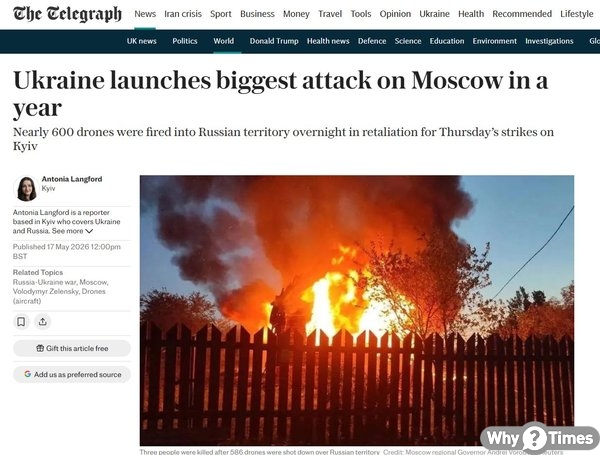
The Telegraph reported on May 18, "This drone offensive is a direct counterattack to the ultra-large-scale airstrikes Russia launched against Kyiv on May 15. At that time, Russia rained down approximately 1,500 drones across Ukraine within 24 hours, scoring a direct hit on a nine-story apartment building in Kyiv with cruise missiles, which collapsed the structure, leaving 24 dead and over 50 injured." The outlet added, "As rescue workers recovered bodies from the rubble, hundreds of citizens spent the night without knowing the fate of their families and neighbors. The following day was declared a national day of mourning, with flowers and stuffed animals piling up downtown, and dolls commemorating the three children who perished filled the disaster site."
The Telegraph continued, "Immediately following the airstrikes, Ukrainian President Volodymyr Zelensky ordered his military command to 'instantly propose possible response measures,' and two days later, Ukraine's long-range drone units launched a massive counteroffensive." It noted, "The very fact that a counterattack of this scale was possible in such a short timeframe proves that Ukraine's drone capabilities have completely established themselves as a routine wartime operational capacity."
Furthermore, The Telegraph stated, "Moscow Mayor Sergey Sobyanin confirmed that at least three people were killed in the capital region alone due to this attack. Some of the downed drones bypassed air defense networks and crashed into the capital's downtown, with local Telegram channels continuously uploading videos of flashes and explosions lighting up the night sky." Witnesses reported hearing explosions even in central Moscow.
"Debris from drones also fell in the area of Sheremetyevo International Airport, Russia's busiest airport, disrupting flight operations," The Telegraph added. "The Russian Ministry of Defense stated that drones were shot down across 14 regions, including Belgorod, as well as around the occupied Crimean Peninsula, with one additional fatality reported in Belgorod."
["End the War": Zelensky’s Resolute Message]
On May 18, President Zelensky personally confirmed the attack by releasing a video on social media showing drones flying over Moscow and smoke billowing from explosion sites. He emphasized, "Ukraine’s long-range strikes have reached the Moscow region, and Russia must end this war." He added, "The Moscow region possesses Russia’s most densely deployed air defense network, but we are breaking through it."
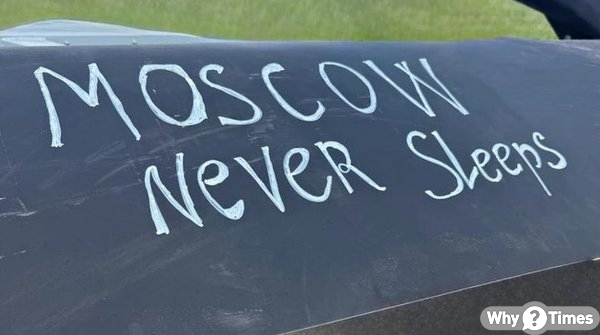
Robert Brovdi, commander of a Ukrainian drone unit, posted a telling photograph on Telegram showing a drone wing inscribed with the words, "Moscow never sleeps." He added the caption: "The one-way pass to a peaceful life issued to Moscow’s aristocratic neighborhood 'Patriki' and its surrounding areas has been canceled." This sent a direct warning message targeting the Patriarshiye Ponds area, a dense enclave for the capital's wealthy elite.
According to analyses from local channels, the primary targets of this attack included oil refineries, cruise missile and various munitions production plants, fuel storage and loading depots, and technology parks. The long-range strikes by the Ukrainian military are executed by concentrating on factories, refining facilities, and air defense assets to paralyze the enemy's production and logistical capabilities. Just the day prior, President Zelensky announced that Ukrainian forces successfully destroyed a rare amphibious aircraft deep within enemy territory.
[Putin Humiliated on Victory Day: The Myth of a 'Strong Leader' Cracks]
This drone offensive reads as even more symbolic due to the dismal spectacle seen just ten days earlier during the Victory Day parade in Moscow's Red Square. The Wall Street Journal (WSJ) pointed out, "For over 25 years since taking power, President Putin has turned May 9—the anniversary of the Soviet Union's defeat of Nazi Germany—into a virtual state religion. However, this year’s Victory Day was conducted without heavy armor like tanks or missiles for the first time since 2007. While organizers cited 'minimizing terrorist threats' as the reason, this was effectively an open admission by Russia that the defense of the capital's airspace is incomplete."
The WSJ explained, "Amid non-stop Ukrainian drone attacks, Putin personally requested a short-term ceasefire during the festival period from U.S. President Trump. He was reduced to begging for a truce on Victory Day, Russia's biggest international event since the war in Iran." That was not all; mobile phone and internet services across downtown Moscow were also severed for several days.
Commenting on this, Nico Lange, a former senior German defense official who leads the German IRIS think tank, analyzed: "If Putin had a free choice, he would not have held the parade. However, due to the quasi-religious significance of May 9, he was in a position where he could not afford to skip it."
["No Longer Superman": Structural Cracks and Public Alienation]
Experts analyze that internal rifts within Russian society are deepening beyond simple war weariness into structural vulnerabilities. Alexander Baunov, a senior fellow at the Carnegie Russia Eurasia Center, stated, "Putin is now perceived as an old grandfather detached from today's reality. He is no longer viewed as a protector, nor as Superman."
Abbas Gallyamov, a former Putin speechwriter who now engages in opposition activities abroad, diagnosed: "The psychological turning point of this war occurred in January of this year, when the invasion of Ukraine exceeded four years—surpassing the duration of the Soviet Union's war against Nazi Germany (1941–1945). Since then, every day feeds the sentiment that 'we are not living up to the memory of our grandfathers.' Putin created a cult of ancestor worship, and now it is backfiring." Even Anastasia Kashevarova, a prominent pro-war Russian media personality, wrote on Telegram: "The grandfathers of World War II already reached Berlin; why are we still rambling about red lines?"
Sergey Radchenko, a professor of history at Johns Hopkins University, observed, "Everyone except Putin is beginning to realize that the war is not going according to plan." He pointed out, "In particular, the series of Ukrainian attacks that devastated the Tuapse refinery and export ports along the Black Sea coast served as a turning point. The war has come directly to those who used to support it from a distance."
The WSJ explained, "Analyses suggest that roughly 70% of the Russian population is now within Kyiv’s striking range. Even regions located more than 1,600 kilometers away from the front lines are no longer safe zones." Vovacola, a TikTok influencer with 178,000 followers from the Chuvashia region near the Volga River, urged, "Drones targeting military factories have destroyed nearby large shopping malls and caused civilian casualties. Both Putin and Zelensky need to sit down at the negotiating table and 'show that brains are better than brawn.'"
[The Limits of Internet Blockades and Rule by Fear]
The Telegraph reported, "As Ukraine's long-range strike capabilities strengthen by the day, Putin enacted an emergency decree completely blocking the release of information regarding damage from attacks on the Russian mainland. Posting text, photos, or videos containing attack damage details without official government authorization will subject individuals to fines, and this measure will remain in place indefinitely." The WSJ added, "Russian security agencies have introduced powerful internet censorship measures mimicking China's Great Firewall. Paradoxically, however, this control is provoking warnings of an 'imminent revolution' even among pro-war nationalist loyalists."
Victoria Bonya, a Russian Instagram celebrity residing in Monaco who had previously abstained from political commentary, spoke out for the first time in a video that garnered 1.6 million likes. Addressing Putin directly, she warned, "You do not know reality because greedy bureaucrats lie to you, and because you rule the country through fear." She added, "People will stop being afraid one day; they are currently compressed like a spring, and one day that spring will snap back."
Marat Gelman, a former Putin advisor turned anti-government activist abroad, noted, "The Kremlin knows that severe discontent could be on the horizon, so it is currently permitting the expression of low-intensity grievances. For now, it still possesses sufficient resources to suppress any civil uprising." Conversely, John Sullivan, who served as the U.S. Ambassador to Russia during the early stages of the Russian invasion, remarked, "In Russia, things move slowly, but once they break, they break instantly." He stated, "I wouldn't have said this a year or two ago, but now I think it is possible."
["Revolutionary Change Will Come Within Two Months": Warning Signs of Internal Cracks]
Unrest within Russia is also being detected among the elite class. Nationalist commentator Aleksandr Kartavykh wrote on his Telegram channel, "In the current state of Russia's 'collective mental derangement,' the margin of social stability will not last beyond two months. After that, 'revolutionary changes' will arrive." Hardline nationalists are furious over systemic corruption lingering since the tenure of former Defense Minister Shoigu, as well as the promotion of Colonel General Chayko—who led the failed attempt to capture Kyiv in early 2022—to Commander-in-Chief of the Aerospace Forces. Notably, four former deputy defense ministers have already been arrested on corruption charges.
With the 'May 9 cult' that sustained Putin's rule facing a severe backlash and drones blanketing the capital's skies, Gallyamov's warning is increasingly viewed as a realistic scenario rather than a mere aphorism. He warned, "People who used to be indifferent to politics are now beginning to express political views and view empathizing with the people's suffering as a trend. Historically, such trends usually emerge right before a revolution."
The drones and black smoke filling the skies over Moscow demonstrate that the nature of this war has completely shifted. The unyielding courage and uncompromising retribution displayed by Ukraine will stand as a harsh and terrifying warning to every dictatorship on Earth and the forces that shield them.


-중국 푸단대학교 한국연구원 객좌교수
-전 EDUIN News 대표
-전 OUR NEWS 대표
-제17대 대통령직인수위원회 정책기획팀장
-전 대통령실 홍보기획비서관
-사단법인 한국가정상담연구소 이사장
-저서: 북한급변사태와 한반도통일, 2012 다시우파다, 선거마케팅, 한국의 정치광고, 국회의원 선거매뉴얼 등 50여권