
Update2026.10.24 (토)

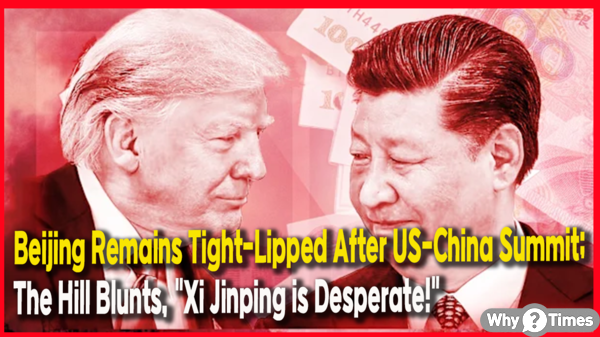
[Beijing Fails to Confirm or Deny Trump’s Unilateral Announcements]
Three days have passed since the conclusion of the US-China summit, yet the Chinese Ministry of Foreign Affairs (MFA) has failed to release an official statement regarding the agreements reached. While US President Donald Trump loudly proclaimed that "China agreed to everything," the Chinese MFA has maintained ultimate silence. It remains unresponsive even to reporters' inquiries. Why, then, is China unable to officially announce the summit's outcomes? Notably, this silence is not merely a strategic calculation; it is an inevitable byproduct of the domestic political vulnerabilities currently facing Xi Jinping.
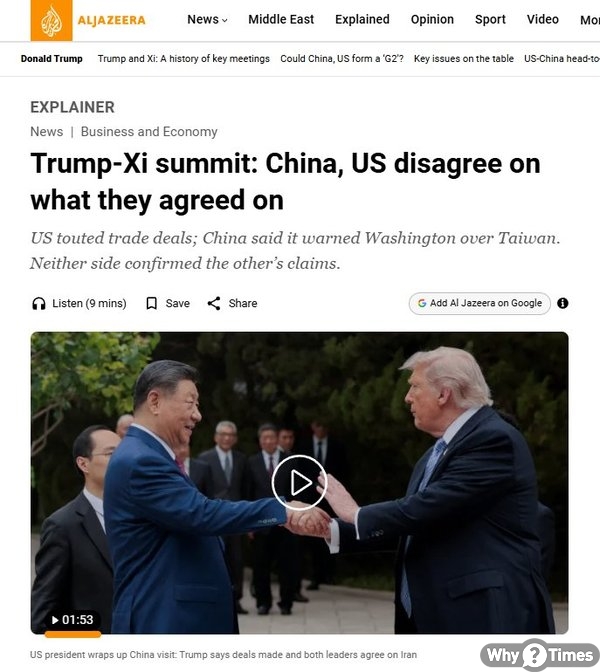
On May 16, Al Jazeera, a Qatar-based international news channel with a Middle East-friendly perspective, reported:
"The two-day US-China summit, held at the Great Hall of the People and Zhongnanhai in Beijing from May 14 to 15, has concluded. Following the meetings, US President Donald Trump boarded Air Force One, assessing that they had reached a 'fantastic deal.' Immediately upon his return, he stated in a Fox News interview that China had agreed to purchase 200 Boeing aircraft, pledged to buy soybeans, oil, and LNG, and promised to halt the provision of military equipment to Iran."
Al Jazeera further noted, "However, the Chinese MFA has not officially confirmed any of these details. The post-summit statements released by the White House and the Chinese MFA shared extremely limited overlap; items included in the White House announcement were conspicuously absent from the Chinese MFA statement, and vice versa." The two nations presented starkly different narratives regarding the exact same meeting.
In this regard, Joey Liu, an analyst at the Council on Foreign Relations (CFR), observed, "The Chinese Ministry of Commerce was asked about the Boeing aircraft purchases but provided no direct answer," adding that "the pledge for soybean purchases also remains officially unconfirmed by the Chinese side." While Trump touted the achievements, China has remained quiet.
[“Xi is Desperate” — A Stark Assessment by Congressional Media The Hill]
Immediately following the summit, The Hill, a prominent US political media outlet, published an analysis titled "After the Trump-Xi summit, China, not America, is on the back foot." The piece pointed directly at the intense pressure weighing on Xi Jinping beneath his veneer of confidence.
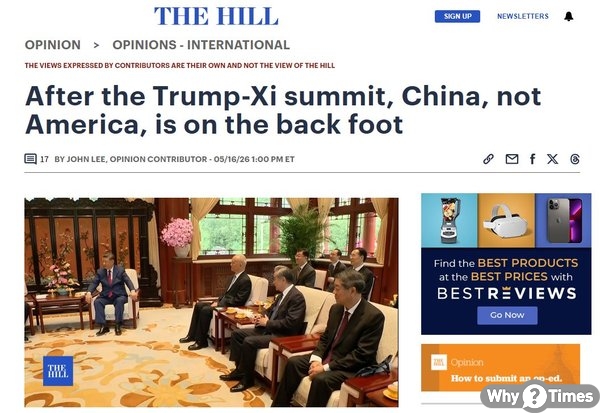
The Hill pointed out that the Chinese Communist Party (CCP) has continuously drilled a narrative into the non-Western world that "the US is in decline, China’s rise is certain, and the fall of the West is inevitable." However, the outlet noted that as Xi welcomed Trump, he was simultaneously facing mounting domestic criticism over his excessive concentration of power and his economic and political stewardship. "In this respect," The Hill underscored, "contrary to his surface-level confidence, he was carrying substantial internal pressure."
[The Triple Burden Weighing on Xi Jinping]
In reality, Xi Jinping could not have been at ease throughout the summit. His approach to these talks was shaped by three underlying structural vulnerabilities:
First, the Economy: According to the Asia Society’s 2026 China Analysis Report, China is currently grappling with a youth unemployment rate nearing 20%, alongside a deepening real estate slump and sluggish household consumption. While the economy continues to grow, that growth is increasingly driven and skewed by the state, resulting in output expansion devoid of productivity gains.
Second, Politics: The Hudson Institute analyzed that "while the anti-corruption campaign and internal purges have removed hundreds of thousands of officials, this has fostered a governance style rooted in fear rather than loyalty." It further pointed out that "the simultaneous convergence of a real estate collapse, capital flight, and a brain drain has shattered consumer confidence."
Third, the Political Calendar: The 21st National Congress of the CCP in 2027 is scheduled to elect a new Central Committee and approve Xi Jinping’s fourth term as General Secretary. The year 2026 is a critical window during which he must consolidate political power and tighten control over the military ahead of the congress. At a juncture where he must solidify his power base, he cannot afford to expose any weakness in foreign negotiations.
[A Four-Hour Reversal on Beef — The Most Explicit Evidence of Internal Resistance]
An incident during the summit captured how these vulnerabilities are translating into actual diplomatic behavior. China appeared poised to lift its year-long ban on US beef imports, only to reverse the decision a mere four hours later. A decision that had progressed to the brink of an official announcement was abruptly overturned.
The silence on the Iran cooperation pledge, the refusal to confirm the Boeing purchases, and the abrupt reversal on beef imports all stem from the same structural dilemma: the more unilaterally Trump announces these developments, the harsher the domestic backlash will be for China if it officially confirms them, as it would signal that "Xi Jinping capitulated."
Given that the consolidation of the Xi Jinping regime is structurally tied to a hardline stance against the United States, confirming Trump’s propaganda would shake the very logic of the regime. Consequently, Chinese authorities find themselves trapped in a dilemma where they can neither confirm nor deny the claims.
During a briefing, CFR analyst Joey Liu explained, "The core concession from the US was ultimately 'status recognition' for China, which is exactly what Xi Jinping and the Chinese government wanted." She added, "This acknowledges China as an 'important partner' rather than merely a 'problem to be solved.'"
However, this status recognition did not come free of charge. Time magazine noted:
"Prior to his visit to China, Trump had already made significant preemptive concessions, such as permitting the export of Nvidia’s advanced AI semiconductor chips to China and putting a $13 billion arms sale to Taiwan on hold. What the US gave up first was, in fact, a preemptive strike."
Time further pointed out, "Despite this, Xi issued warnings regarding Taiwan, and Trump remained silent on the matter. While the Chinese MFA wished to frame this as an achievement, they refrained from making an announcement out of fear of a domestic public backlash if it were openly confirmed. Instead, they resorted purely to political propaganda."
[Conclusion: A Gamble Toward the 2027 Party Congress — The Politics of Silence]
Commenting on this environment, SinoInsider warned, "Public dissatisfaction within China regarding Xi's governance has intensified across society as we enter 2026," adding that "if Xi’s support base fractures ahead of the 2027 Party Congress, factions within the party may use this as leverage."
Viewed through this lens, the Chinese MFA's silence is not simply a negotiating tactic. The moment an official list of agreements is published, a narrative that "we knelt before Trump" will spread domestically. Such a narrative could fracture Xi Jinping’s authority leading up to the 2027 Party Congress. Silence, therefore, serves as the ultimate firewall to prevent that fracture.
In conclusion, the bizarre silence hovering over Beijing politics following the curtain-drop of the US-China summit serves as stark evidence of the structural limitations and vulnerabilities of the Xi Jinping regime. This passive posture stands in stark contrast to the aggressive momentum of China's usual "Wolf Warrior diplomacy." As The Hill astutely analyzed, the summit has laid bare that it is the CCP regime—not the United States—that has truly been pushed into a corner. It reaffirms that while Xi has long championed the decline of the West and the rise of China, he is in reality facing severe internal pressure brought on by excessive centralization of power and policy missteps.
Currently, Xi Jinping's greatest Achilles' heel is a Chinese economy on the brink of collapse. As highlighted in the Asia Society’s latest report, with youth unemployment hovering near 20% and the real estate market stagnating, Xi's state-led economic policies are producing mere output increases devoid of productivity. This economic distress is fueling public alienation, leaving Xi with little choice but to rely on nationalist agitation through a hardline stance against the US.
Furthermore, a reign of terror sustained by political purges has reached its limits. As the Hudson Institute noted, an anti-corruption campaign that eliminated hundreds of thousands of officials has generated cautious passivity and fear rather than genuine loyalty, while accelerating capital flight and a brain drain. In this climate, officially acknowledging massive economic concessions to Trump would deal a fatal blow to Xi’s absolute authority.
Most critically, next year’s 21st National Congress of the CCP in 2027 is the decisive stage for approving Xi Jinping’s fourth term as General Secretary. For Xi, who must thoroughly fortify his power base this year, the outcomes of this US-China summit act as poison. The farce of announcing the approval of US beef imports only to rescind it four hours later directly reflects the intense internal resistance and confusion swirling within the Chinese leadership.
While the CFR notes that the US granted China the symbolic victory of "status recognition" as an important partner, this was merely a face-saving gesture for Xi. In terms of tangible gains, it was a gamble where the US secured a decision-point victory. As Time magazine pointed out, the advanced chip export permissions and the suspension of the Taiwan arms sales that Trump offered upfront were carefully calculated traps designed to bind China to the negotiating table and extract massive purchasing commitments.
This explains why the Chinese MFA is trapped in a catch-22, unable to either confirm or deny the White House announcements. The moment the list of agreements is officially proclaimed, the narrative that "Xi Jinping bowed to Trump" will proliferate among the Chinese public and opposition factions within the party. With public discontent deepening, as warned by SinoInsider, silence remains Xi’s sole defense mechanism to prevent cracks from forming on his path to a fourth consecutive term.
Ultimately, this US-China summit has demonstrated how powerless the CCP's vaunted diplomatic pride becomes when confronted by the robust realist diplomacy of the United States. Xi Jinping may wish to externally propagandize that he extracted concessions from the US, but he has no choice but to hold his breath when faced with the massive invoice Trump has presented. It is a case where weak domestic governance, hidden beneath the flashy packaging of an authoritarian regime, has hamstrung its diplomacy with the United States.
Communist dictatorships routinely manufacture external tensions to mask internal contradictions. However, when faced with economic reality and a crisis of political legitimacy, they invariably lose control. The further Xi Jinping pushes his reckless gamble toward finalizing his regime structure in 2027, the deeper the internal fractures caused by strategic US pressure will become. Beijing's current silence is merely the overture to those impending fractures.
In the end, the most symbolic scene following this US-China summit was not the content of the agreement, but Beijing’s profound silence and inability to officially acknowledge it.
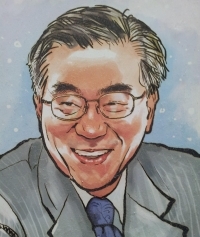
-중국 푸단대학교 한국연구원 객좌교수
-전 EDUIN News 대표
-전 OUR NEWS 대표
-제17대 대통령직인수위원회 정책기획팀장
-전 대통령실 홍보기획비서관
-사단법인 한국가정상담연구소 이사장
-저서: 북한급변사태와 한반도통일, 2012 다시우파다, 선거마케팅, 한국의 정치광고, 국회의원 선거매뉴얼 등 50여권