
Update2026.06.10 (수)

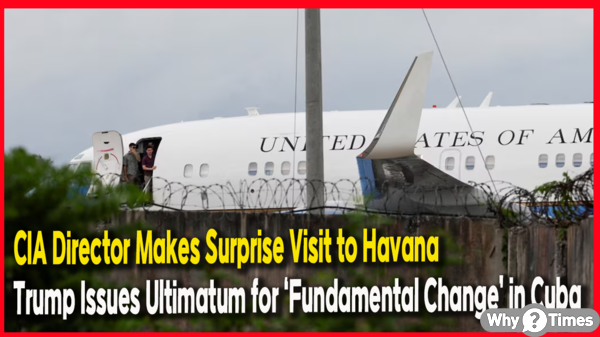
[U.S. Government Plane Lands at Havana Airport… First Secret Contact in 60 Years]
High-level contact between the U.S. and Cuba has surfaced after a U.S. government jet was spotted taking off from Jose Marti International Airport in Havana, Cuba. On this day, John Ratcliffe, Director of the U.S. Central Intelligence Agency (CIA), made a surprise visit to Havana to meet with high-ranking Cuban officials. In this meeting, Director Ratcliffe delivered a message from President Donald Trump that carried the weight of an ultimatum. Currently, Cuba is facing its worst economic crisis since the establishment of the regime, with nationwide blackouts and protests occurring due to an energy blockade and the collapse of the power grid.
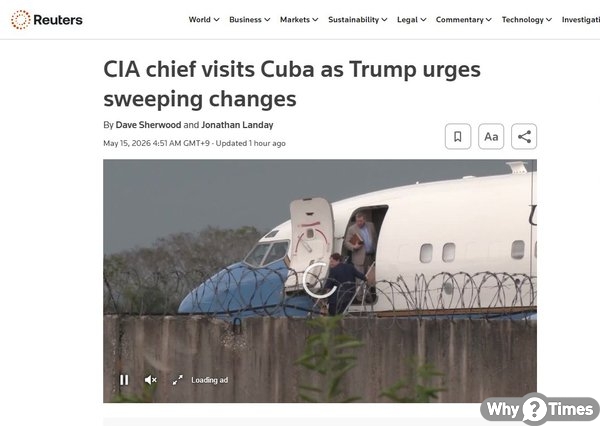
Reuters reported on the 15th, “High-level contact between the U.S. and Cuba was revealed as a U.S. government jet was captured by a Reuters reporter taking off from Jose Marti International Airport in Havana,” adding, “CIA Director John Ratcliffe made a surprise visit to Havana the previous day and held talks with Cuba’s highest-ranking officials.”
Reuters further noted, “CIA officials stated that this visit marks only the second time a CIA director has visited Cuba since Fidel Castro’s 1959 revolution,” pointing out that “the rarity of the event itself proves how extraordinary this contact is.”
The Cuban government also released a statement, disclosing that “Director Ratcliffe held talks with Cuban officials at the Ministry of the Interior in Havana.” Regarding this, Reuters explained, “The meeting was attended by Raulito Rodriguez Castro, grandson of Fidel Castro; Minister of the Interior Lazaro Alvarez Casas; and the head of Cuba’s intelligence agency,” and added, “The fact that the CIA chief personally visited Havana shows that the U.S. has made a strategic decision to deliver a message directly to the regime based on a precise understanding of Cuba’s internal situation.”
[“No Dialogue Without Fundamental Change”… Trump’s Ultimatum]
The message Ratcliffe delivered at this meeting was firm. A CIA official stated, “We delivered President Trump’s message that the U.S. is prepared to engage in serious dialogue on economic and security issues only if Cuba achieves fundamental change.” He added, “Information cooperation, economic stability, and security issues were discussed under the context that Cuba can no longer be a safe haven for hostile forces in the Western Hemisphere.”
There are three major demands the U.S. has made of Cuba for decades: the opening of the state-led economy, compensation for property confiscated by the Castro government, and the holding of free and fair elections. These are essentially demands to relinquish the core foundations of the Communist Party's one-party dictatorship.
The Cuban side also immediately issued a statement, emphasizing “interest in developing bilateral cooperation between law enforcement agencies for the benefit of both countries and regional/international security.” They also reaffirmed that Cuba does not pose a threat to U.S. national security. While showing a willingness to cooperate, they appeared to draw a line against any logic of infringing on sovereignty.
Director Ratcliffe stated that he “sought to initiate substantive consultations on specific steps Cuba must take to build a productive relationship.” CIA officials presented the case of Venezuela as a benchmark for this contact with Cuba. It is interpreted that the U.S. is applying the same approach to Cuba as it did when it sent Director Ratcliffe to Venezuela to build a provisional cooperation system following the January military operation that ousted President Maduro. President Trump had already warned directly in March that “Cuba is next after Venezuela.”
[“Not a Single Drop of Fuel”… The Reality of the Cuban Energy Crisis]
Director Ratcliffe's visit comes at a time when Cuba is facing the worst energy crisis since the establishment of the revolutionary regime. Vicente de la O Levy, Minister of Energy and Mines, appeared on state television on the night of the 13th and stated, “There is absolutely no fuel, no gasoline, no diesel,” adding, “All we have is associated gas from domestic wells and domestic crude oil, the production of which is increasing.” He added, “The situation is very tense. The impact of the blockade is causing significant damage, and we are still not receiving fuel.”
Regarding this, CNN stated, “This crisis did not arrive overnight,” explaining that “Cuba's power grid relies on 16 major thermal power plants, most of which were built in the 1960s to 1980s with Soviet, Japanese, and Czech technology. These aging facilities have far exceeded their design life of about 100,000 hours, and Cuba’s thermal power plants are operating at only 34% of their average capacity.”
CNN further reported, “In late March, Russia donated 100,000 tons of crude oil, providing temporary relief in April, but that volume was exhausted by early May.” It added, “Cubans are now experiencing blackouts for most—sometimes all—of the day. Some residents complain they cannot even charge electric mopeds or cell phones and must wake up in the middle of the night to handle basic daily tasks like laundry and cooking during the short windows of power supply.”
The energy crisis goes far beyond power issues. The UN Human Rights Office stated, “The U.S. blockade and resulting fuel shortages are threatening Cuba’s food supply and have paralyzed water systems and hospital functions.” Fuel shortages have made harvesting crops impossible and have disrupted relief efforts by the UN World Food Programme. The Cuban government has closed schools and universities and restricted public transport. Trash is piling up in cities nationwide, including Havana, as garbage collection vehicles have stopped running due to a lack of fuel.
Solar power is currently an insufficient alternative. Cuba is rapidly pursuing a transition to solar power under an agreement with China to build 92 solar parks by 2028, but the limitation is that without battery storage systems, they provide no help during the peak demand hours at night. The core of the power grid crisis is precisely this nighttime peak time.
[Public Sentiment Spills onto the Streets of Havana… The “Pot-Banging” Revolution]
The energy crisis has exploded into street resistance. U.S. News & World Report reported, “On the evening of the 13th, protests erupted across Havana,” adding, “Hundreds of Cuban citizens poured into the streets of suburban residential areas, burning piles of trash to block roads and banging pots while shouting ‘Turn on the lights!’ and ‘The people, united, will never be defeated!’” This was the largest single nighttime protest in Havana since the energy crisis began.
Protests began sweeping across Havana on May 12. Residents of Reparto Bahía held pot-banging protests on the 13th, shouting “Down with the dictatorship!” while residents of San Miguel del Padrón demanded “Electricity and food!” in front of local government buildings.
According to the Cuba Observatory of Conflicts, 1,133 protests were recorded in the single month of April 2026, a 29.5% increase compared to the same period last year. The already simmering public sentiment crossed its limit in May as the energy crisis reached its peak.
[Return of the 30-Year-Old Shootdown Incident… Indictment of Raul Castro Imminent]
On the very night Ratcliffe’s visit to Havana was made known, the Trump administration pulled out another card. Reuters, quoting a U.S. Department of Justice official, reported, “We are pursuing criminal indictment against former Cuban Council of State President Raul Castro (94).” While grand jury approval is required, the official said it “sounds imminent.” The U.S. Attorney’s Office for the Southern District of Florida is leading this effort and is known to have broadly reviewed the possibility of criminal indictments against senior Cuban Communist Party officials.
The core of the indictment dates back to 1996. On February 24, 1996, a Cuban Air Force MiG-29 shot down two unarmed civilian Cessna aircraft operated by the humanitarian organization 'Brothers to the Rescue' in international airspace. All those on board were killed, and the bodies were never recovered.
'Brothers to the Rescue' was founded in 1991 by the Cuban exile community in Miami with the humanitarian purpose of rescuing 'balseros' (rafters) escaping Cuba. At the time of the attack, they were performing a search mission for Cuban refugees in international airspace. Then-Secretary of State Madeleine Albright released transcripts of communications showing the Cuban pilots knew the planes were civilian and condemned them, saying she was “shocked by pilots who find pleasure in cold-blooded murder.” President Bill Clinton declared a national emergency, calling it a clear violation of international law.
Regarding this, CBS News stated, “Raul Castro’s direct command responsibility has been raised since then along with physical evidence,” noting that “a letter sent by Republican lawmakers to President Trump included the statement that ‘Raul Castro ordered MiG fighters to shoot down two Brothers to the Rescue civilian aircraft in international airspace.’”
CBS News continued, “Nonetheless, for 30 years, the Castro brothers have evaded legal responsibility,” adding, “The only person convicted in connection with this incident was Gerardo Hernandez, a Cuban intelligence officer sentenced to life for conspiracy to commit murder, but he was released in a 2014 U.S.-Cuba prisoner exchange.” It only became known 30 years later that U.S. prosecutors had prepared indictments at the time, but were blocked by some within the intelligence community and State Department who feared diplomatic repercussions.
The case resurfaced after the 30th anniversary of the shootdown earlier this year. Florida Attorney General James Uthmeier stated, “Upon learning that the investigation had been closed during the Biden administration, we immediately reactivated the relevant files.”
[Simultaneous Diplomatic and Judicial Pressure… A Strategic Move Beyond Symbolism]
The fact that the CIA Director's visit and the push for the indictment of a former head of state occurred on the same day shows that the Trump administration's strategy toward Cuba has moved beyond simple diplomatic pressure. It is a dual strategy of keeping the door to dialogue open while simultaneously playing the judicial card.
Although Raul Castro officially stepped down as head of the Communist Party in 2021, he is still considered a power player in the Cuban system. Analysts say that since he has never set foot in the U.S. and there is no extradition treaty between the U.S. and Cuba, this indictment carries greater symbolic and political implications than legal enforcement power. It serves as a powerful signal to the Cuban-American electorate in Florida while further isolating the Cuban leadership internationally.
While the Trump administration's pressure causes controversy over international law, the options presented to Cuba are clear: accept U.S. demands and choose fundamental change, or face isolation while enduring a fuel blockade, economic collapse, and judicial pressure. As the CIA official emphasized, the time for that choice is not infinite.

-중국 푸단대학교 한국연구원 객좌교수
-전 EDUIN News 대표
-전 OUR NEWS 대표
-제17대 대통령직인수위원회 정책기획팀장
-전 대통령실 홍보기획비서관
-사단법인 한국가정상담연구소 이사장
-저서: 북한급변사태와 한반도통일, 2012 다시우파다, 선거마케팅, 한국의 정치광고, 국회의원 선거매뉴얼 등 50여권