
Update2026.10.24 (토)

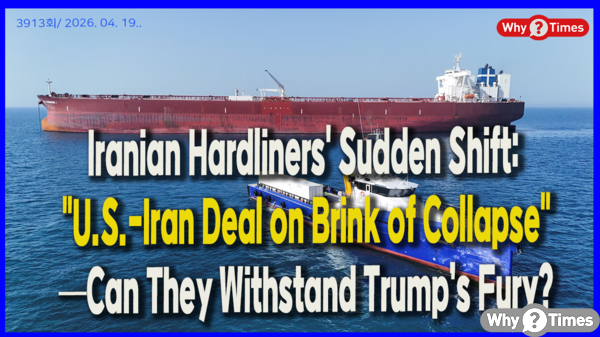
Chaos in Hormuz: Iran Declares Re-control of the Strait
In a dramatic reversal within just 24 hours, Iran has rescinded its declaration to open the Strait of Hormuz and resumed full control over the waterway. This immediate countermeasure followed the U.S. announcement that it would maintain its blockade on Iran-affiliated vessels, reigniting tensions that threaten to unsettle global energy markets.
The resurgence of "last-stand" hardliners over negotiators within Iran suggests that U.S. President Donald Trump may follow through on his warnings of massive retaliatory strikes. Notably, this shift occurred right after a Pakistani mediation team left Tehran, leading to grim forecasts for future U.S.-Iran negotiations.
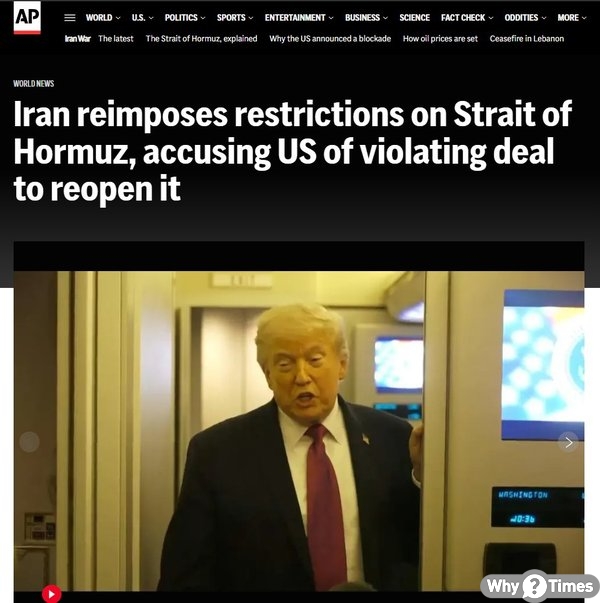
The AP reported on the 18th that the Iranian Integrated Military Command officially announced that "control over the Strait of Hormuz has returned to its previous state and is now under the strict management of armed forces." The Iranian military warned it would continue blocking the strait as long as the U.S. blockade of Iranian ports persists.
This reversal came only hours after Iran had declared the strait open to commercial shipping on the 17th, following the 10-day ceasefire between Israel and Hezbollah in Lebanon. While Iran has cited the end of the Lebanon war as a core demand, it pivoted immediately after President Trump clarified that the U.S. blockade would remain in "full effect" until a nuclear deal is signed.
Threat to Energy Security and Global Urgency
As tensions rise, the impact on the global economy is expected to be significant. International oil prices, which had dipped on hopes of a compromise, began to rebound. Experts warn that a global energy market already struggling with supply chain bottlenecks could face a severe price spike due to the uncertainty in the Strait of Hormuz.
According to data analytics firm Kpler, shipping through the strait is currently restricted to specific routes pre-approved by Iran. Meanwhile, U.S. Central Command (CENTCOM) confirmed via social media that it has diverted 21 Iran-linked vessels back to their ports since the blockade began, signaling real physical pressure to stifle Iran’s economy.
The Deadline: April 22nd
Despite the military tension, diplomatic efforts continue. Pakistan, a key mediator, suggested a deal could still be reached before the April 22nd deadline. Pakistani Foreign Minister Ishaq Dar, attending the Antalya Diplomacy Forum, noted that the Lebanon ceasefire was a positive sign and that talks in Islamabad last weekend were nearly finalized.
However, the "ultra-hardliners" in Iran remain a major obstacle. Iran International reported that when Foreign Minister Abbas Araghchi announced the opening of the strait on social media, state-run media and hardline outlets slammed him for "immature communication" that harmed national interests.
The internal rift is deep. While Araghchi announced the opening on X (formerly Twitter) to align with the Lebanon ceasefire—which Trump initially touted as a diplomatic victory—hardline outlets like Meher News argued that the tweet gave Trump a perfect excuse to "distort reality and declare himself a winner." Tasnim News Agency, linked to the IRGC, labeled the announcement a "bad and incomplete tweet" that lacked necessary details on regulation mechanisms.
The core problem is the lack of a stabilizing figure in Iran. With the new Supreme Leader, Mojtaba Khamenei, reportedly in a coma following U.S.-Israeli strikes, ultra-hardliners within the Revolutionary Guard (IRGC) appear to be taking a defiant stance in his name, potentially vetoing any diplomatic breakthroughs.
U.S. Warning: "Bombs Away" if Agreement Fails
In response, President Trump has set a firm deadline of April 22nd for a final peace agreement. Speaking to reporters aboard Air Force One, Trump warned, "If a final agreement is not reached by the 22nd, we may not extend the ceasefire. If it ends, we will not only continue the blockade but will have to start dropping bombs again."
The Devastating Cost of Hardline Policy
Iran’s flip-flopping is meeting fierce backlash both at home and abroad. The Telegraph reported that Iran has suffered astronomical damages of approximately £200 billion (approx. 345 trillion KRW) over the past 40 days of war—equivalent to the damage from 26 years of oil sanctions. Key industrial hubs, including the Khuzestan and Mobarakeh steel complexes, have been destroyed, paralyzing the construction and automotive sectors.
With the U.S. blockade preventing the import of reconstruction materials (cement, glass, etc.) and basic necessities (40% of food and 70% of medicine raw materials are imported), Iran faces a potential famine and medical crisis.
As the IRGC maintains its grip on 40% of Iran's GDP through smuggling networks, experts warn that the regime’s legitimacy is crumbling as ordinary citizens face hyperinflation while the elite access scarce resources.
The question remains: Can the Iranian hardliners truly withstand another round of indiscriminate U.S. offensives?


-중국 푸단대학교 한국연구원 객좌교수
-전 EDUIN News 대표
-전 OUR NEWS 대표
-제17대 대통령직인수위원회 정책기획팀장
-전 대통령실 홍보기획비서관
-사단법인 한국가정상담연구소 이사장
-저서: 북한급변사태와 한반도통일, 2012 다시우파다, 선거마케팅, 한국의 정치광고, 국회의원 선거매뉴얼 등 50여권