


추부길 whytimespen1@gmail.com
[Chinese AI Model Stocks and Optical Transceiver Makers Both Hammered]
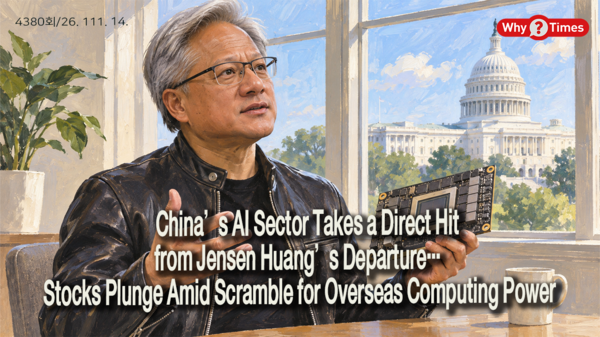
China’s artificial intelligence (AI) industry suffered a direct blow following the step-down of Jensen Huang, who led Nvidia for 33 years. On the Hong Kong stock market, leading Chinese AI model developers Zhipu AI and MiniMax plummeted roughly 10% and 8%, respectively, in a single day, while Alibaba and Tencent lost a combined $75 billion in market capitalization over the course of a week. Fearing that the United States will restrict the use of Nvidia chips via overseas data centers, Chinese AI companies are rushing to secure computing power in advance, while middlemen in China’s gray market have begun stockpiling restricted chips. Huang had consistently argued in favor of continuing chip sales to China despite Washington’s hawkish stance. His ouster means the political shield that China’s AI industry relied upon has vanished. The prospect of tightened regulations from Washington is simultaneously shaking the development plans and market valuations of Chinese AI firms.
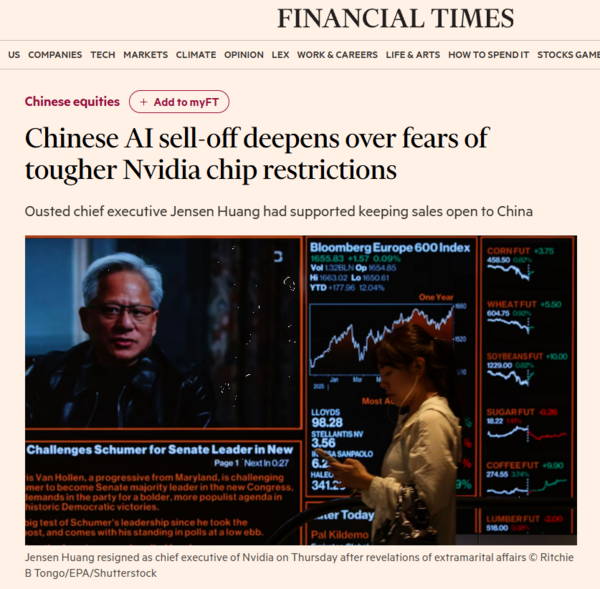
The Financial Times (FT) reported on the 13th (local time) that "sell-offs in Chinese AI stocks deepened amid concerns that the Nvidia turmoil could lead to tighter U.S. semiconductor restrictions on China." On that day in Hong Kong, Zhipu AI (Z.ai) fell 10.04% and MiniMax dropped 8.19%. According to the FT, their two-day market capitalization losses reached approximately 20% for Zhipu AI and 15% for MiniMax. On the same day, the Hang Seng Index fell 1.55% and the Hang Seng Tech Index declined 3.02%.
Mainland stock markets tumbled as well. The Shanghai Composite Index dropped 0.59%, the Shenzhen Component Index fell 2.05%, and the ChiNext Index slid 3.32%. The STAR 50 Index rose over 2% intraday before closing down 2.30%. More than 4,700 stocks declined across Shanghai and Shenzhen, with trading volume reaching approximately 1.66 trillion yuan.
The sell-off spread to China’s two biggest tech giants. According to the FT, shares of Alibaba and Tencent dropped 14% and 8%, respectively, over a week, wiping out a combined $75 billion in market value. Both companies have trained their AI models using Nvidia chips. If avenues to access advanced chips narrow, the cost and time required to develop and upgrade models could increase.
Zhongji Innolight and Eoptolink, which supply optical communication equipment to U.S. data centers, also fell more than 8% each on the same day. Beyond the chip procurement struggles of Chinese AI developers, these firms were weighed down by concerns that purchases from U.S. clients could shrink. According to Reuters, Zhongji Innolight generated 62% of its first-quarter revenue this year from the United States. Reuters also reported in August that the U.S. Federal Communications Commission (FCC) is preparing measures to ban the import of new Chinese-made optical transceivers on national security grounds. Following the Chinese AI sector’s struggle to obtain advanced U.S. chips, Chinese equipment makers now face pressure on their sales channels within the United States. Fear that U.S. sanctions could spread beyond chips to the broader supply chain dominated the market.
[Why ‘Jensen Huang Alone’ Was the Achilles' Heel of China’s AI]
The reason the Chinese market reacted so sharply to the departure of a single corporate executive is that Jensen Huang was the most vocal advocate in Washington for selling chips to China. Huang maintained the logic that selling chips to China keeps the country dependent on American technology, which in turn benefits U.S. AI hegemony. He even met directly with President Donald Trump to shift policy; his lobbying played a major role in Trump reversing an existing ban and approving the sale of H200 chips to China.
Just one month before the scandal broke, Huang made no secret of his expectations for the Chinese market in an interview with Fortune, stating that the opportunity in China is large and growing, much like the global AI market. Now, the man who led the company for 33 years has stepped down, and the market interpreted his exit as a sign that the dam holding back stricter export controls against China is breaking. Kenny Ng, a strategist at Everbright Securities International, told the FT that the United States could tighten semiconductor export controls at the policy and regulatory levels, which would impact Chinese tech firms with high demand for computing power.
[“Secure It Before It’s Blocked”… Why Chinese AI Firms Are Rushing Overseas]
What Chinese AI companies fear most is the closure of remote rental channels through overseas data centers. Unable to import advanced chips directly, Chinese firms have circumvented sanctions by renting Nvidia GPUs hosted in data centers across third countries such as Southeast Asia and Japan. Under current regulations, the U.S. Department of Commerce’s Bureau of Industry and Security (BIS) does not classify the provision of cloud computing services as an export.
The Remote Access Security Act (RASA), aimed at closing this loophole, passed the House of Representatives by an overwhelming vote of 369 to 22. However, it had stalled in the Senate Banking Committee for nearly 10 months. The Senate version targets any customer whose ultimate parent company is headquartered in China regardless of ownership structure, posing a more direct blow to Chinese firms than the House bill. The market expects the Jensen Huang fallout to provide the political momentum needed to push through the stalled Senate review. Nvidia had already begun exercising caution; the FT reported earlier this month that Nvidia asked cloud clients to ensure at least 51% of their customers are non-Chinese. Without Huang at the helm, Nvidia’s leadership is likely to act even more conservatively.
[Race to Preempt Overseas Computing Power and Black-Market Hoarding]
According to three sources cited by Reuters, a major Chinese cloud provider is internally reviewing plans to secure overseas Nvidia computing power in advance. Several other firms have also inquired with data center operators about pre-booking computing capacity, and even smaller AI research labs are reaching out to major computing rental firms in Southeast Asia. Meanwhile, in China’s domestic gray market, middlemen anticipating stricter U.S. anti-smuggling crackdowns are buying up restricted chips and building stockpiles.
Paradoxically, these moves expose the large loopholes that still exist in U.S. export controls. According to procurement records, a Chinese university on the U.S. export blacklist due to its close ties to the People’s Liberation Army purchased Nvidia H200 chips in October. In March of this year, U.S. prosecutors indicted three individuals, including Supermicro co-founder Wally Liaw, on charges of smuggling servers equipped with Nvidia chips into China via a Southeast Asian company. According to prosecutors, the Southeast Asian firm purchased roughly $2.5 billion worth of servers from Supermicro between 2024 and 2025, some of which are suspected of having been diverted to China. Justification for Washington hawks to tighten enforcement has been steadily piling up.
[Washington Hawks Rally… “It Won’t End with Jensen”]
The mood in the U.S. Congress is shifting rapidly. House Speaker Mike Johnson stated on the 12th, the day Huang resigned, that semiconductor export controls on China have always been a major issue and that a growing consensus is forming within Congress on the importance of taking this stance. Lawmakers from both the Democratic and Republican parties are demanding stricter limits on China’s access to advanced AI chips. Occurring right after the midterm elections, this incident is serving as a catalyst to solidify a bipartisan hardline approach toward China.
Beijing’s reaction has been sharp. China’s Ministry of Foreign Affairs warned the United States not to use the incident as a pretext to tighten export controls on core technologies. The Global Times, affiliated with the Communist Party’s official newspaper, framed Huang’s downfall as a "political witch hunt." Song Zhe, a senior investment specialist at BNP Paribas Asset Management, told the FT that people do not see this story ending with Jensen and that no one knows where it will stop, adding that uncertainty for Chinese suppliers will continue to grow.
[Why Times Insight]
The essence of this crisis is not a personal scandal, but the "disappearance of a political buffer." Over the past several years, U.S. chip controls on China fluctuated between tightening and loosening amid pressure from hawks and lobbying by Jensen Huang—evidenced by the back-and-forth between banning the H20 and permitting the H200. With Huang’s departure, one side of the scale has vanished. Moving forward, no Nvidia executive will easily dare to publicly advocate for expanding sales to China at the risk of being branded with a "Chinese spy scandal."
What makes this even more fatal for China is the timing. When direct imports were blocked, Chinese AI firms survived through remote rentals; when that grew uncertain, they turned to smuggling. If the passage of the Remote Access Security Act, heightened anti-smuggling crackdowns, and Nvidia’s self-imposed customer restrictions converge simultaneously, all three pathways will narrow at once. Hoarding and pre-booking are merely short-term fixes—and could backfire by handing Washington hawks concrete proof that loopholes truly exist.
Beijing’s fierce pushback ironically underscores how deeply China’s AI industry relies on American technology. As seen in the surge of Cambricon’s stock, Beijing will use this crisis to justify accelerating localization. However, the prevailing assessment is that domestic Chinese chips cannot currently replace Nvidia in terms of the computing scale and software ecosystem required to train cutting-edge models. The very fact that Chinese firms are taking risks to secure Nvidia computing power overseas is a tacit admission of the limitations of domestic chips. Now that the shield known as Jensen Huang is gone, the U.S.-China AI gap is far more likely to widen once again than to close.
- TAG