


추부길 whytimespen1@gmail.com
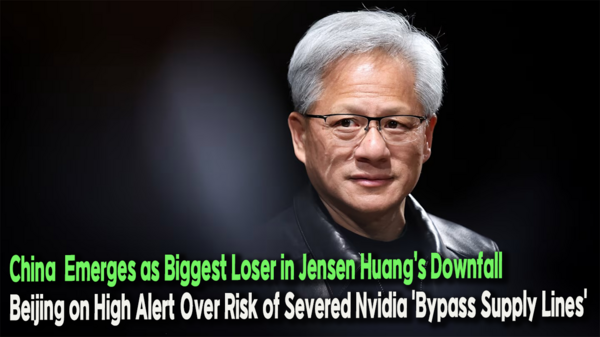
[Jensen Huang Exits After 33 Years… Board Announces "Immediate Effect"]
Analysts suggest that the party suffering the greatest blow from Jensen Huang’s departure is not Nvidia, but China. On the 12th (local time), Nvidia’s board of directors announced the immediate resignation of CEO Huang. Huang stepped down from the company he led for 33 years following a dual scandal: one involving a relationship with a woman suspected of ties to Chinese intelligence, and the other involving a relationship with a direct subordinate within the company. This incident goes beyond the downfall of a single corporate executive. It has handed China hawks in the United States a decisive justification and threatens both the gray market and legal import channels on which China’s artificial intelligence (AI) industry has relied. In a situation where even Huawei cannot meet domestic demand, a severed supply line of advanced chips will inevitably deal a heavy blow to Chinese AI firms. Furthermore, the strongest voice in Washington advocating for open models and chip sales to China has vanished. Beijing’s hasty move to contain the fallout by denying "espionage narratives" ahead of next week's U.S.-China summit underscores this sense of crisis.
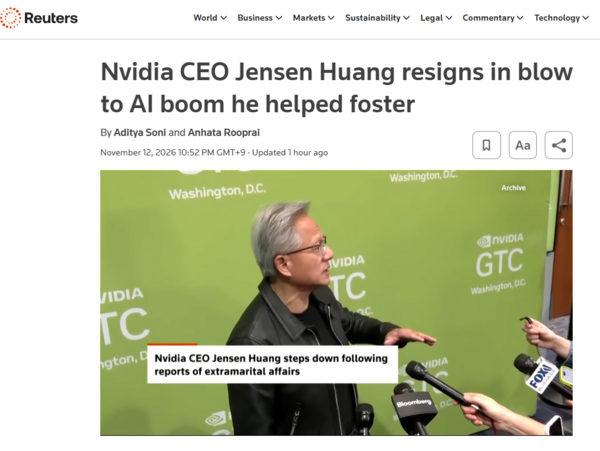
Reuters reported on the 12th (local time) that "Jensen Huang stepped down as Nvidia CEO following uproar over his relationship with a woman suspected of links to Chinese intelligence," adding that "Nvidia announced Huang immediately stepped down as CEO, president, and board member, with Chief Financial Officer (CFO) Colette Kress assuming the role of interim CEO." Reuters further noted that "given Huang’s efforts to maintain access to the Chinese market, his departure could also impact U.S. chip export policies."
The controversy originated with Alice Huang, a former executive at Singapore-based data center firm Megaspeed International. Alice Huang is a Chinese national who previously worked as a broadcaster for Chinese state media and as a private banker. The New York Times (NYT) reported that "U.S. intelligence authorities have suspected her of being a Chinese intelligence asset." Subsequently, U.S. tech outlet The Information reported that "at least $7.5 billion worth—roughly 240,000 Nvidia chips—flowed to Chinese companies through a corporate network she established with her husband and younger sister." Nvidia countered that "allegations of chip diversion by Megaspeed were thoroughly investigated last year and found to be groundless." However, the U.S. House Select Committee on China labeled Alice Huang a "Chinese intelligence asset" and demanded Jensen Huang appear for a briefing on the 18th.
[Beijing’s Reaction… "Stop Fabricating Espionage Narratives"]
China’s attitude is particularly noteworthy. On October 30, Foreign Ministry spokesperson Guo Jiakun dismissed the initial NYT report detailing the relationship between Jensen Huang and Alice Huang as "groundless speculation." On the 9th, he added, "The so-called Chinese espionage allegations are baseless and merely a smear against China."
On the day Jensen Huang’s resignation was finalized, spokesperson Mao Ning stepped up at the regular press briefing. When asked about the impact of the Nvidia affair on bilateral relations, she replied, "China’s scientific and technological development is based on independent innovation and open cooperation." She added, "The United States must stop fabricating so-called 'Chinese espionage' narratives as a pretext for technological restrictions."
She also offered conciliatory remarks mindful of the upcoming summit. Mao stated, "We will work with the U.S. to implement the important common understandings reached by the two heads of state," and pledged to "build a constructive relationship of strategic stability based on respect, fairness, and mutual benefit." It is a dual message attempting to strongly deny the allegations while avoiding a deterioration in ties.
There is a clear reason for Beijing’s heightened sensitivity. President Xi Jinping and President Donald Trump are scheduled to meet next week at the Asia-Pacific Economic Cooperation (APEC) summit in Shenzhen. The bilateral trade truce has been extended until January 10, 2027, leaving less than two months before the deadline. Following the scandal, lawmakers in Washington have consecutively demanded stricter controls on tech products. Having the "Nvidia espionage scandal" on the table at the summit is inherently disadvantageous for China.
[Reasons Why China Is the 'Biggest Victim' ① Severed Chip Supply Lines]
On the surface, the Chinese government has demonstrated a will to break free from its reliance on Nvidia. Last September, China’s internet regulator ordered major tech firms such as Alibaba and ByteDance to halt testing and orders of Nvidia’s China-specific RTX Pro 6000D chip, judging that domestic chips alone could meet demand. However, mass-producing cutting-edge AI processors cannot be achieved through administrative decrees alone. Regarding this, Bloomberg noted that "even Huawei cannot meet all of China’s domestic demand."
The gray market and regulatory loopholes have been filling that void. A prime example is Moonshot AI, hailed as a "flagbearer of Chinese AI." Bloomberg reported that "Moonshot utilized roughly 20,000 Nvidia GPUs via clouds operated by Alibaba and others to train its 2.8-trillion-parameter Kimi K3 model." Alibaba is Moonshot’s largest shareholder, holding a 36% stake. White House Office of Science and Technology Policy Director Michael Kratsios wrote on X (formerly Twitter) that Moonshot "secured servers equipped with GB300s and used GB300s in Thailand." This means even China’s top-tier models could not be completed without American chips.
This scandal puts all such bypass routes squarely in the crosshairs. Regardless of whether the $7.5 billion chip diversion allegations are proven true, China hawks have already gained powerful justification. Gray channels—such as leasing Southeast Asian data centers, re-exporting via third countries, and remote cloud access—are primary targets for blockade. Even the approved channels through which Chinese companies legally accessed Nvidia products could be shut down.
[Reasons Why China Is the 'Biggest Victim' ② Dual Burden on Chinese AI Firms Facing Profitability Tests]
The timing could not be worse. Despite rapid technological progress, Chinese AI firms are already struggling just to survive domestic competition, and even fewer have found viable revenue models. Investors' questions have now shifted from technological achievements to "can you make money?" If the supply of computing resources falters at a time like this, costs will rise and development speeds will slow. In connection with this, Bloomberg reported that "Chinese AI-related stocks plunged across the board on the day Nvidia’s board discussed Jensen Huang’s future."
[Reasons Why China Is the 'Biggest Victim' ③ Loss of the Greatest Champion of Open Models and 'Distillation']
The blow extends beyond semiconductors. Jensen Huang was both the foremost advocate for selling chips to China and one of the strongest supporters of open models in Silicon Valley—the very field on which Chinese firms have staked their survival. According to a Bloomberg column, as concerns over a U.S. ban on Chinese AI grew last July, Huang posted on X for the first time in his life, appealing to the American tech industry to support open-weight AI.
Huang also defended "distillation"—training a new model using the outputs of another model—as a "widely used technique" and "competition." Distillation is a core point of contention in U.S. regulatory debates over Chinese open models, as American companies and lawmakers have criticized Chinese firms for "stealing" U.S. AI achievements. Director Kratsios also alleged that "Moonshot trained Kimi K3 by distilling Anthropic’s Fable model." With the industry’s most influential defender gone, pressure for a crackdown will inevitably mount. U.S. startups and developers relying on cheap, easily modifiable Chinese models may also suffer, but the immediate shock is concentrated on Chinese AI companies that have just lost their biggest cheerleader.
[Reasons Why China Is the 'Biggest Victim' ④ U.S.-China AI Safety Dialogue on the Brink of Collapse]
According to Bloomberg, the scandal broke just weeks before the U.S.-China AI safety talks. Already low expectations for cooperation have effectively been extinguished. As mutual distrust deepens, channels for both sides to gauge each other’s technological progress will shrink. This raises concerns that an espionage affair reminiscent of the Cold War could drive the race for AI supremacy into a more opaque and reckless sprint.
[Counterargument… "Tighter Controls Only Accelerate China’s Self-Reliance"]
Of course, there is a counter-perspective, and Huang himself was its leading proponent. He told lawmakers that "U.S. export controls drove Nvidia’s share of China’s AI chip market from 95% to 0%" and that "this policy has largely backfired." The logic is that tightening controls only pushes China to accelerate self-reliance centered around Huawei. It is also worth noting that espionage charges have not been legally proven and both Nvidia and Megaspeed deny any wrongdoing. Nevertheless, long-term goals and short-term survival are separate matters. If supply lines are severed before domestic chips catch up to demand, the cost to China’s AI industry will be substantial.
[Why Times Insight | With the Bridge-Builder Gone, China Is Left Isolated on the Other Side]
From Beijing’s perspective, this situation is a paradox. The Chinese government blocked purchases of Nvidia products on its own, vowing to reduce dependence on the company. In reality, however, the cutting edge of Chinese AI was propped up by Nvidia chips routed through Southeast Asia and overseas clouds. U.S. export controls were aggressive enough to ignite China’s will for self-reliance, yet porous enough to cushion the pain of that transition. Amid this "worst-case combination," China had been buying time by exploiting loopholes—and the figure who effectively symbolized those loopholes was Jensen Huang.
Huang was widely viewed as someone who built bridges between the two camps, driven by the belief that the AI revolution did not need to be neatly bifurcated into the U.S. and China. Now, his legacy is likely to remain an example of how quickly one person can burn down that bridge. Once the bridge collapses, the side left isolated on the far bank is not the United States, but China. The fact that spokesperson Mao Ning—even while denouncing the allegations as "fabrications"—made a point of emphasizing "open cooperation" reads as a clear signal of just how much Beijing fears this isolation.
- TAG