


추부길 whytimespen1@gmail.com
[Sitting Down Again on the 27th… Is There a Solution to Overcome the 70% Rejection?]
Micron faces a crucial test on the 27th to determine whether it can resolve conflicts at a key production hub during negotiations with the Taoyuan union in Taiwan. Although the 24-hour warning strike by 11 union leaders has ended, the union warned of potential further collective action, stating that approximately 70% of its members opposed the company's compensation proposal. This negotiation represents a critical turning point that will decide whether the dispute concludes as a limited action or expands into wider workplace participation. If this escalates into actual production disruptions, it could impact memory procurement for US client firms and influence supply negotiations with Samsung Electronics and SK Hynix.
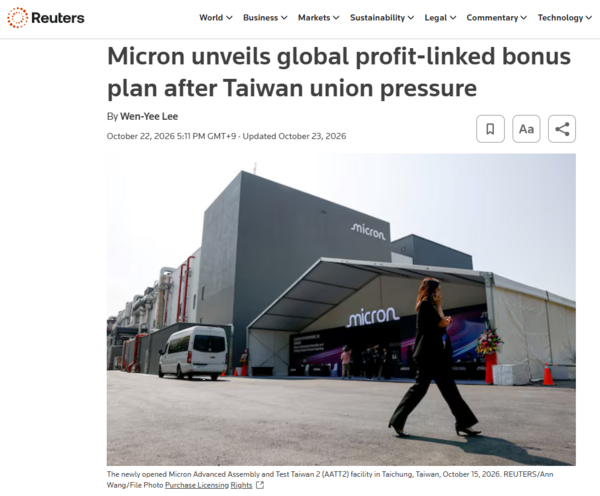
Reuters reported on the 23rd that "Micron is rolling out a global quarterly performance-linked incentive plan in response to demands from the Taiwan union." However, the conflict with the Taoyuan union remains unresolved. The following day, AFP reported, "Micron's Taoyuan union stated that around 70% of its roughly 2,300 members rejected the company's new profit-sharing proposal," adding that "the union warned of potential further collective action, and follow-up talks postponed due to a typhoon are scheduled for the 27th." This signifies that the conclusion of the warning strike does not mean labor tensions have ended.
Earlier, 11 union leaders staged a 24-hour warning strike from 9:00 AM on the 22nd to 9:00 AM on the 23rd. Taiwan's Central News Agency (CNA) described this as a symbolic strike. The union clarified that the action was not intended to disrupt production, yet warned that more employees could participate going forward. What is confirmed at present is not a full-scale plant shutdown, but a targeted, limited action to exert pressure for negotiating progress.
Therefore, the focal point of the talks on the 27th is not merely whether a signed agreement emerges that day. Observers must watch whether the gap over distribution criteria narrows and whether concrete proposals surface that convince the union to withhold further action. Even if negotiations collapse, dialogue could continue; however, if mutual distrust deepens, both the scale and intensity of the next collective action could escalate.
[The Company Offers More Money, The Union Demands a Distribution Formula]
The union's demands encompass two intertwined issues: the payout amount and the institutional formula. According to AFP, unions in both regions had demanded a one-off bonus equivalent to 83 months' salary alongside a permanent system distributing 15% of the company's operating profit quarterly. This context explains why friction persisted even after Micron offered compensation worth up to 68 months' salary—a dispute that cannot be understood solely through the lens of bonus sums.
The benchmark cited is Micron's South Korean competitors. According to Reuters, SK Hynix agreed to allocate 10% of its annual operating profit as performance incentive funds, while Samsung Electronics established a special performance bonus pool equivalent to 10.5% of its semiconductor division's operating profit, subject to profitability conditions. The Taiwanese union referenced these precedents to demand a higher allocation rate. "K-performance bonuses" have effectively influenced compensation demands by offshore tech workers.
According to Reuters, Micron also tabled a new framework. Starting in fiscal year 2027, the company plans to introduce a quarterly performance-linked bonus for global employees—split evenly between cash and stock—on top of existing annual packages. However, this new formula factors in net profit after tax and anticipated capital expenditure for the subsequent quarter, leaving the fixed distribution ratio undisclosed. Given that payout pools could shrink during heavy capital investment phases, this remains at odds with union demands.
This gap lies at the heart of the standoff. The company favors a structure where it provides compensation while securing the capital required for massive manufacturing expansions, whereas the union seeks a transparent, predictable formula to guarantee the employees' cut whenever profits are generated. The fundamental issue is whether the dispute will end as a one-time increased payout or establish lasting future distribution principles.
[The Real Trouble Lies After a Breakdown… The Possibility of Strike Expansion at a Core DRAM Hub]
Taoyuan's strategic significance is evident in its production capacity. According to analysis by KB Securities, this facility accounts for approximately 22% of Micron's total DRAM production capacity. In fact, Micron's overall reliance on Taiwan is substantial. AFP noted, "Micron manufactures roughly 50% to 60% of its chips in Taiwan." However, this figure encompasses all of Taiwan, including both Taoyuan and Taichung. A limited strike in Taoyuan cannot be cited as a "shutdown of half of Micron's production." Rather, the critical question is into which specific processes and labor pools the conflict could spread.
An expert cited by Reuters explained that a strike does not instantly translate into a complete factory shutdown provided sufficient personnel remain for equipment maintenance, process monitoring, and anomaly handling. A one-day symbolic protest where core operations remain staffed differs fundamentally from a prolonged strike where on-site technicians are pulled. After the 27th, attention must center not on declarations of strikes, but on actual worker participation rates, impacted process stages, and actual shipping delays.
[Spillover Pressure on US Clients… Distinguishing HBM from Standard DRAM]
The primary transmission channel of risk to US Big Tech is memory procurement. If operational disruptions linger, clients will have to evaluate their inventory cushions against the possibility of securing additional allocations from alternative suppliers. Failing to obtain required specifications on time can trigger schedule delays and cost pressures in server deployments. That said, no tangible delivery disruptions affecting specific Big Tech firms have been verified as a result of the recent warning strike.
The situation is different in Taichung, the hub for high-bandwidth memory (HBM). Micron and the Taichung union signed an agreement on the 21st, formally withdrawing a scheduled mediation proceeding. According to Reuters, Taoyuan focuses on frontend DRAM wafer manufacturing, while Taichung is involved in advanced DRAM and HBM fabrication as well as packaging and testing. The Taichung accord ultimately lowered labor-management uncertainties at the HBM manufacturing hub.
While the Taoyuan union claimed that complaints regarding the corporate proposal are also surfacing among regular staff in Taichung, no nullification of the Taichung agreement or resumption of strike activity has been confirmed. A collapse in Taoyuan talks must not be conflated with an immediate cutoff of HBM supply bound for Nvidia. The labor conditions and operational impacts across both sites must be evaluated separately.
[An Opportunity for Samsung and SK Hynix… Surplus Supply Capacity is Key]
Should additional disruptions materialize, they could affect pricing negotiations. On the 20th, Taiwan's Commercial Times projected that fourth-quarter DRAM contract prices would climb around 20% compared to the prior quarter. The analysis indicated that while price increases may decelerate, AI-driven demand and tight supply continue to underpin price levels. If manufacturing uncertainty escalates against this backdrop, the strain on customers trying to secure allocations will intensify.
Windfall gains for South Korean chipmakers, however, do not materialize automatically. Even if customers request replacement volumes, Samsung Electronics and SK Hynix must possess the spare production capacity to fulfill those exact specifications. Preexisting supply commitments and customer-specific product qualification processes must also be taken into account. Only when tangible production cutbacks and actual shift orders are observed can one judge whether enhanced pricing leverage will translate into balance sheet gains.
[Why Times Insight | What Micron Must Safeguard is Supply Reliability]
What Micron must safeguard during the negotiations on the 27th extends beyond compensation budgets. The operational stability that allows clients to place orders with confidence is at stake. In the AI era, competitiveness is determined concurrently by the ability to develop cutting-edge memory and the reliability to supply committed volumes without fail.
Customers do not abruptly jump ship the moment negotiations stall. However, if labor frictions recur and delivery schedules wobble, buyers will price new risk factors into their procurement equations. Movements to diversify allocations toward rivals or stockpile surplus inventory could easily follow. That is precisely where windows of opportunity open for Samsung Electronics and SK Hynix.
It is also worth noting how the South Korean-style profit-sharing model has emerged as an international benchmark. Nevertheless, profit-linked performance incentives do not constitute fixed operational costs. Future financial burdens should instead be assessed through recurring disputes over base salary increases, allowances, and downward compensation adjustments during industry downcycles.
The 27th will not determine Micron's fate overnight. It will, however, serve as an indispensable litmus test for whether management can defuse tensions at the warning strike phase. If the company fails to dismantle distrust surrounding its profit distribution principles and the dispute boils over into real manufacturing disruptions, a dispute that began at the negotiating table could rapidly evolve into an issue eroding customer trust in supply reliability.
- TAG