


추부길 whytimespen1@gmail.com
[The long shadow cast behind CXMT's record-breaking earnings]
A flurry of media reports has claimed that the surging financial performance and next-generation technology announcements from ChangXin Memory Technologies (CXMT), China's largest DRAM manufacturer, suggest it is overtaking South Korea's semiconductor industry. However, much of this coverage misses the mark. While CXMT's pursuit is real, equating product launch roadmaps with commercially viable, high-volume mass production is an exaggeration. The real test is whether the company can reliably supply competitive products after the current pricing boom subsides.
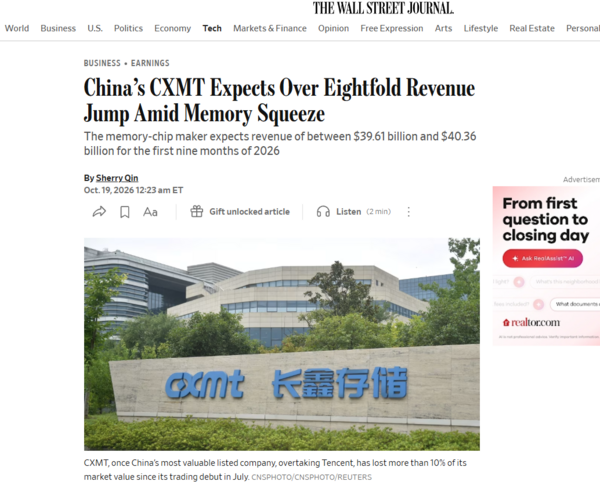
The Wall Street Journal (WSJ) reported on the 20th that "benefiting from an AI-driven memory shortage, CXMT projected that its revenue for January to September this year would surge to more than eight times that of the same period last year." The report added that "the company guided revenue between 265 billion and 270 billion yuan, with net profit estimated at 131 billion to 132.5 billion yuan, driven by supply deficits and rising prices linked to expanding AI demand." This illustrates why a sudden spike in profit cannot simply be interpreted as a reversal in manufacturing prowess.
Despite these record-breaking earnings projections, the market did not celebrate. According to the South China Morning Post (SCMP), CXMT's share price fell 7.8% on the 19th. Given that broader investor sentiment toward semiconductor and AI-related stocks was volatile at the time, this drop should not be attributed solely to skepticism over its technology disclosures. Rather, the simultaneous emergence of skyrocketing profits and declining share prices demonstrates that the market is scrutinizing the sustainability of those earnings, not just current profits.
Quarterly momentum also signaled a shift. Analyzing the earnings guidance, Investing.com reported that "CXMT's third-quarter net profit increased by roughly 1% to 4% quarter-on-quarter, moderating considerably compared to the sharp growth recorded in the second quarter." However, this does not represent a drop in earnings, just as a deceleration in price increases differs from a decline in prices. What is confirmed is a deceleration in growth momentum, which should not yet be extrapolated into a collapse of the supercycle.
[Korean media's "Faster than Samsung" claim: What was left out?]
In this regard, parts of the South Korean domestic press appear to be overestimating CXMT. On the 13th, SBS Biz reported on CXMT's next-generation memory rollout under the headline "Faster than Samsung." Yet the substance of the report described the company's plan to unveil server DDR5 RDIMMs featuring a 4F² (the cell area used to store a bit of data in DRAM) architecture by the end of the year. Announcing the launch of a product built on a specific structure does not denote an overarching reversal in memory manufacturing competitiveness.
A product launch can encompass entirely different stages: sampling, limited delivery to select customers, and full-scale commercial mass production. Placing such plans side by side with a competitor's mass production schedule without clarifying the exact development stage easily leads readers to assume an overtaking has already occurred. Not all domestic reporting fell into this trap. iNews24 noted that "it remains unverified whether CXMT's development milestone equates to actual volume mass production." Such caveats should be reflected clearly in both headlines and analysis.
[A 4F² metric is not a definitive ranking of manufacturing competitiveness]
4F² is a metric that expresses DRAM cell surface area based on the minimum feature size ($F$). Assuming an identical $F$, it reduces the cell area by approximately one-third compared to the conventional 6F² design. However, when actual dimensions and implementation methods vary across chipmakers, cell area figures alone cannot determine superiority. Even if a smaller cell is achieved, the economic viability of the finished chip—factoring in peripheral circuitry and manufacturing yields—remains an entirely separate issue.
CXMT's G5 process documentation released in September cited an active area half-pitch of 11.95 nm alongside an increase in gross dies per wafer compared to its previous process node. Crucially, the company explained that this die count was calculated as an equivalent gross die figure based on a specific capacity benchmark. The theoretical number of dies patterned onto a wafer differs substantially from the number of functional, salable chips. Announcements regarding density improvements should not be accepted as proof of yield maturity or cost advantages.
Conversely, concluding that CXMT remains stuck at 16 nm based on past teardown analyses is equally imprecise. TechInsights' analysis of the G4 platform serves as structural documentation for that specific historical generation; subsequent product milestones must be re-evaluated on their own terms. Applying a gap observed in older products across the entirety of the company's current standing merely counters the overtaking narrative with an exaggeration in the opposite direction.
[Acknowledge LPDDR6 progress, but read the actual operating conditions]
There is also no basis for dismissing all of CXMT's product milestones as mere propaganda. In an official disclosure in September, the company announced mass production of LPDDR6 and its adoption in Xiaomi smartphones, marking an entry into a newer product category. However, the official documentation stated that while the maximum transmission speed reaches 12,800 Mbps, it operates at 10,667 Mbps when integrated with the device's system-on-chip. Performance gain metrics were also qualified as internal testing figures.
Therefore, securing a product specification must be distinguished from delivering peak performance inside commercial devices. Even within identical memory specifications, operational frequency, power efficiency, reliability, and supply consistency cannot be assumed to be equal. While the phrase "LPDDR6 mass production" represents an important starting line, it does not justify concluding that CXMT's manufacturing technology has surpassed established market leaders.
[The burden of lacking EUV: Why calling it "impossible to produce" misses the mark]
CXMT's core structural constraint is restricted access to advanced lithography equipment. However, claims that advanced DRAM cannot be produced without extreme ultraviolet (EUV) lithography are factually incorrect. Micron officially disclosed that it did not employ EUV on its 1α (10nm-class 4th generation) process, subsequently introducing EUV at the 1γ (10nm-class 6th generation) node. Semiconductor node progression advances sequentially through 1α (4th gen) → 1β (5th gen) → 1γ (6th gen). Consequently, the value of EUV should be assessed in terms of process efficiency and sustainable scaling competitiveness rather than as an absolute gateway below which fabrication is impossible.
CXMT stated that it achieved finer circuitry by adding multi-patterning steps using existing DUV lithography equipment. Yet making features smaller is different from making them cost-effectively. Complex multi-patterning significantly inflates manufacturing cycle times and process costs. While high memory prices enable profitability today, whether the company can sustain profits once prices normalize remains to be seen. Ultimately, the impact of equipment sanctions must be judged not by new technical announcements, but by the volume of defect-free chips a company can produce at low unit costs. Simply put, proving the capability to fabricate smaller transistors does not demonstrate the ability to manufacture them cheaply, reliably, and at scale.
[Washington targets entry into Western supply chains]
US pressure extends well beyond wafer fabrication equipment. On July 16, House Select Committee on the CCP Chairman John Moolenaar and Representative George Whitesides sent a letter to the Secretary of Commerce voicing concerns over moves by US firms, including Apple, to procure Chinese memory. They urged the administration to expedite reviews regarding placing CXMT on the Entity List and to coordinate supply chain measures with South Korea, Japan, and the European Union. While this represents a congressional policy demand rather than a finalized procurement ban or executed contract, it signals mounting regulatory friction.
A distinction must also be drawn between the Section 1260H Chinese Military Companies list and the Commerce Department's Entity List. The former governs defense procurement restrictions under distinct statutes, whereas the latter restricts the export of items subject to the US Export Administration Regulations (EAR). CXMT has filed legal challenges against its military company designation. Even if technical and pricing requirements are met, political hurdles in accessing major Western markets remain a primary source of corporate uncertainty.
[Why Times Insight | The moment announcements are mistaken for overtaking, analysis turns into fiction]
When assessing CXMT, the biggest error is conflating disparate metrics into a single declaration of triumph. Surging revenue reflects commercial tailwinds, while tape-outs of next-generation standards demonstrate R&D milestones. High mass-production yields, low unit production costs, and recurring orders from major tier-one customers represent an entirely separate tier of competitiveness. Success in the former does not automatically validate the latter.
State capital must be evaluated under the same framework. While state subsidies sustain long-term capital expenditure, state support should not be used as an excuse to dismiss genuine engineering progress. Conversely, massive funding alone does not complete manufacturing competitiveness. What ultimately counts is whether invested capital translates into competitive yields, productivity, and dependable supply.
South Korean media must move beyond merely relaying Chinese corporate press releases. If a headline claims a product arrived "Faster than Samsung," it must specify the baseline of comparison. Failing to differentiate between engineering samples and volume production, peak specifications and operating conditions, or cell layout concepts and finished chip economics clouds objective judgment rather than sharpening vigilance.
South Korean industry has no grounds for complacency either. Even before achieving parity at the leading edge, if CXMT supplies acceptable-quality memory in high volumes, it will exert pricing and margin pressure on established competitors. What is needed is neither alarmist rhetoric nor premature declarations of Chinese failure, but rigorous tracking of commercial supply capacity by specific product segment.
CXMT’s pursuit is a reality. Yet claims that it has overtaken South Korean chipmakers remain unproven assertions. The focus must be placed on commercial yield over announcement dates, real-world operating performance over product branding, and resilience through price downcycles rather than boom-period profits. Skipping this verification risks transforming corporate ambition into an established fact.
- TAG