


추부길 whytimespen1@gmail.com
[Chill in the Chinese Market Confirmed by Latest Corporate Earnings]
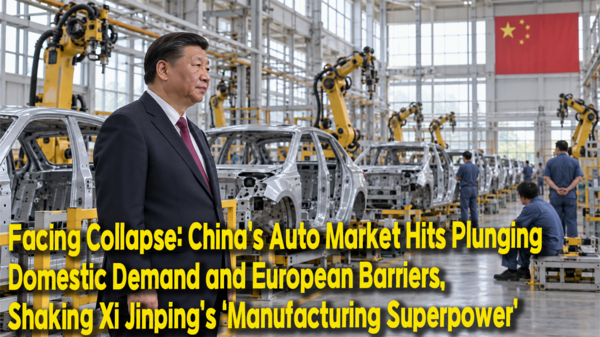
The Chinese auto industry faces triple pressures: a sharp drop in domestic demand, European export barriers, and scaling back of export subsidies. Following a 28% drop in passenger vehicle retail sales in September—traditionally the peak season—sluggishness continued into October. If the auto industry, which has served as a pillar for China's economy following the real estate downturn, falters, the impact could spill over beyond factories and dealerships into employment, consumption, and local government finances. The achievements of Xi Jinping's "Manufacturing Superpower" strategy and the Chinese Communist Party's economic management capabilities will be tested simultaneously.
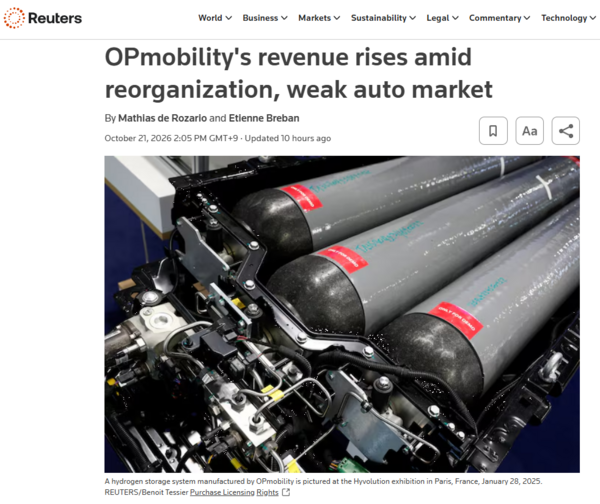
Reuters reported on the 21st (local time): "Asian sales for French automotive supplier OPmobility fell 11.6% on a like-for-like basis in the third quarter," adding, "CEO Félicie Burelle noted that the Chinese market remains difficult, indicating that declining vehicle sales are transmitting directly into global supply chain corporate earnings. The old formula—that expanding production and sales in China guarantees growth—is weakening."
Data released the same day by the China Passenger Car Association (CPCA) also highlights ongoing weakness. From October 1 to 18, retail sales of passenger cars reached 789,000 units, down 26% from the same period last year. Cumulative retail sales since the start of the year stood at 14,123,000 units, a 22% decline. While these are not finalized monthly figures, the market remains significantly below last year's level despite the National Day golden week holidays and promotional campaigns.
[Disappearance of the ‘Golden September and Silver October’… ICE Vehicles Halved]
The Chinese automotive industry refers to the high-sales months of September and October as "Golden September and Silver October" (金九銀十), denoting peak market season. However, passenger car retail sales in September this year fell 28.0% year-on-year to 1,618,000 units. Cumulative sales from January to September also declined 21.7%. Even considering the payback effect from purchases pulled forward by last year's policy support, a cumulative drop of over one-fifth cannot be dismissed as a simple base effect of a single month.
The blow landed heavily on internal combustion engine (ICE) vehicles. In September, retail sales of fuel vehicles including conventional hybrids dropped 43%, while pure ICE vehicles fell 49%. New energy vehicles (NEVs) were not safe either; September retail sales dropped 16.7% to 1,084,000 units. While NEV market share reached a record 67%, this also reflects the steeper drop in ICE vehicle sales. Interpreting market share growth as a boom overlooks the underlying contraction in actual sales volume.
Market leader BYD could not escape domestic chills. In September, its domestic retail sales dropped 28.9% to 246,816 units, and its cumulative January–September sales fell 33.3%. While certain companies managed growth, the fact that the industry leader is enduring falling sales proves that this slowdown is not limited to weaker competitors.
[Losses Despite Discounts… The Retail Network Faltered First]
Dealerships on the ground are running out of stamina. According to a survey by the China Automobile Dealers Association (CADA), 56% of Chinese car dealers operated at a loss last year, up significantly from 42% the previous year. Eighty-two percent of surveyed dealers sold new cars below wholesale price—a dynamic where dealerships discount prices to maintain sales volume, absorbing losses in the process.
Policy support has also waned. Caixin pointed out: "Purchase tax incentives for new energy vehicles were scaled back this year, and consumption stimulus measures have also weakened." It noted: "With the purchase tax exemption reduced to a partial reduction, consumers bear a heavier burden. After pulling forward demand with subsidies, the reduced intensity of support tests whether underlying organic demand is sufficient to sustain the market."
[Buoyed by Exports… But Europe Caps Volumes]
Filling the domestic gap was overseas sales. According to the CPCA, which tracks production, sales, and exports while analyzing market trends, passenger car exports in September—including semi-knocked-down units—rose 73.7% to 917,000 units. Exports rose to account for 36% of total vehicle sales. While this reflects overseas competitiveness, it also underscores that Chinese factories depend more heavily on foreign demand than domestic consumption.
However, Europe is now pumping the brakes on this export expansion. According to the Financial Times (FT), an agreement between the EU and China includes provisions capping imports of Chinese hybrids to approximately 350,000 units annually—less than half of this year's expected 800,000 units. The South China Morning Post (SCMP) reported that "the measure targets implementation by December 1, following member-state approvals." For manufacturers expecting further export expansion, this represents a major, unexpected constraint.
Export profitability is also under pressure. According to Reuters, China will lower the export value-added tax (VAT) rebate rate for new energy vehicles from 13% to 9% starting next April. Sales volumes are being restricted in Europe while export support is being trimmed at home. The SCMP reported that "in response, Chinese automakers are pushing forward with localized manufacturing by establishing new plants or utilizing idle production facilities in Europe."
[If Autos Collapse Too, What Will Sustain the Chinese Economy?]
The core issue is that if vehicle contraction spills into widespread insolvencies among automakers, the fallout will not be contained within final assembly. Steel, aluminum, batteries, semiconductors, auto glass, logistics, retail, and maintenance networks could all suffer declining orders. Because auto manufacturing possesses extensive supply-chain linkages, production cuts at a single plant exert simultaneous revenue pressure across multiple regions and suppliers.
The first transmission channel is employment and consumption. Reduced orders lead to cuts in overtime, wage adjustments, and hiring freezes, prompting worker households to scale back spending. Neighboring restaurants, shops, and transport services feel the effects. Depressed vehicle sales heighten income insecurity, which in turn causes households to delay car purchases in a compounding vicious cycle.
The second channel involves local government finances and regional banking. Local governments that attracted automotive assembly plants built industrial parks and infrastructure expecting tax revenue and job creation. When corporate output and profitability decline, expected fiscal revenues dry up. Expanding corporate subsidies inflates local fiscal burdens, while halting aid risks plant closures and mass unemployment. When supplier payment delays and loan repayment strains compound, an industrial issue quickly escalates into a regional financial risk.
[Why Times Insight | The Industry Xi Built, The Responsibility That Returns to Him]
The automotive crisis weighs heavily on Xi Jinping's leadership because the sector represents the flagship achievement of China's industrial upgrading. Electric vehicles and batteries hold an essential position in the strategy to shift away from real estate reliance toward advanced manufacturing. If competitiveness in this domain fails to translate into stable jobs and household income, the limits of an expansion-first production strategy are laid bare.
First, the Communist Party's narrative of economic competence loses its persuasiveness. Even if global market share climbs, the reality felt by citizens diverges sharply when worker wages shrink and dealerships operate at a loss. As the gap widens between national industrial achievements and household financial stability, Beijing's optimistic narrative loses credibility. Announcements of technical breakthroughs alone cannot alleviate anxiety over employment and income.
Second, industrial restructuring escalates governing costs for the CCP. Allowing struggling firms to fail requires managing unemployment, supplier payment disputes, and regional economic slumps. Conversely, propping up insolvent companies to cover policy miscalculations ties up fiscal and financial resources while perpetuating overcapacity. When individual local governments scramble to protect their local plants and enterprises, capacity adjustments stall. The objective of minimizing economic losses clashes directly with short-term social stability.
Third, as authority is centralized, accountability for policy failure gravitates directly to top leadership. Having framed industrial promotion and resource allocation as central strategic achievements, Beijing cannot easily dismiss the costs of overinvestment and domestic demand shortfalls as mere private sector failures. The Xi leadership must demonstrate not only how much productive capacity it has built, but whether that industry can provide sustainable income for its citizens.
This does not imply that an automotive slowdown triggers an immediate political collapse for the Party. However, if autos follow real estate into a prolonged slump, the combined pressures on growth, employment, and fiscal stability will compound. The crisis in China's automotive sector represents a fundamental test: the growth model based on "producing more makes the nation stronger" has run up against the limits of domestic purchasing power and foreign markets. As those costs mount, scrutiny over Xi's "Manufacturing Superpower" strategy and the CCP's economic governance will inevitably deepen. In short, it is another emerging crisis for the Chinese Communist Party.
- TAG