


추부길 whytimespen1@gmail.com
[Additional Pressure Directives Issued Immediately Following Agreement on Chinese Auto Export Cap]
The European Union (EU) has begun turning its back on China. Moving beyond merely imposing tariffs on Chinese products, Brussels is preparing policies to diversify supply chains currently concentrated in China and swiftly restrict European market access when necessary. Notably, even Germany—which had long exerted braking pressure on hawkish policies toward Beijing—has joined France in demanding new trade defense mechanisms, giving momentum to this strategic pivot. Europe, which previously prioritized expanding commerce with China, is now realigning its policy agenda around reducing Chinese dependency. In short, Europe has awakened to the vulnerabilities of its previous pro-China stance and is decisively pivoting away.
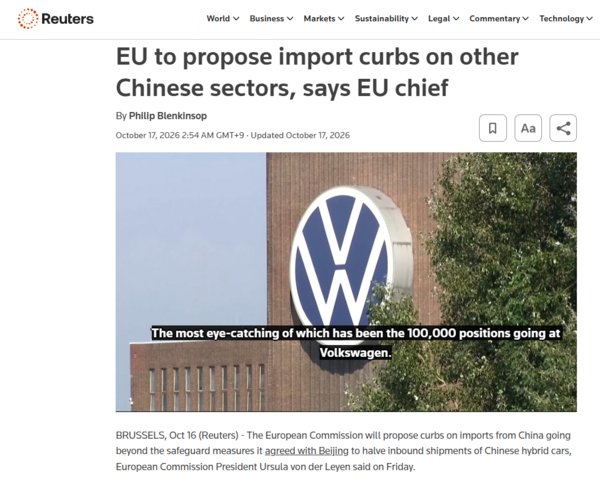
Reuters reported on the 17th (local time) that European Commission President Ursula von der Leyen announced immediately after the Brussels summit that the EU would push for additional import restrictions extending beyond Chinese automobiles. This decision stems from the assessment that an agreement in the automotive sector alone cannot resolve a goods trade deficit with China that exceeds €1 billion per day. French President Emmanuel Macron also highlighted potential trade measures targeting chemicals, plastics, and ferroalloys. Immediately after finalizing auto negotiations with Beijing, Europe signaled its intention to respond across other industrial sectors as well.
The scope of pressure is already broadening. EU Trade Commissioner Valdis Dombrovskis stated in an interview with Reuters on the 14th that trade rebalancing is necessary in other sectors following automotive measures. Sectoral targets raised by negotiating officials include chemicals, furniture, industrial machinery, steel, and wind power components. Europe, which previously viewed the influx of low-cost Chinese goods as a localized corporate competitiveness issue, now perceives it as a structural threat to its broader manufacturing base.
[“Ending Dependence on Single Suppliers”… Fundamental Restructuring of Procurement Strategies]
At the core of this transition lies the ‘Diversify EU’ framework. According to EFE, von der Leyen stated on the 16th that she will propose this initiative in December to reduce reliance on single suppliers. The objective is to enable companies to rapidly mitigate supply chain risks without restricting measures exclusively to a single nation.
Under consideration is a requirement mandating that enterprises in critical industries secure at least three suppliers across multiple countries. The South China Morning Post (SCMP) reported in late September that such diversification instruments were under development. While finalized requirements await the upcoming proposal, the policy direction is clear: economic security criteria will now govern corporate procurement decisions, penalizing reliance on single-source Chinese sourcing purely driven by low prices.
The chemical industry is already raising survival concerns. According to Nikkei Asia, chemical manufacturer Solvay stated that China's structural overcapacity is dealing severe blows to European producers. Solvay highlighted that closure plans accounting for nearly 10% of European chemical production capacity have been announced since 2022. While this does not mean all facilities have ceased operations immediately, it serves as a stark warning regarding the pace of industrial erosion.
However, abruptly cutting Chinese imports alone will not resolve the crisis. Solvay urged that product-specific characteristics and downstream user burdens must be taken into account. Restricting Chinese raw materials could drive up production costs for European manufacturers using those inputs. Europe’s task is to secure alternative supply chains alongside import restrictions. Simply increasing the number of suppliers yields little real risk reduction if those secondary suppliers remain dependent on the same Chinese raw materials.
[Germany, Once China's Shield, Now Demands Market Access Barriers]
The most critical political variable in this realignment is Germany. According to Reuters, Germany voted against additional EU tariffs on Chinese electric vehicles in October 2024. At the time, the German automotive industry demanded compromise out of concern that trade conflicts would harm their business operations in China. Corporate interests seeking to protect revenues and profits generated in China constrained Europe’s collective stance against Beijing.
However, a joint letter sent by German Chancellor Friedrich Merz and French President Emmanuel Macron on October 5 marked a clear departure. According to SCMP, the leaders of Europe's two largest economies called for tools to respond swiftly to severe market distortions and instantly block access to the single market when necessary—a so-called ‘kill switch.’ Germany, which once placed weight on preventing trade friction with Beijing, is now demanding powerful mechanisms to defend the European market.
Three distinct policy pillars must be differentiated here: ‘Diversify EU’ is a mechanism to lower supply chain dependencies; rapid market access restriction is a separate initiative targeting severe market distortions; and a solidarity mechanism is being developed to support member states and industries facing extraterritorial coercion or retaliation. Europe is assembling a comprehensive toolkit: altering procurement structures, defending its market, and establishing a unified front against subsequent economic retaliation.
[Hybrid Restrictions Are Only the Beginning]
Restrictions on Chinese hybrid vehicles have already manifested in concrete figures. Reuters reported on the 12th a four-year safeguard measure that caps first-year import volumes at 350,000 units, followed by annual increases of 6%. Compared to this year’s projected import volume of approximately 800,000 units from China, this represents a substantial reduction. Reports indicated the measure is expected to take effect as early as December.
This measure also serves to close loopholes in existing tariff structures. When extra tariffs were imposed on pure electric vehicles in 2024, Chinese automakers pivoted by expanding exports of plug-in hybrids and other exempted categories. Simultaneously, they increased local European production and component sourcing. Consequently, Europe’s trade debate has broadened from finished vehicle import volumes to local content requirements and component supply chains. Moving production bases will no longer guarantee that Chinese firms can evade regulatory scrutiny.
Europe is also attempting to influence the trade postures of external partners. The Financial Times reported that France and Germany are discussing plans to require the UK to align with EU tariffs on Chinese automobiles as a condition for including the British auto industry in a ‘Made in Europe’ public procurement system. While UK participation remains unconfirmed, the concept of linking access to European market benefits with trade policy toward China poses a significant burden for Beijing.
[Why Times Insight | The Europe China Relied On Has Changed]
The core of this shift lies in Europe changing the metrics by which it evaluates China. In the past, the primary consideration was how much Europe could sell to the Chinese market. Now, Europe calculates how deeply it depends on China and how much that dependency threatens European production and employment. Policymakers are balancing the consumer benefits of cheap imports against the structural losses incurred when domestic factories close.
Germany’s pivot is particularly damaging to Beijing. When Germany previously shielded its China operations by curbing hawkish policies, joint EU action was effectively stymied. With Germany now co-demanding market blocking instruments alongside France, Beijing's political maneuvering room within Europe has narrowed significantly. While the entire German industrial sector has not agreed to a full decoupling, the weakening of the single largest obstacle to a firm European stance carries massive strategic weight.
The combination of supply chain diversification and solidarity mechanisms is equally critical. Individual companies fear supply disruptions, and individual member states fear targeted retaliation from Beijing. Political calls to reduce dependence on China often failed because acting alone carried disproportionate risk. If the EU supports alternative procurement while jointly absorbing the fallout of retaliation, it fundamentally alters a structure where individual countries and companies had to bear the costs of standing up to China by themselves.
However, the success of this policy pivot will be decided after implementation. Questions remain regarding who will absorb the costs of shifting suppliers, how domestic European production will be scaled up, and how conflicting interests among member states will be reconciled. Raising protective barriers without successfully restoring the competitiveness of European industry risks burdening consumers and businesses without achieving resilience. Reducing dependency on China must translate into actual industrial renewal for this transition to be sustainable.
South Korea will not automatically become a passive beneficiary of this shift. While opportunities open up to be selected as an alternative supply source to China, South Korean firms will also face the burden of satisfying stringent supply chain transparency and local sourcing criteria demanded by Europe. What South Korean enterprises need is not only the capacity to replace Chinese suppliers, but the thorough preparation to prove supply chain stability from critical raw materials to finished products.
What Beijing must recognize is that Europe’s fundamental perception of the relationship has transformed. Europe intends to continue trading with China while constructing a framework that relies far less on Chinese dominance. The vast export market China relied upon is now drafting rules explicitly designed to curb Chinese economic leverage. The European market China took for granted will no longer remain open unconditionally—this is the most daunting strategic shift facing Beijing today.
- TAG