


추부길 whytimespen1@gmail.com
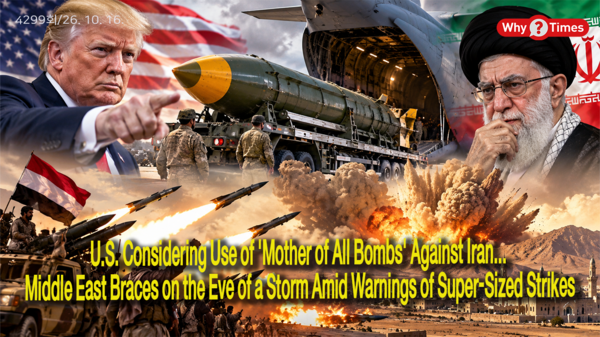
[The Massive Bomb That Could Shake Iran: Immense Destruction and Terror Arrive Together]
Reports indicate that the United States has included the GBU-43/B Massive Ordnance Air Blast (MOAB)—famously known as the "Mother of All Bombs"—in its contingency plans for additional military strikes against Iran. If actually deployed, the weapon would inflict catastrophic physical damage on target areas while delivering a formidable psychological warning to Iranian leadership that the U.S. is prepared to escalate military pressure to an extreme level. Compounded by Houthi attacks against Saudi Arabia, a volatile lull between the U.S. and Iran is concealing a rapidly accumulating risk of wider military escalation. The Middle East stands at a critical crossroads between a war exit strategy and a massive re-escalation of hostilities.
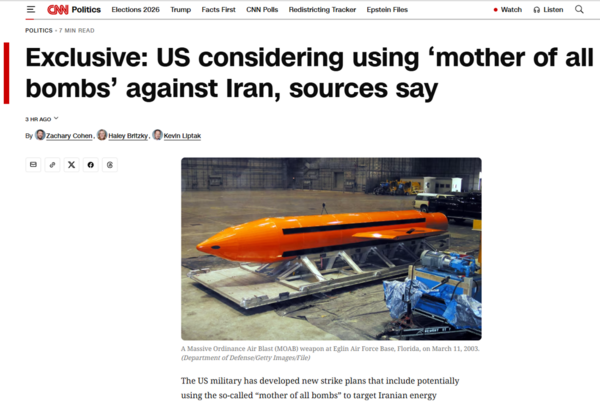
On October 15, CNN reported exclusively that "the U.S. military has prepared new operational strike plans targeting Iranian energy infrastructure and nuclear facilities, which could involve the employment of the GBU-43/B MOAB." The report noted that these plans are designed for execution "in the event President Trump orders a resumption of offensive military operations."
The threat posed by the MOAB cannot be measured solely by its weight of approximately 9.8 tons. Beyond inflicting massive blast radius damage across a broad area, the weapon is deliberately intended to shock and paralyze an adversary's operational willpower. Official U.S. Air Force development concepts explicitly highlight forcing opponents to grasp the immense costs of continued military resistance. The bomb is engineered to operate simultaneously as a tool of physical destruction and coercive psychological shock.
Should this ordnance be dropped on Iranian soil, the message received by Tehran would extend far beyond localized casualties and infrastructure destruction. It would be interpreted as a clear signal that Washington is willing to undertake high-threshold, large-scale offensive action. Particularly if paired with strikes against energy infrastructure, Iran would be forced to calculate not only immediate military retaliation, but also severe long-term burdens on state administration and facility restoration.
[Why MOAB Now? A 'Fireworks Show' and an Exit Strategy]
The inclusion of a weapon whose immediate strategic utility is debated stems largely from a political imperative. With over six months of aerial bombardment yielding no tangible diplomatic breakthrough, the Republican Party faces growing concerns over potential voter backlash against an unpopular conflict ahead of the upcoming midterm elections. President Trump and his advisers have reportedly spent months discussing methods to deliver a "definitive" conclusion to the war—at least from a messaging perspective.
A source cited by CNN observed that "President Trump has backed himself into a position where he feels almost compelled to do something." In the absence of specialized bunker-busting capabilities within this specific force posture, leveraging high-yield psychological shock appeared logical, making the MOAB a candidate. Another source familiar with Pentagon planning discussions noted that "the military developed a 'fireworks display' option intended to grant the President a symbolic exit, irrespective of whether core strategic objectives are achieved."
Conversely, the path to a decisive military victory remains functionally blocked. A broad consensus within and outside the administration acknowledges that decisively breaking Iranian resistance would necessitate a major ground invasion risking thousands of American casualties—an option no current policymaker advocates. Consequently, senior officials have spent weeks seeking a symbolic domestic victory, utilizing an agreement to reopen the Strait of Hormuz as a starting point without cutting off diplomatic channels. Simultaneously, expectations are growing that a portion of U.S. Central Command (CENTCOM) forces scheduled for routine rotation in the coming weeks may not be replaced, signaling a potential drawdown.
[Massive Surface Blast vs. Hardened Underground Nuclear Targets]
The primary operational debate surrounding the MOAB centers not on blast yield, but on target suitability. Delivering high blast overpressure across open terrain is fundamentally different from penetrating deep subterranean rock formations. The weapon specifically designed by the U.S. Department of Defense to defeat heavily fortified underground bunkers and tunnel complexes is the GBU-57A/B Massive Ordnance Penetrator (MOP). Despite sharing similar acronyms, the MOAB and MOP serve distinct tactical roles.
Sources cited by CNN questioned whether facilities protected deep beneath mountain ranges, such as Pickaxe Mountain, could be neutralized using a MOAB. This doubt does not suggest the MOAB lacks destructive power; rather, it underscores that causing catastrophic surface damage does not guarantee the destruction or neutralization of deeply buried nuclear assets. Tactical shock effects and nuclear capability denial must be evaluated as separate operational outcomes.
[A Final Strike Plan: Will the Adversary Treat It as the End?]
A notable detail in the CNN report suggests that an additional strike could take place prior to any withdrawal or redeployment of U.S. forces within CENTCOM’s area of responsibility. This indicates discussions surrounding a "hit hard and disengage" operational model. However, because these details originate from anonymous planning sources, they do not constitute confirmed force movement orders or locked strike timetables.
The fundamental flaw in such a strategy is that a war does not terminate simply because one party declares its final strike complete. If Tehran responds with retaliatory strikes to restore regime deterrence and prestige, Washington will face renewed pressure to respond. Conversely, if the U.S. absorbs retaliatory strikes without responding, Iran will frame the outcome as successful endurance. Escalating military pressure while simultaneously breaking the cycle of retaliation remains a complex operational challenge.
[Strikes on Saudi Airports: Another Front Accelerates]
While the U.S.-Iran standoff continues, civilian infrastructure in Saudi Arabia is coming under direct attack. According to a report by Australia's ABC on October 10, a strike targeting Riyadh International Airport resulted in 13 deaths and over 300 injuries, with follow-on strikes causing additional casualties the following day. The Houthi movement subsequently warned commercial airlines and international travelers to avoid Saudi aviation hubs.
Saudi Arabia has intensified military operations against the Houthis in support of Yemeni government forces. In response, the Houthis have struck the Saudi mainland to raise the financial and security costs of Riyadh's intervention. As civilian aviation becomes caught in the crossfire, President Trump stated that the U.S. is considering joining Saudi offensive actions targeting Houthi positions. As Washington seeks an exit strategy from the Iranian theater, it faces the prospect of deeper entanglements in Yemen.
On October 15, ABC highlighted vulnerabilities in Saudi air defense coverage and potential shortages of interceptor missiles. For Saudi Arabia, defending vast energy assets and commercial airports against relentless drone and missile salvos presents a severe strain. Even localized air defense penetrations disrupt aviation schedules and critical infrastructure. For a nation focused on expanding international tourism and foreign investment, restoring safety guarantees is as urgent as physical reconstruction.
[Red Sea Shipping Routes Threatened, but Not Under Total Houthi Control]
Ground combat along Yemen’s western coastline remains equally volatile. ABC reported that following the Houthi capture of Mocha in September, Saudi-backed Yemeni government forces launched a counteroffensive to retake the coastal city. Tactical control surrounding the Bab-el-Mandeb Strait continues to shift rapidly. Rather than assuming total Houthi control over the strait, it is more accurate to describe the situation as a conflict between offensive operations targeting maritime lanes and counteroffensives aimed at securing them.
The Bab-el-Mandeb Strait serves as the critical southern gateway connecting the Red Sea to the Gulf of Aden. Instability here heightens operational risks for commercial vessels transiting between Asia and Europe. However, northbound maritime traffic originating from the Port of Yanbu heading toward the Suez Canal does not pass through this southern strait. Assertions that "all Saudi export routes are blocked" represent hyperbole. The true operational risk lies in compound disruptions across multiple maritime corridors, escalating shipping premiums and logistics burdens.
[Eve of the Storm: Preparing Strikes as Battlefronts Expand]
Describing the current environment as the "eve of a storm" is not based on a confirmed strike date for U.S. forces. Rather, it reflects a reality where the U.S. prepares options against Iran, Saudi Arabia counters Houthi offensives, and the Houthis vow further retaliation. Even as a relative lull persists on the primary U.S.-Iran axis, secondary battlefronts are expanding rapidly. At the very moment conflict appears dormant on the surface, conditions that make stopping the war harder are accumulating behind the scenes.
[Why Times Insight | Shocking Iran Is Not the Same as Ending the War]
Deploying the MOAB would deliver a severe military and psychological shock to Iran. However, transforming that initial shock into an actual end to hostilities requires a clear diplomatic roadmap outlining what choices the adversary is expected to make post-strike. Strikes executed without defined negotiation parameters or mechanisms to arrest retaliation risk becoming the starting point for the next cycle of escalation.
An even more intractable challenge is posed by the Houthis. Former U.S. Ambassador to Saudi Arabia Michael Ratney noted to ABC that "the Houthis are acting with increasing autonomy, meaning an agreement reached exclusively with Tehran may no longer be sufficient to constrain Houthi operational choices." In short, even if Washington reaches a tactical understanding with Iran, threats to Saudi commercial airports and Red Sea shipping lanes could persist.
What is required is not merely a high-impact military strike, but an integrated framework for war termination. Unless Iranian nuclear verification, the cessation of strikes on Saudi territory, and maritime freedom of navigation are addressed concurrently, declarations of war termination will diverge sharply from realities on the battlefield. The current quiet in the Middle East is fragile precisely because actions expanding the war are moving faster than calculations to bring it to an end.
- TAG