


추부길 whytimespen1@gmail.com
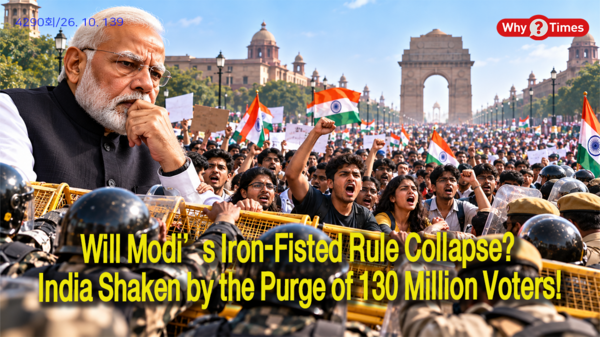
[Protests Persist Despite New Delhi Lockdown: What Is Happening to the Modi Regime?]
Prime Minister Narendra Modi, who has wielded formidable power while governing India for over twelve years, is confronting a grave political challenge. With the purging of more than 130 million voters from electoral rolls sparking widespread allegations of voter manipulation, Indian national politics has been thrown into turmoil. Anti-government demonstrations led by Gen Z—now joined by opposition parties—continue to defy heavy-handed police crackdowns, directly challenging the political legitimacy of the Modi administration. For Modi, who has long projected an image of decisive leadership, the escalating crisis goes beyond administrative disputes over election management to pose a critical test to the stability of his long-standing rule.
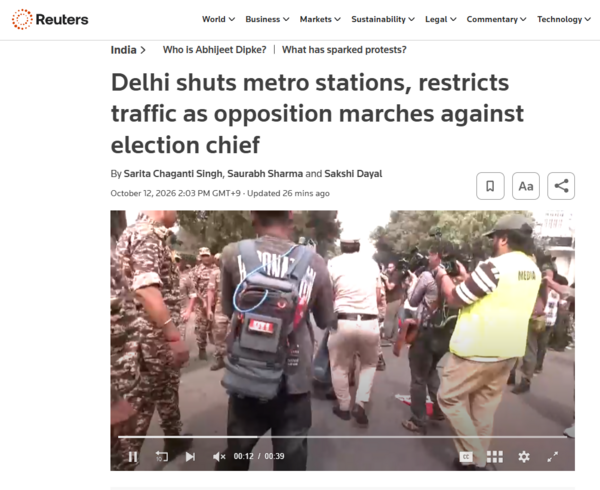
Reuters reported on October 12 that "India's capital, New Delhi, is gripped by high tension as anti-government protests over alleged voter list manipulation escalate." It noted that "Indian authorities shut down several metro stations and cordoned off major thoroughfares to block protesters marching toward the Supreme Court, while demonstrators demanded the immediate resignation of Chief Election Commissioner Gyanesh Kumar."
Reuters further detailed that "around 60,000 security personnel, including police, were deployed to guard the capital region between October 10 and 11. Barricades were erected along major entry routes, metro stations were shuttered, and mobile network restrictions were imposed." Authorities reported that "police detained approximately 2,400 protesters in a single day on October 10."
"Controversy over press freedom also erupted as journalists covering the protests were detained," Reuters reported. Media watchdog Reporters Without Borders (RSF) criticized the crackdown, noting that "at least 16 journalists were taken into custody." Despite these stringent government measures, public outrage remains unsuppressed. Observers warn that the massive mobilization of police force may backfire by further fueling anti-government sentiment.
[Deletions Exceed Japan’s Entire Population: Serious Doubts Cast on Electoral Fairness]
The catalyst for the crisis was a massive electoral roll revision carried out by the Election Commission of India (ECI). According to Reuters, roughly 133 million names were purged during the process—a figure exceeding the entire population of Japan. The deletions reportedly included approximately 28 million deceased individuals, 63 million migrants, and 30 million voters whose locations could not be verified.
The core issue lies in growing accusations of political bias. Opposition parties contend that minority groups, particularly Muslims who are statistically less likely to vote for the Hindu nationalist Bharatiya Janata Party (BJP), along with opposition supporters, were unfairly targeted and purged from the voter rolls.
The Indian Express reported that "two election commissioners internally voiced concerns regarding several decisions made during the voter roll revision." This revelation amplified public skepticism regarding the independence and impartiality of the Election Commission. Both the ECI and the ruling BJP have strongly denied allegations of voter suppression. The commission clarified that the revision was a routine administrative procedure designed to remove deceased, duplicate, or fraudulent registrants, emphasizing that improperly deleted voters could re-register. While it cannot be assumed that all 133 million deletions were improper, the widespread erosion of trust in electoral fairness itself presents a formidable political burden for the Modi regime.
[“Are We Cockroaches?”: Gen Z Mounts a Bold Challenge Against Modi]
The most prominent force behind these demonstrations is India’s youth. Spearheading the protests is the "Cockroach Janta Party" (CJP), an online political movement that grew out of youth frustration over rampant unemployment and educational inequality. The party's name reportedly originated as a satirical response to controversial remarks likening unemployed youth to cockroaches. What began as a movement rooted in socio-economic grievances has now transformed into a broad anti-government campaign demanding electoral integrity.
According to AP, CJP’s Instagram following has surpassed 25 million, eclipsing the follower count of the ruling BJP—though social media followers do not directly equate to formal political polling. The CJP had previously mobilized mass protests over alleged leaks in national medical entrance examination papers. By bringing issues of educational inequality and youth unemployment to the national forefront, the movement earned substantial support among younger generations.
During the recent demonstrations, key CJP leaders, including founder Abhijeet Dipke, were detained by police before being released. Following his release, Dipke labeled Prime Minister Modi a "national disgrace" and vowed to press forward with the movement. Crucially, youth anger appears to be evolving from dissatisfaction with specific policies into a systemic distrust of the political establishment. Young Indians, feeling the brunt of job shortages and unequal opportunities despite rapid national economic growth, are now linking electoral fairness directly to their fundamental political rights.
[Crackdowns Backfire: Internal Disagreements Emerge Within the Ruling Coalition]
Adding to Prime Minister Modi's woes is the risk that the crisis could trigger internal rifts within his governing coalition. The Indian Express reported on October 10 that "divergent views are emerging within the Modi-led National Democratic Alliance (NDA) regarding how to handle the protests." Figures within coalition partner parties have advocated for dialogue with youth leaders rather than reliance on heavy-handed suppression.
Modi has long utilized his strongman image as a key political asset. However, relying on police force against citizens demanding electoral integrity risks reinforcing the perception that the government fears public opposition.
Meanwhile, opposition parties are intensifying their offensive. Opposition leaders, including Rahul Gandhi of the Indian National Congress, are framing the issue as a defense of democracy and the constitution. On October 12, opposition politicians marched toward the Supreme Court, demanding accountability from the Election Commission. The challenge facing Modi is not merely the physical size of the protests, but the confluence of youth frustration, opposition unification, and internal coalition friction into a single political current.
[A Test for 12 Years of Iron-Fisted Rule: 2027 Elections Serve as a Watershed Moment]
Since taking power in 2014, Prime Minister Modi has dominated Indian politics through Hindu nationalism, economic growth, and an image of decisive leadership. However, the political landscape shifted after the 2024 general elections, in which the BJP failed to secure an absolute majority on its own. While Modi secured a third consecutive term with the support of coalition partners, maintaining stable governance now requires constant cooperation from allied parties.
Against this backdrop, allegations of voter list manipulation carry severe political risks. Unlike policy failures, erosion of confidence in electoral fairness directly targets the democratic legitimacy of the administration itself. Furthermore, pivotal state assembly elections are scheduled for 2027, including in Uttar Pradesh—India's most populous state and a foundational stronghold for Modi’s Hindu nationalist platform.
If the controversy lingers and concrete instances of voter disenfranchisement are confirmed, public distrust in election management bodies will deepen further. Conversely, if the Election Commission can demonstrate transparency in its purging procedures and reinstate wrongfully excluded voters, the situation may stabilize. While it is premature to predict an immediate collapse of Modi's power, should these protests translate into a electoral rebuke of the ruling party, the political foundations of his long-term governance will inevitably suffer a serious blow.
[Why Times Insight | Modi’s True Crisis Lies Far Deeper Than Voter Fraud Allegations]
What Prime Minister Modi should fear most in this crisis is not simply the number of protesters in the streets, but the structural erosion of public trust in the electoral system that underpins his authority.
First, the core of the crisis is a 'legitimacy crisis,' not a 'policy failure.' Previous protests over the NEET medical entrance exam leaks were directed at specific policy oversights and ended with the resignation of the Education Minister. In contrast, the current protests directly target the fundamental premise of Modi's regime: its mandate as a democratically elected power. If the Election Commission's credibility collapses, every future BJP victory will be questioned—a crisis that cannot be resolved simply by sacrificing a cabinet minister.
Second, dismissing Chief Election Commissioner Kumar represents a double-edged sword. Replacing the head of the ECI might temporarily appease the public, but it would implicitly signal an admission of systemic flaws in the voter roll revision. This would likely trigger demands for a comprehensive audit of all 133 million deletions. Conversely, holding the line guarantees prolonged street protests and opposition consolidation. Navigating between these two difficult choices constitutes the real danger of this crisis.
Third, the post-2024 coalition structure remains a critical variable. Having lost its single-party majority, the BJP relies on regional coalition partners to sustain its government. If electoral integrity disputes persist and coalition partners begin distancing themselves, the crisis on the streets could swiftly spill into parliament. (To date, no reports indicate an imminent coalition split.)
Fourth, heavy-handed suppression yields short-term suppression at high long-term costs. Capital lockdowns, communications blackouts, and journalist detentions may temporarily stifle rally sizes, but they have drawn explicit warnings from the Supreme Court and severe condemnation from international press freedom organizations. This inflicts lasting damage on India's international image as the "world's largest democracy." In an environment where the CJP surpasses the ruling party in digital mobilization capability, offline repression threatens to trigger a vicious cycle of escalating online outrage.
While the full facts surrounding the voter deletion controversy are still unfolding, the crisis has laid bare a profound vulnerability in Modi's long-term governance. Raw political power can be maintained through police forces and parliamentary seats, but public trust cannot be manufactured by force. Modi’s true crisis begins at the precise moment that trust starts to fracture.
- TAG