


추부길 whytimespen1@gmail.com
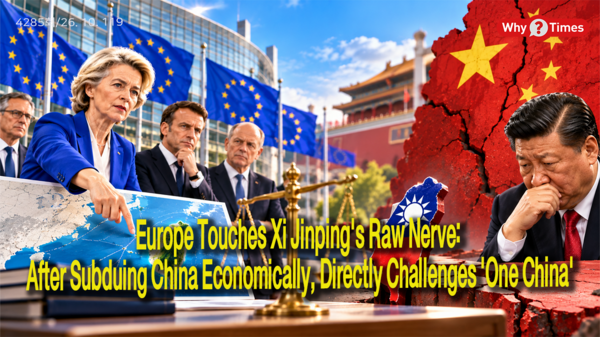
[Europe Touches China's Vulnerable Spot… Beijing Thrown into Turmoil]
Europe, having already taken a tough stance against Chinese overcapacity and secured an agreement to cut Chinese hybrid vehicle exports, is now directly confronting Taiwan—the Chinese Communist Party's (CCP) most sensitive diplomatic nerve. On October 7, the European Parliament adopted recommendations on political relations with China, reaffirming that the EU has never endorsed China's "One China principle." While Beijing immediately retaliated, condemning the move as interference in its internal affairs, Europe is increasingly stepping away from its past approach of avoiding political and diplomatic clashes to protect economic interests. Attention is now focused on whether Europe has begun to view China's influence and leverage as diminished.
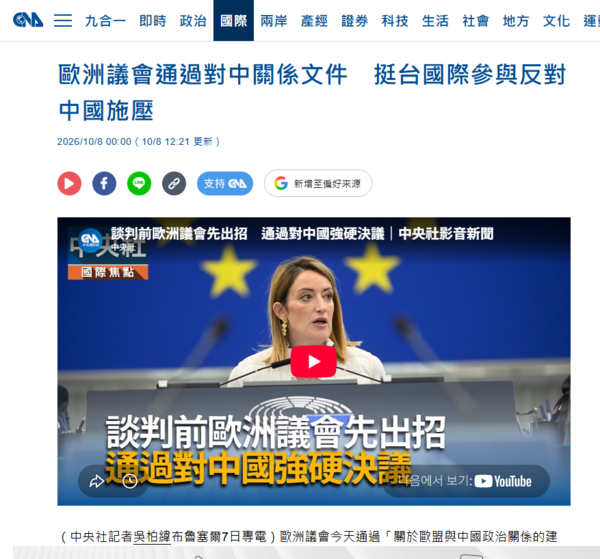
Taiwan’s state-run Central News Agency (CNA) reported on October 8 that “the European Parliament has publicly drawn a line regarding the 'One China principle,' which the Chinese Communist Party considers most sensitive.” CNA noted that “during a plenary session in Strasbourg, France on October 7, the European Parliament adopted the 'EU-China Political Relations Recommendations' by a vote of 454 in favor, 86 against, and 110 abstentions. The report emphasized that peace and stability in the Taiwan Strait are crucial to global security and prosperity, while opposing any unilateral attempt to change the status quo by force or coercion.” CNA added, “Although these recommendations are non-binding political advice, they carry immense significance by demonstrating how drastically the political atmosphere surrounding Europe's China policy has shifted.”
China launched a fierce backlash against the European Parliament's political recommendations. According to CNA, the Chinese Mission to the EU issued a statement on October 9 asserting that the report was filled with ideological bias and false claims about China, while condemning it as interference in China’s internal affairs, including the Taiwan issue. Beijing lodged a formal protest with the EU, accusing it of politicizing trade and economic issues and expanding them into security matters.
[EU Draws a Clear Line Against 'One China'… A Diplomatic Vulnerability for Xi Jinping]
The most critical aspect of these recommendations is the explicit distinction drawn between the EU's "One China policy" and China's "One China principle." Beijing's principle maintains that Taiwan is an inalienable part of Chinese territory and that unification is purely an internal affair. Conversely, while the EU's policy recognizes the government in Beijing as the sole legal government of China, it does not endorse Beijing's sovereignty claims over Taiwan. This mirrors the diplomatic principle upheld by the United States.
The European Parliament reaffirmed its longstanding position that the EU has never supported China's "One China principle." It also opposed Beijing's interpretation of UN General Assembly Resolution 2758 as a basis for asserting sovereignty over Taiwan. This does not mean the EU is abandoning its existing policy. However, it is highly significant that Europe has publicly put the brakes on a diplomatic principle that Beijing has long interpreted strictly to its own advantage.
[Checking Beijing's Strategy to Isolate Taiwan… Expanding Security Cooperation to South Korea and Japan]
The European Parliament's pressure extended beyond mere declarations. The recommendations criticized Beijing's actions to pressure international organizations and foreign nations to limit Taiwan's international participation. Specifically, it urged the UN to resist Chinese demands and allow Taiwanese passport holders access to UN facilities and events. It also voiced opposition to China's cross-border judicial actions targeting Taiwanese politicians.
In the realm of security, the report called for strengthening cooperation between Europe and regional democracies to maintain peace in the Taiwan Strait. Alongside recommending expanded security cooperation—such as naval activities and joint exercises—it proposed establishing regular cooperative frameworks with South Korea, Japan, and Taiwan for counter-disinformation, early warning, and information sharing. From Beijing's perspective, European involvement in the Taiwan issue is expanding beyond political support into security, technology, and international organization representation.
[Slashing Hybrid Vehicle Exports by Half… Europe Changes Its Stance in Economic Warfare]
This diplomatic friction must be viewed alongside the ongoing economic conflict between Europe and China. Reuters reported on October 9 that “the EU and China reached an agreement that could reduce European exports of Chinese hybrid and plug-in hybrid vehicles by more than half over the next four years.” Maroš Šefčovič, EU Commissioner for Trade and Economic Security, announced these results in Beijing following negotiations with Chinese Commerce Minister Wang Wentao.
China also agreed to improve market access for roughly €4 billion worth of European goods, including auto parts, olive oil, and footwear. Progress was also made regarding export licensing for rare earth elements and permanent magnets. While Commissioner Šefčovič called the agreement an important first step, he noted that further negotiations are necessary. The fact that Europe secured new restriction commitments just as China was using hybrid cars to bypass EV tariffs is of major significance.
[Europe Views China with New Eyes… Germany and France Take a Hard Line]
This shift in European attitudes did not happen overnight. In a report published on September 28, the European Parliament Research Service pointed out that “China's growth model centered on overcapacity poses a grave challenge to the European and global economies.” It further assessed that “China's support for Russia's war effort, aggressive posture in the Taiwan Strait, and deepening domestic authoritarianism are deteriorating EU-China relations.”
In the past, Europe viewed China primarily as a vast export market and investment destination. Now, however, it recognizes China's industrial policies, supply chain dominance, and economic coercion as direct threats to Europe's industrial base and security. Crucially, major powers like Germany and France have begun calling for stronger trade defense mechanisms. Hardline sentiment toward Beijing has evolved from regional complaints into a strategic imperative shared by major European economies. While member states do not hold entirely uniform views—some still prioritize trade and investment with China—the overall trajectory is clear.
This shift does not signal an intent to sever ties with Beijing. Rather, it means European policy is evolving toward maintaining economic relations without unilaterally yielding to Chinese demands.
[Has Europe Uncovered China's Weakness?… A New Crisis for Xi's Diplomacy]
Why has Europe taken such a firm stance? The primary factor is Europe's updated assessment of China's economic leverage. While China remains a global manufacturing powerhouse, sluggish domestic consumption and overcapacity have increased its dependence on foreign markets. With the United States erecting high trade barriers against Chinese goods, a contraction in the European market would place immense pressure on Chinese manufacturing.
Conversely, Europe possesses a massive consumer market and robust trade defense instruments. Although China can attempt to weaponize rare earths and critical raw materials, Europe is discovering that restricting market access is an equally potent countermeasure.
What merits close attention is how China's ability to translate economic power into diplomatic leverage is changing. Europe is actively conducting trade negotiations with Beijing while simultaneously rejecting its diplomatic demands regarding Taiwan. While this cannot be taken as definitive proof of the CCP's decline, it clearly indicates that China's traditional playbook—using economic leverage to dictate other nations' foreign policies—is reaching its limits. This realization marks the beginning of Europe's strategic awakening: rather than fearing or appeasing Beijing, Europe is identifying China's vulnerabilities and asserting its own bargaining power.
[Why Times Insight | Is Europe Reading the Decline of the Chinese Communist Party?]
The essence of this situation is not merely that the European Parliament adopted a hardline recommendation on Taiwan. It lies in the fundamental transformation of Europe's attitude toward China. In the past, Europe sought to avoid conflict on sensitive diplomatic issues out of concern for China's vast market and the threat of economic retaliation. Today, Europe is aggressively countering Chinese overcapacity while publicly voicing opposition on Taiwan—the CCP's most sensitive issue.
Is Europe reading the decline of the Chinese Communist Party? While China undeniably retains formidable manufacturing capacity and dominance over critical supply chains, its weak domestic demand, structural overcapacity, and heavy reliance on export markets indisputably constrain its bargaining leverage. More importantly, China's economic strength no longer translates smoothly into diplomatic clout. Europe has concluded that it can negotiate trade terms with China while firmly turning down Beijing's demands on Taiwan.
To be sure, a European Parliament recommendation does not automatically translate into binding EU policy. Actual policy toward China rests with the European Commission and individual member states, and voices prioritizing economic ties with China persist within Europe. Nonetheless, this milestone underscores a crucial shift: Beijing's practice of using economic weight to constrain the foreign policy choices of other nations is no longer as effective as it once was.
What is most painful for Xi Jinping is not simply that Europe has challenged the 'One China principle.' It is the fact that Europe, which once feared Beijing's backlash, is now willing to absorb that pushback and confront China head-on. If China is transitioning in European eyes from an entity to be feared into a competitor to be kept in check, that represents the single most serious crisis facing Xi Jinping's diplomacy today.
- TAG