


추부길 whytimespen1@gmail.com
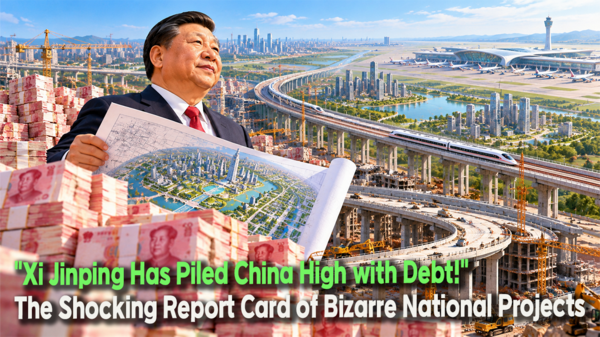
[Trapped in a Mountain of Debt, Yet Xi Jinping’s Prescription Is Construction Once Again]
Xi Jinping’s state-led growth strategy—which poured astronomical sums into making China the world's premier infrastructure powerhouse—is now returning as a massive debt burden. Massive capital was funneled into high-speed rail, expressways, airports, and urban transit systems, but controversies over profitability have erupted everywhere, while astronomical investments continue to flow into Xi Jinping’s signature legacy project, the Xiong’an New Area. With even the International Monetary Fund (IMF) warning that Chinese local government debt could threaten the stability of the financial system, accounts receivable of industrial enterprises have exceeded 29 trillion yuan. Has Xi Jinping truly made China rich and powerful, or has he placed the Chinese economy atop an unbearable mountain of debt?
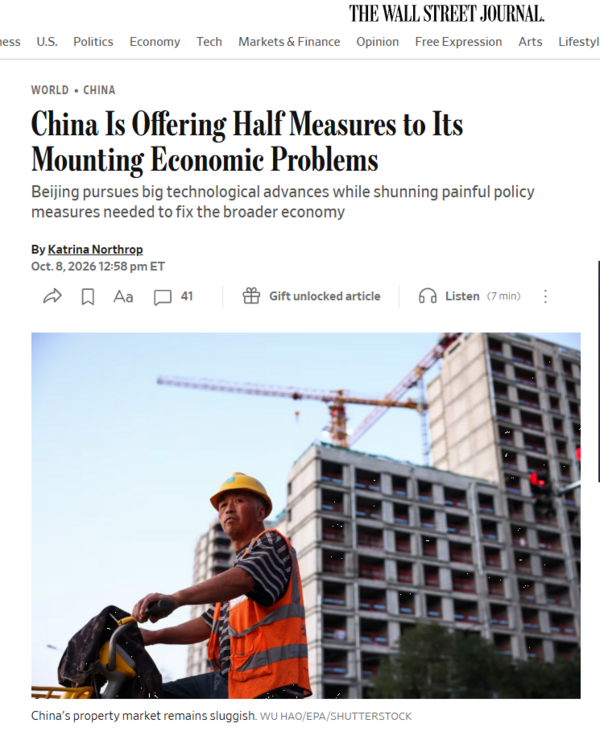
The Wall Street Journal (WSJ) reported on the 8th (local time), "While the Chinese economy is trapped in a complex crisis of real estate slump, local government debt, and worsening corporate profitability, the Xi Jinping leadership remains reluctant to engage in fundamental structural reform." It added, "Economists evaluate that although the Chinese government is repeatedly deploying limited prescriptions such as mortgage assistance, bank capital replenishment, and infrastructure investment, these measures fall far short of solving the economy's structural issues." Furthermore, it pointed out, "The problem with the Chinese economy is no longer how much money to pump in, but how fundamentally the existing growth model can be changed."
Yet the Chinese government's response remains largely trapped in familiar patterns. Reuters reported on September 28 that "China's State Council is pushing for the issuance of government bonds and the early launch of key infrastructure projects to achieve its growth rate targets." In the past, whenever the economy slowed down, China supported growth by constructing roads, railways, and industrial parks. However, in a context where investment efficiency has fallen and local government debt has accumulated, repeating the same prescription risks incurring far heavier long-term fiscal burdens in exchange for defending short-term growth rates.
In a financial analysis of Chinese local governments released on September 25, the International Monetary Fund (IMF) warned that "debt from local governments and Local Government Financing Vehicles (LGFVs) could threaten macroeconomic and financial system stability." It stressed that "simply extending debt maturities or rolling over into lower-interest bonds cannot fundamentally solve the problem." China is currently caught in the paradox of having to clear debt generated by past construction projects while simultaneously expanding new construction initiatives.
[Xi Jinping’s Future City, Xiong’an: 8600 Billion Yuan Poured In, But...]
The project that most symbolically encapsulates Xi Jinping’s state-led growth strategy is the Xiong’an New Area in Hebei Province. Launched in 2017 under Xi Jinping’s personal directive, this new city was pursued under the rationale of decongesting Beijing and establishing a new hub for high-tech industries. However, despite cumulative investments exceeding 8600 billion yuan by February 2025, doubts surrounding the city's self-sustainability and investment efficiency remain unresolved.
Reporting on Xi Jinping's visit to the Xiong'an New Area on March 24, Reuters analyzed that "this project is intimately tied to Xi Jinping's personal political legacy." Indeed, the major problem is that Xiong’an is not merely an urban development project, but a supreme leader's political achievement. As Xi Jinping's political authority and the success of the state project become tied together, the risk grows that sustaining the project itself takes priority over cool-headed assessments of economic viability.
[Laying 60,000 km More High-Speed Railway: Expansion Continues Unchecked Despite Accumulated Debt]
High-speed rail is another representative national project that China proudly showcases. According to China State Railway Group, the operating mileage of high-speed rail expanded from 37,900 km in 2021 to 50,400 km by the end of 2025—an increase of 12,500 km in just five years. Yet it does not stop there. China has unveiled plans to expand its high-speed rail network to 60,000 km by 2030.
The problem is that as the route network grows, railways expand into regions with low economic viability. Warnings regarding railway debt issues have been raised for a long time. The total debt of China State Railway Group reported by Nikkei Asia at the end of 2021 reached approximately 5.91 trillion yuan. While high-speed rail offers social benefits by shortening travel time between regions and spurring economic activity, not all routes can cover their construction and financial costs through their own operating revenues.
Expressways face similar problems. According to Caixin, China's toll road operations recorded a surplus of 3.2 billion yuan in 2010, but turned into a deficit of 402.7 billion yuan by 2017. At that time, debt related to toll road construction had reached 5.2 trillion yuan. While these are historical statistics and should not be taken as current profit-and-loss figures, they demonstrate that China’s debt-driven infrastructure investments have been compounding fiscal burdens for a long time.
[Shenzhen Metro's Shocking Loss: State-Owned Enterprises Saddled with Real Estate Distress]
In urban rail transit, the interconnected structure between China's infrastructure investments and the real estate crisis stands exposed. A primary example is Shenzhen Metro. As a major shareholder in Vanke, a large real estate developer, Shenzhen Metro has been deeply involved not only in subway operations but also in property investment and development projects.
Shenzhen Metro's net loss for 2025 was reported to be approximately 37.5 billion yuan. However, this should not be interpreted as a deficit generated purely by subway operations themselves. Investment losses and asset devaluations resulting from Vanke’s business deterioration heavily impacted its financial results. The structural issue lies in exposing a public transit enterprise responsible for citizens' daily commutes to the distress of real estate developers.
This highlights the risks facing China's so-called 'Railway + Real Estate' development model. The approach of funding transit infrastructure costs through profits gained by constructing subways and developing surrounding land can be effective when the property market is booming. However, when the housing market falls into a prolonged slump, property investment losses are added on top of the fiscal burden of transit facilities.
[Built Two Airports Only to Accumulate Deficits? Beijing’s Uncomfortable Report Card]
Another symbolic project of the Xi Jinping era is Beijing Daxing International Airport. Constructed with a project cost of roughly 80 billion yuan, this airport was showcased upon its opening in 2019 as a flagship facility demonstrating China’s technological prowess and national stature. However, the emergence of Daxing Airport created new challenges: demand diversion from the existing Beijing Capital International Airport, facility duplication, and operational cost burdens.
According to disclosures by Beijing Capital International Airport Co., Ltd., listed on the Hong Kong Stock Exchange, its cumulative after-tax loss from 2021 to 2025 reached approximately 9.4 billion yuan. Of course, this cannot be attributed entirely to the construction of Daxing Airport; the suspension of international flights due to COVID-19 and the subsequent slow recovery were also major causes. Nonetheless, having to maintain the facilities and operational costs of two massive airports over a long period after constructing an additional megastructure remains a critical issue when evaluating the economic logic of airport expansion policies.
Chinese regional airports are similarly forced to rely on continuous support from local governments if they fail to secure sufficient air travel demand. From the moment an airport is built, fixed costs for maintenance, safety management, and personnel operations loom large. Ultimately, what matters more than building numerous airports is securing the passengers and flights to consistently utilize them.
[Unresolved Problems Despite a 12 Trillion Yuan Debt Package]
The Chinese government is also aware of the severity of the problem. In November 2024, it announced a large-scale program to address hidden local government debt. The plan expands the local government debt ceiling by 6 trillion yuan and utilizes 4 trillion yuan in previously approved special bond issuances to refinance a total of 10 trillion yuan in debt. Described as a 12 trillion yuan response package, it also incorporates 2 trillion yuan in debt related to shantytown redevelopments maturing after 2029.
However, debt refinancing is fundamentally different from eliminating the debt itself. Replacing high-interest off-balance-sheet debt with low-interest official local government bonds can reduce immediate interest burdens and repayment pressures, but it does not improve the profitability of non-performing projects. The IMF similarly evaluated that while government debt refinancing alleviates short-term burdens, it fails to fundamentally resolve the lack of project profitability and debt repayment capability of LGFVs.
Even more noteworthy is the analysis of Chinese local government debt released by the IMF on September 30. According to the IMF, the combined total of official local government debt and LGFV debt exceeded 80% of GDP in 2024. Compared to around 10% prior to the global financial crisis, this represents a rapid surge. The IMF emphasized that restructuring unsustainable LGFV debt is necessary and must be pursued alongside fiscal system reforms.
[Why Times Insight | Xi Jinping Has Piled China High with Debt]
China's debt problem was not created solely by Xi Jinping. The massive economic stimulus and expansion of local government borrowing that began after the 2008 global financial crisis were crucial starting points for today's debt troubles. However, the responsibility for maintaining policies reliant on state-led investment even after the limits of the existing growth model were exposed—and for continuing to push megaprojects tied to his personal political legacy—rests squarely with the Xi Jinping administration.
What makes the situation far more serious is that acknowledging the potential failure of these projects and changing course is extraordinarily difficult. Projects tied to the supreme leader's political authority, such as the Xiong’an New Area, are evaluated not only by economic profitability but also by political achievement metrics. If local governments and state-owned enterprises prioritize political goal fulfillment over profitability, the risk that inefficient investments will persist over long periods remains high.
Ultimately, Xi Jinping stands before two choices: admit the limits of his state-led growth strategy and move toward clearing distressed projects, reforming fiscal structures, and restoring the private economy—or stick to existing policies, merely extend debt maturities, and prop up growth rates through new construction projects.
The real crisis of the Chinese economy lies not merely in the fact that it holds massive debt, but in the possibility that it cannot fundamentally change the growth model that produced that debt. If Xi Jinping prioritizes protecting his political legacy over economic efficiency, China will consume the resources meant for future growth merely to service the debt generated by past investments. Xi Jinping promised to turn China into the world's greatest infrastructure powerhouse. But the question he must now answer is entirely different: Who will pay for these lavish construction bills, and how?

- TAG